Project review
Project Review: When Is a Deeper Investigation Worth It?
A project has slipped again. The team has reviewed the schedule, reassigned work, and agreed on another delivery date. You can explain what's late. You're less certain why the fixes haven't held.
A deeper project review needs a business reason. Establish what the problem continues to cost and what value a better decision could still protect before committing more time or money.
By Jim Wilde, Founder of Emergent Skills
Start with the value still at stake
For a project manager or business analyst, recurring project problems raise a practical question: how much more effort does this investigation deserve?
The original budget tells you the scale of the commitment. It doesn't tell you how much to spend investigating the current problem. Money already spent cannot, by itself, justify spending more.
Look at what can still change. Stalled projects may be delaying savings. Repeated corrections may be consuming time needed for customer work. Management may be preparing to add people or buy another system without knowing whether that will address the cause.
Separate the amounts you can support:
- Continuing costs: repeat work, extra reviews, overtime, and time spent chasing decisions.
- Delayed or threatened benefits: savings, customer delivery, or revenue dependent on the result.
- The next commitment: additional staff, supplier work, software, or another project phase.
Record the period, assumptions, and evidence behind each estimate. Separate labor time that could be used elsewhere from cash the business could save. Benefits that arrive late differ from benefits lost altogether. Don't count the same loss twice.
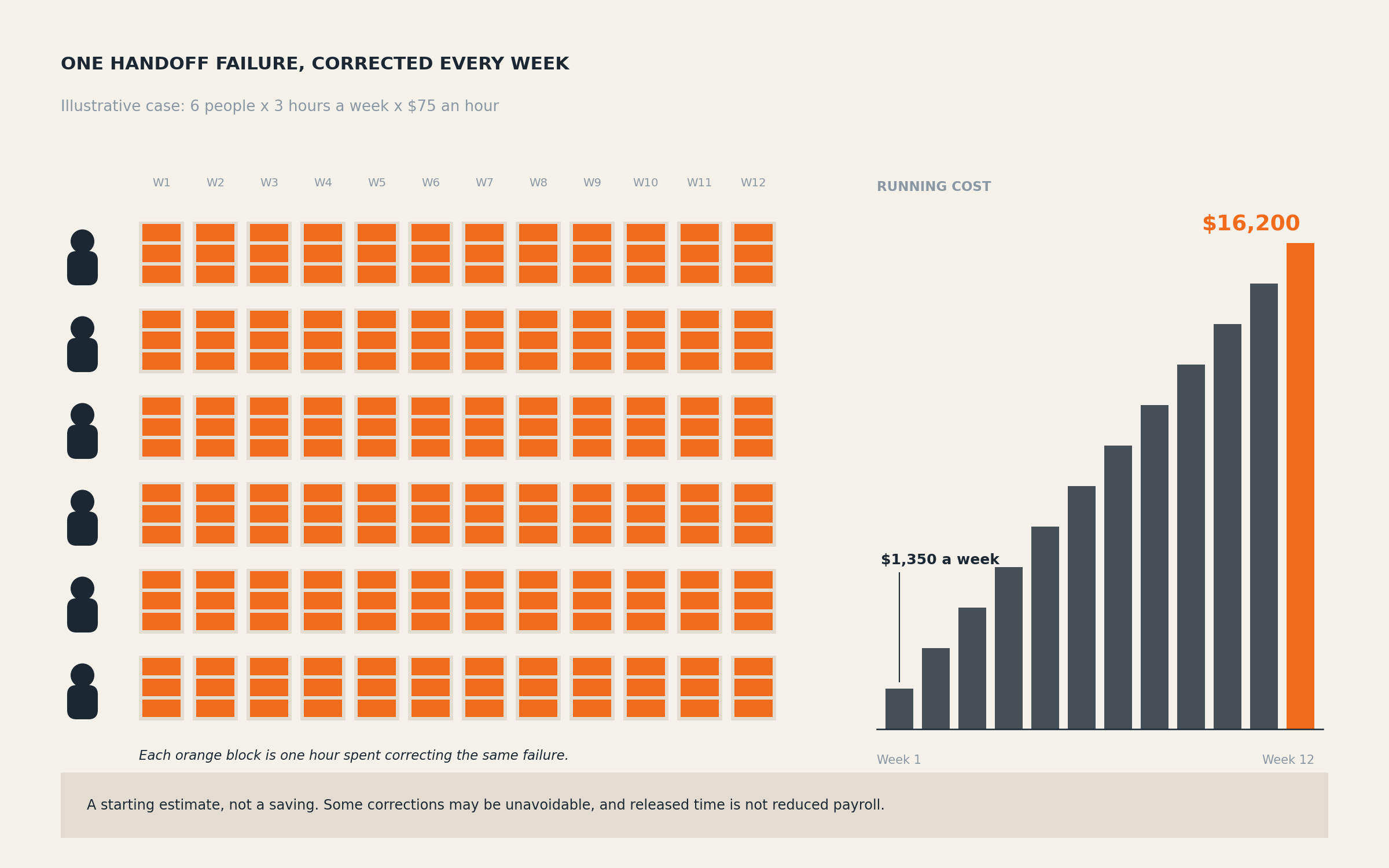
Estimate the cost of project delays and rework
Consider an illustrative case. Six people each spend three hours a week correcting the same type of handoff failure. At an assumed loaded labor rate of $75 an hour, that is $1,350 a week, or $16,200 over 12 weeks.
That estimate gives the investigation a starting point. It doesn't mean every correction is avoidable or that eliminating the work would reduce payroll by $16,200. The benefit might be time released for other work.
You still need to establish the cause, the feasible reduction, and the cost of making the change. But even this limited calculation gives a manager something concrete to weigh against the time and expense of investigating.
When an internal project review is enough
An internal employee may be best placed to investigate. They know the systems, the history, and who can explain an unusual exception. Use that knowledge.
An internal review may be enough when the team can establish what happened, test the explanation, and make the correction. If an approval is waiting because nobody was assigned authority to give it, clarify the authority and check whether the delay stops. Accountability without authority: why work still waits examines that gap.
Further investigation needs a reason. Recurrence after a correction, conflicting accounts, or a costly decision resting on an untested assumption can provide one.
Give the investigator the conditions to do the job
Assigning someone to investigate doesn't automatically give them the time, access, or authority they need. They may be reviewing a process they helped design, questioning a senior manager's decision, or fitting the investigation around a full project schedule.
People may withhold details if they expect blame. A workaround may be so familiar that nobody mentions it. The review may stop at a department boundary even though the explanation sits on the other side.
Before commissioning a larger review, check whether the investigator can speak to the people involved, examine relevant records, and challenge the accepted explanation. Agree on the scope and allow an inconclusive finding. Pressure for a quick answer can close the investigation too soon.
What an independent project review should add
An independent project review is useful when it adds something specific: dedicated time, access agreed by the responsible manager, a method the team lacks, or independence from earlier decisions. An external reviewer still needs cooperation and evidence.
Check both routes into delays and rework
Project records and process maps can show where work waited, changed hands, or returned. Workflow analysis helps examine that record. Use it to investigate two possible routes into the shortfall.
The work path: queues, unclear handoffs, approval loops, and dependencies can directly delay the result or create rework.
The demands surrounding the work: interruptions, constant switching, and competing decisions may impair judgment or attention, contributing to errors, reversals, and missed handoffs.
A document returning for correction might have arrived with incomplete requirements. It might also have been reviewed between repeated urgent requests, with a key inconsistency missed. Both explanations could apply. Each needs evidence.
Research by Sophie Leroy and Theresa Glomb found that concern about returning to unfinished work under time pressure can leave attention on that work and impair performance on the interrupting task. Their studies also found that a brief plan for resuming work could reduce this effect. [1] That supports examining the conditions surrounding a failure; it doesn't establish the cause of a particular project problem.
Check ordinary explanations too: missing skills, information, authority, or funding; a workable standard that isn't being followed; or an outside dependency controlling progress. Confirm that the result is still worthwhile and that competing priorities have been addressed. The evidence may support either route, both, or another explanation entirely.
Ask for a finding that changes the next decision
A useful project review identifies the explanation best supported by the evidence, what remains uncertain, and what would make that explanation wrong. It connects the finding to the costs and benefits the evidence supports.
The next step might be a correction, a limited test, or further investigation. Assign a responsible role and a way to judge the result. If the remaining value doesn't justify more work, stopping is a valid recommendation.
If you're requesting approval, name the decision the investigation will inform. Explain what continues to cost the business money or delay value, what the team has already tried, and what remains unresolved. Include the proposed fee and the time needed from your team. That gives your manager a concrete case to assess.
At Emergent Skills, the $1,500 Stalled Priority Snapshot examines one important shortfall and produces a written finding, with cost estimates where the evidence allows and a recommended next step. We consider both routes alongside other explanations. It's a focused starting point when the problem warrants investigation and the scope fits.
Research reference
[1] Sophie Leroy and Theresa M. Glomb (2018). Tasks Interrupted. Organization Science, 29(3), 380–397. See the University of Washington research summary.
Bring one project that isn't delivering.
Examine one important shortfall in a 90-minute working session. Receive a written assessment within 24 hours, with the strongest explanation the evidence supports and a recommended next step. $1,500, fixed.