Stalled priorities
What better decisions make possible
The project that stalled can show you what to check before your next commitment.
Executive SummaryWhat one stalled project can tell you about the next commitment.+
A stalled project is usually treated as something to fix. It can also reveal conditions a manager needs to address before making the next commitment. A manager who understands how one project became stuck has specific things to check before saying yes again.
This article follows one hypothetical case. A launch struggled despite strong support and a capable team. Looking back, the people involved find a specialist whose time was never secured and a routine decision that kept returning to the sponsor because nobody knew who could make the call. Those two findings shape the next launch: confirm the specialist before offering a date, agree which decisions the project lead owns, and offer a smaller first release if the full service cannot be delivered in time.
The same findings open further moves. Give the lead a defined scope for decisions and a clear route for exceptions. Explain your reasoning, ask the lead to bring a recommendation, and review it once the outcome is known. Separate the question a pilot can answer from the decision to fund a full rollout. Put the time recovered from repeated reviews toward the next opportunity rather than another project.
The Stalled Priority Snapshot is built for the result that has already fallen short. Bring one result that is late, partly delivered, or falling short after launch. In a 90-minute working session, up to three participants reconstruct the work behind it. The written report names the strongest explanation the evidence supports, one next step, and who has to act. When the next important operating commitment is still ahead of you, the Decision Review examines whether the evidence supports making that commitment and whether the work needed to produce the expected result is feasible.
A customer asks whether your team could introduce a new service before their next busy season. It is the kind of opportunity you have been working toward. The customer wants it. Your team has ideas. There is a good reason to act.
What would you need to know before saying yes?
Who has to contribute? Can they make room for the work? Which decisions can the team make themselves? What would need to be tested before you promise a full rollout?
Making better decisions at work starts with questions like these. They help a manager judge what an opportunity requires and make a credible plan for delivering it.
Examining a stalled project can help develop that judgment. The immediate task is to understand what happened and decide what to do next. But the learning can outlast the project. A manager who understands how one project became stuck has something useful to bring to the next commitment.
Make commitments you can stand behind
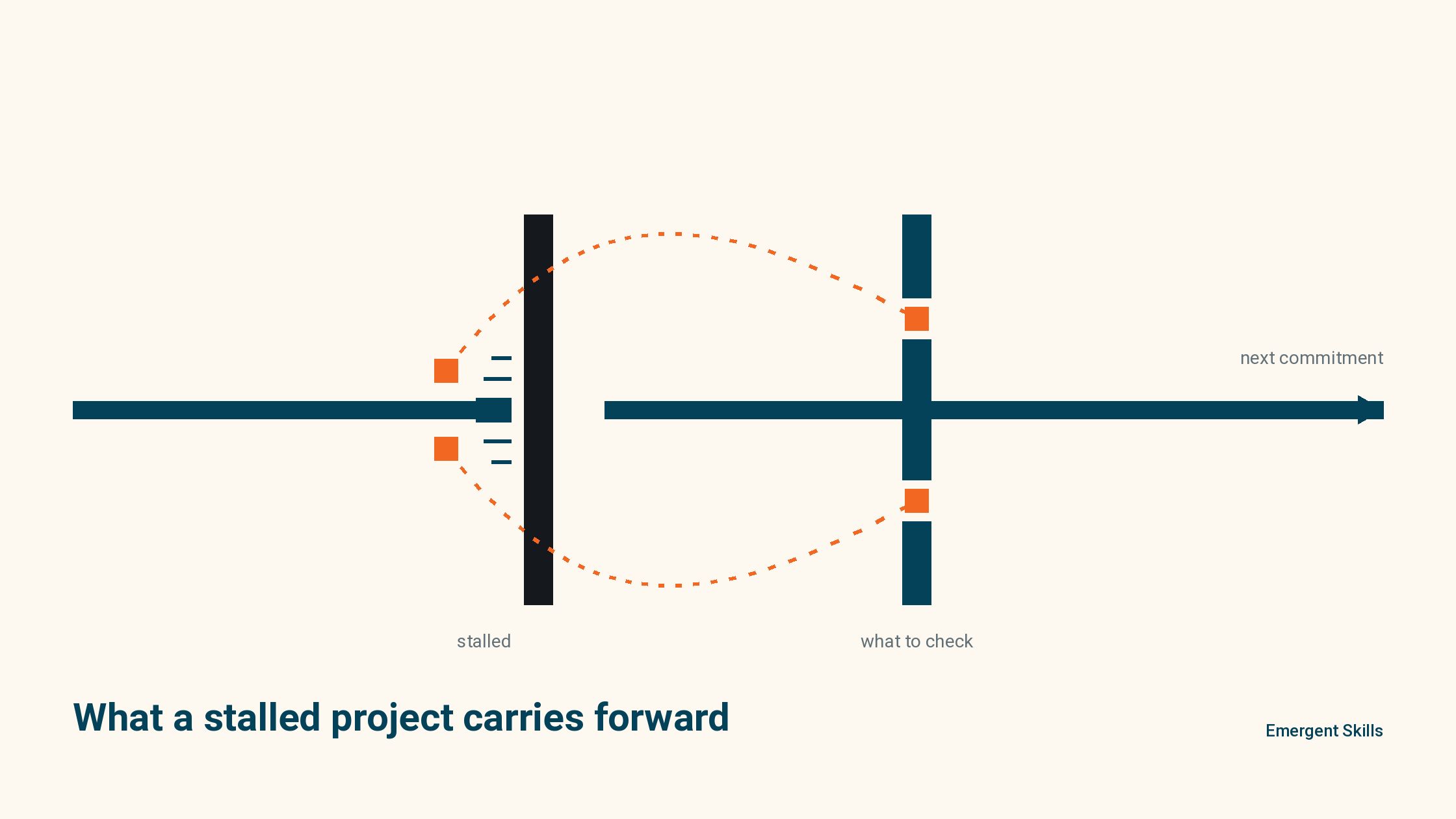
Suppose a manager is preparing to offer a new service to a customer. A previous launch struggled, despite strong support and a capable team.
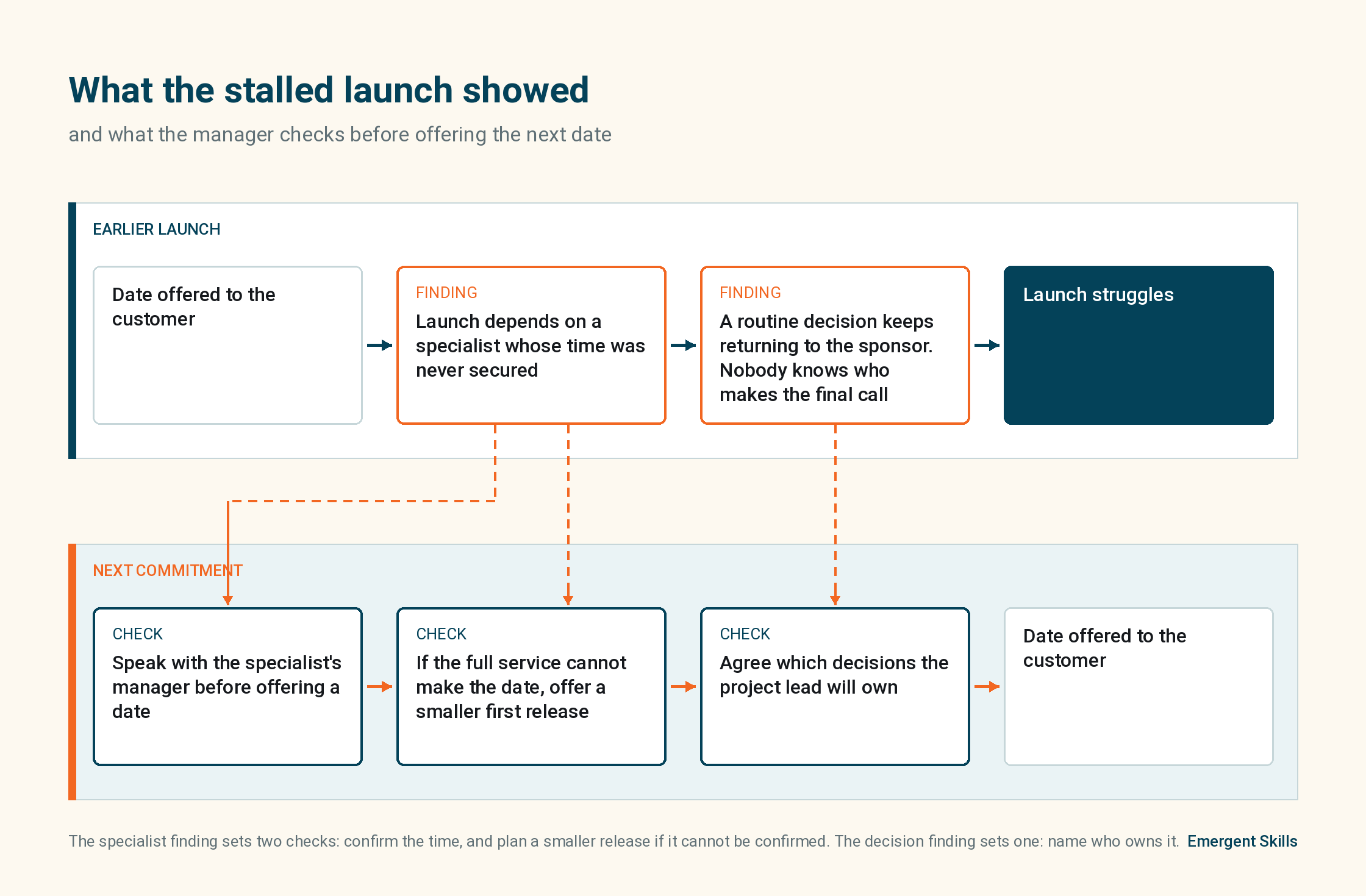
Looking back at the work, the people involved discover that the launch depended on a specialist whose time had never been secured. They also find that a routine operational decision kept returning to the sponsor because nobody knew who could make the final call.
Those findings give the manager specific things to check before the next launch.
They can speak with the specialist's manager before offering a date. They can agree which decisions the project lead will own. If the full service cannot be delivered in time, they can work with the customer on a smaller first release that meets the most pressing need.
The opportunity becomes easier to discuss in concrete terms: what can be delivered, under which conditions, and by when.
A manager can make a commitment with a clearer understanding of what it requires. The customer has something more dependable to plan around, and the team knows what has been agreed.
Use the lesson before the next commitment
Learning from a stalled project is useful. The next question is whether those lessons are being applied before the organization commits again.
The ES Decision Review starts with one proposed operating decision. It examines the evidence and assumptions behind the proposal, serious alternatives, economics and downside, and the work that has to happen after the decision for the expected result to follow.
It also checks whether the people responsible for that work have the authority, capability, information, funding, and available time required. A plan to do the work is not treated as proof that the work can be done.
The review ends with one of five findings: proceed, proceed with changes, test before committing, get specific evidence first, or do not proceed.
Before the commitment: test what has to be true. After the result falls short: investigate what happened.
Give people ownership they can use
In the earlier launch, the project lead was responsible for progress but uncertain about which decisions they could make. Each exception became another request for permission.
For the new service, the manager can establish practical boundaries with the relevant decision owners. The lead might be authorized to resolve routine delivery choices within an agreed scope and budget, with a clear route for exceptions involving risk, cost, or a changed customer promise.
That gives the lead a place to exercise judgment. The manager gets involved when the lead needs a resource, faces a difficult trade-off, or reaches the limit of their authority.
The distinction between contributing to a decision, making it, and carrying it out is also central to Bain's RAPID decision-making framework.
As the lead handles these decisions, the manager can judge whether they are ready to run a larger part of the next project.
Help your team make the next decision
The manager can also make their reasoning useful to someone else. HBR's management tips recommend explaining how you reach decisions and discussing employees' choices to help develop their judgment.
Return to the service-launch example. The manager could explain how the customer's deadline and the specialist's availability affect the scope they can offer. They could discuss what a smaller first release would accomplish and what they would need to learn before expanding it.
Then give the project lead a delivery choice within their authority and ask them to bring a recommendation. Which options did they consider? What evidence supports their choice? What would make them ask for help?
Afterward, review what they knew when they decided, what happened, and what became clear only later. Agree what to repeat or change next time. An unexpected outcome is a reason to examine the reasoning, not enough on its own to judge it.
As the lead gains experience, the manager has a basis for deciding which additional choices to delegate. A new customer request can become an opportunity for the lead to take more responsibility, with clear limits and support available.
Turn a promising idea into something you can learn from
The customer opportunity may still contain an important uncertainty. Perhaps the team knows how to deliver the service but does not yet know whether customers will use it in the way expected.
The manager can separate that question from the decision to fund a full rollout.
A limited pilot could help answer it. The team would agree which customers to involve, what to observe, and what result would justify expanding, adapting, or stopping. The pilot also needs a limit on time and people, and a named person who can decide what happens afterward.
The team can find out whether customers use the service before committing people and money to a full rollout.
Put recovered time toward work that matters
Suppose the changes reduce the repeated reviews and coordination that consumed the manager's time on the earlier launch. What should happen to that time?
There are several worthwhile possibilities: speaking with customers before requirements harden, coaching a new project lead, or addressing a dependency before it becomes urgent.
The manager has to choose and protect that use. A clearer process creates value only when it changes what people can do. Filling every available hour with another project may leave the team just as stretched.
For the new service, the manager might reserve time to join the first customer conversations. Those conversations could improve the offer, expose an assumption, or reveal a need the original plan missed.
This is where better project decisions start to pay off. Time not spent resolving the same confusion again is time that can go into the next opportunity.
Carry the learning into the next project
The lasting value depends on what the manager takes forward.
"We need better communication" gives the next team little guidance. A more useful lesson is specific: "Before we commit to a date, confirm the availability of the specialist whose work determines whether we can deliver."
That lesson can become part of the next planning conversation. Alongside it, the manager can ask:
- What must be true for this commitment to be credible?
- Who can make the decisions the work will require?
- Which uncertainty should we test before committing further?
- What will we observe to know whether our approach is working?
Research on structured learning from experience gives this idea a foundation. A 2021 meta-analysis covering 61 studies found that after-action reviews improved outcomes across several training measures. Their effectiveness depended in part on how the review was designed, including its alignment with individual or team learning and the use of objective performance information. Keiser and Arthur, Journal of Applied Psychology.
Those studies examined debriefing. They do not establish results for the Stalled Priority Snapshot. They provide a reason to take structured reflection seriously. The manager still has to apply the lesson, observe what happens, and adjust it to the next situation.
Start with one result. Build from what you learn.
The Stalled Priority Snapshot starts with one result that is late, partly delivered, or falling short after launch. In a 90-minute working session, up to three participants help reconstruct what happened. The written report identifies the strongest explanation the evidence supports, a next step, and who needs to act. Where the evidence warrants it, that next step may include a small change to test.
Before the next customer request arrives, you can settle who makes routine decisions and confirm how shared specialists will be assigned. When an opportunity comes, you have a better basis for offering a date, proposing a smaller release, or explaining what must change before you can commit. If the next commitment itself needs a structured challenge, use the Decision Review before saying yes.
Have a stalled project in mind?
Tell us what should have happened and what did. The Snapshot starts from that one result.

 Projects stall, results fall short, and problems keep coming back. Trace what happened, test the explanations against the evidence, and decide what’s worth changing.