Operational Payoff · Operations consulting for stalled projects and recurring execution problems. We investigate why important work is not producing the expected business result.
Delivered, no result: find the work nobody was assigned.
The initiative was approved. The tool is installed, the status is green, the project closed. Six months later the business runs exactly as it did before, with one more system to maintain, and you are the one being asked why.
Two explanations get offered. The idea was wrong, or the team is slow. Both are usually false. The idea has a sponsor, a budget, and a kickoff date. What it lacks is an owner for four jobs that sit around every new tool, process, or structure. None of them produce a deliverable. None of them get a line in the plan. All of them decide whether the initiative produces a result.
The four jobs we check for an owner
Job 1
Make it producible here
Who is making it work with your data, your volumes, and your exceptions? "The vendor" means nobody.
Job 2
Make it fit the interfaces
Who got the teams it touches to agree on definitions and handoffs? A meeting held once means nobody.
Job 3
Take out the old process
What has been switched off since this started? If nothing, the new tool is bolted onto the old way of working.
Job 4
Settle who absorbs the disruption
Who lost something in this change, and what did they get for it? If nobody can name a loser, the losers are slowing the work quietly.
We ask for a name for each, not a department. Most stalled initiatives are missing two of the four.
$1,500 USD
Fixed scope. One initiative.
Written input
From people involved in the work (typically 6 to 8)
90-minute session
With up to three participants
Written report
Within 24 hours of the session
15-minute walkthrough
With the sponsor or result owner
Follow-up
After the missing job is staffed or an agreed test
Led by Jim Wilde, founder of Emergent Skills. Nine years as lead consultant at the MTA on mta.info and the NYC subway countdown clocks. Decades in enterprise systems before that.
Why the four jobs go unowned
The idea gets a press release. The jobs get nothing.
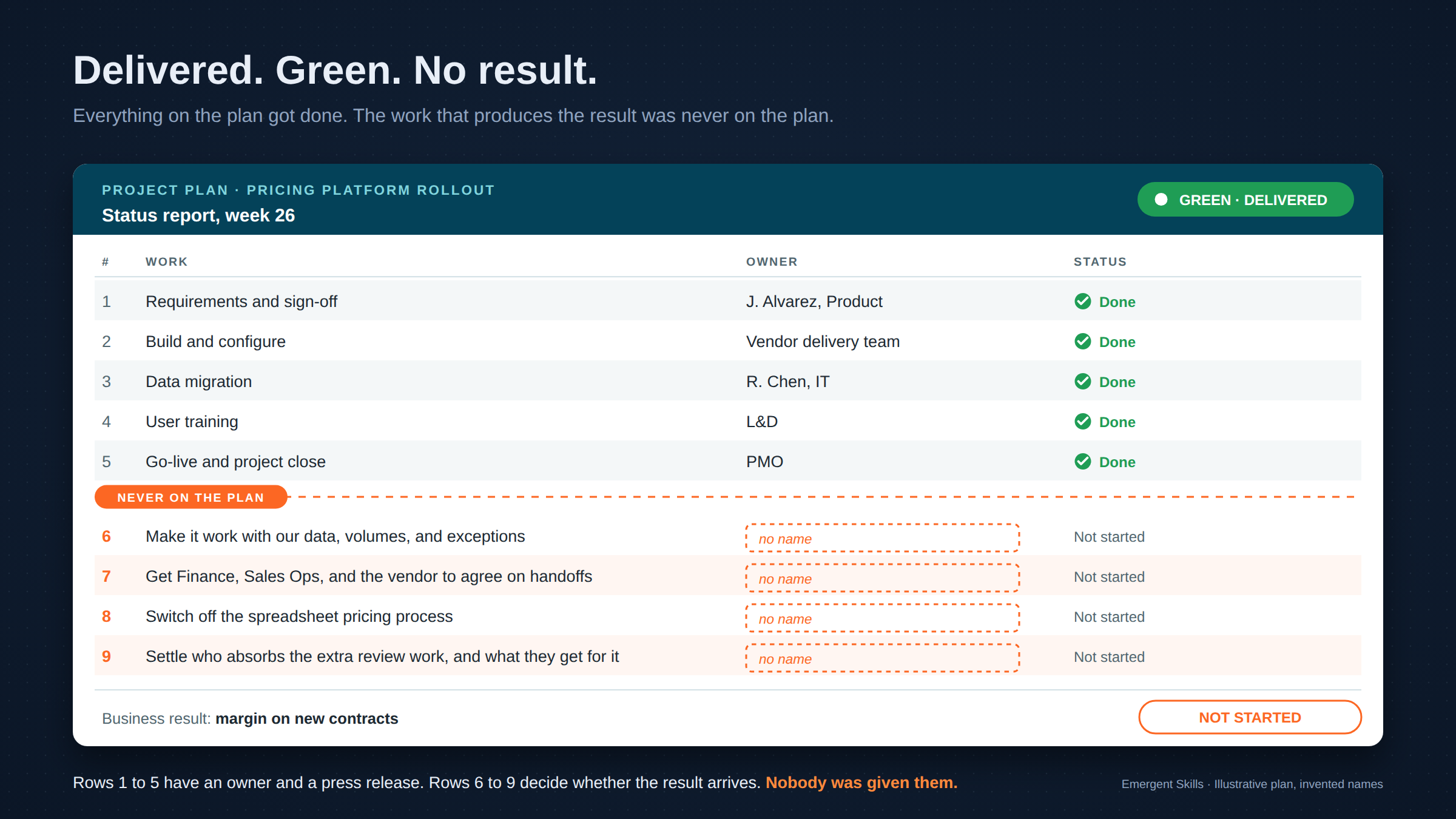
Look at any stalled initiative's org chart. The sponsor owns the outcome. The project manager owns the schedule. The vendor owns the software. Nobody owns making it producible, fitting the interfaces, removing the old process, or negotiating the cost of the change.
This is not carelessness. The four jobs share three properties that keep them off every plan. They produce no artifact, so there is nothing to demo. They cross team boundaries, so no single manager can be told to do them. And they are mostly subtractive, so finishing one looks like nothing happened.
Companies fund what gets a press release. The result is an initiative that is approved, installed, and green on the status report while the business runs exactly as it did before.
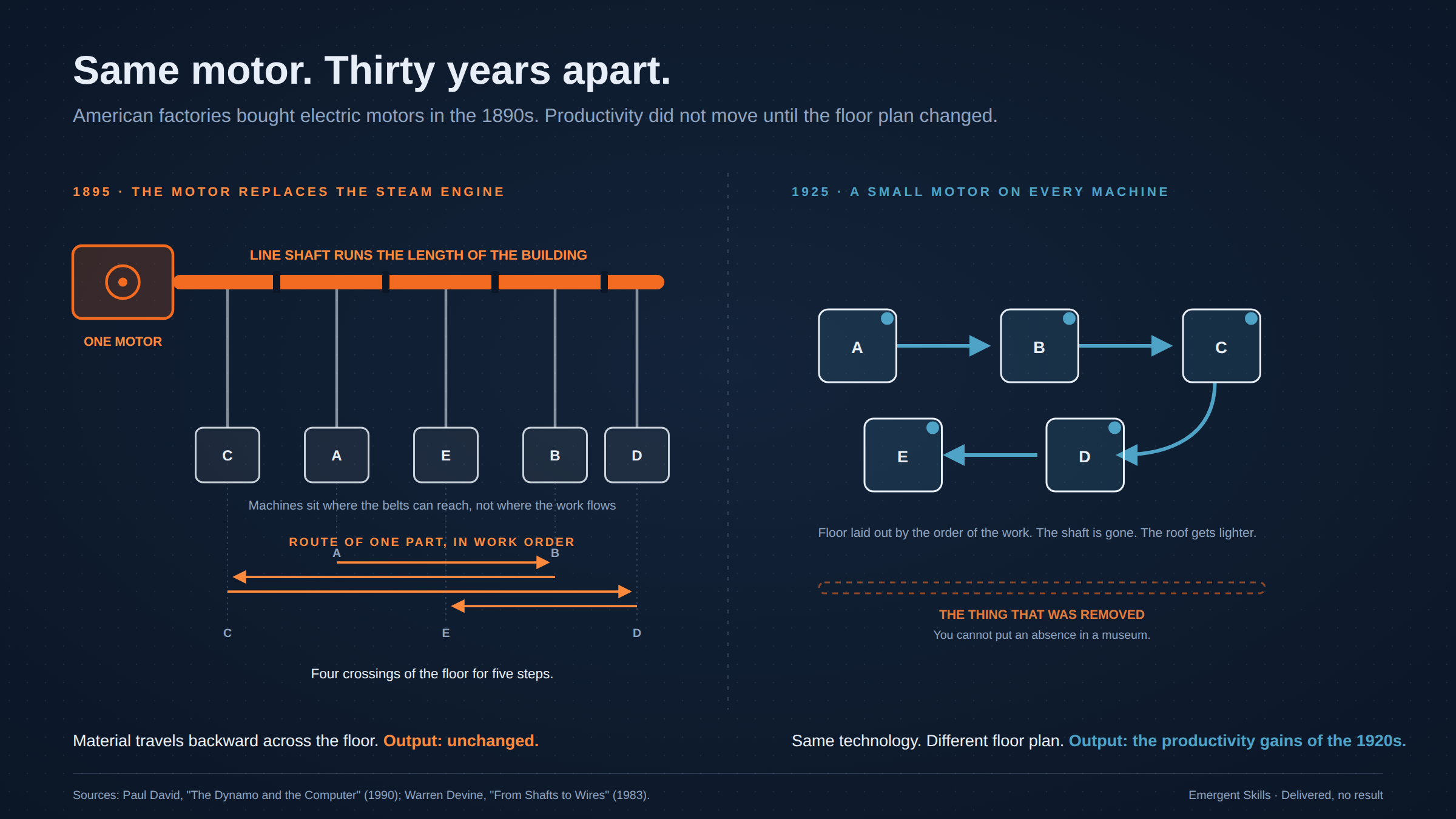
The pattern is not new. American factories bought electric motors in the 1890s and saw no productivity gain for thirty years, because they installed the motor where the steam engine had been, at the end of the same central shaft. The gain arrived when plant engineers put a small motor on every machine, tore out the shaft, and laid the floor out by the order of the work. Same technology. The value came from the floor plan, not the motor, and from people whose names nobody remembers.
Penicillin waited fifteen years for a fermentation chemist and a lab assistant to make it producible. The barcode waited twenty-one years for a grocery committee to force competitors onto one standard. In every case the invention had a famous owner and the four jobs did not.
What you get
A named owner, a cost per week, and the decision.
This is a Stalled Priority Snapshot scoped to an initiative that closed without producing its result. The session runs the Missing Work Check first, then the same two-route investigation every Snapshot uses: where any remaining work is stuck, and whether the conditions around it are adding errors and rework.
Which job has no owner
For each of the four jobs, the name we were given or the fact that none exists, with the evidence behind it.
Who is best placed to own it
The role, the authority it needs, and the hours it will take. Put on the plan as work, with a date, the same as any deliverable.
What leaving it unowned costs
The delay priced per week in extra labor and deferred benefit, with the arithmetic and assumptions beside every figure. Supported estimates only.
The decision
Staff the missing job, redesign around it, or stop. If the evidence points somewhere else, a funding gap, a dependency, an initiative that should not proceed, we say so.
The readout is written for the sponsor. It makes the case for staffing the missing job in numbers the sponsor already uses.
Is this the right fit?
Bring one initiative that closed green and changed nothing.
Best fit: an AI rollout, software implementation, process change, reorganization, or integration that reached its delivery milestone, with a business result that has not started or has stalled well short of the case. A sponsor or operations leader owns the result and can put a name against a job. The value still at stake justifies the fee and your team's time.
Not a fit: a project that has not delivered yet. That is a stalled priority, and the standard Snapshot is the place to start. Also not a fit when the result was never defined, since there is nothing to trace the work back from. We confirm fit before booking and decline when the answer is already clear.
Where this sits. One initiative is a Snapshot. Several initiatives with the same shape, or a portfolio a PE operating partner wants checked, is a Work Demand Diagnostic question. Each step needs its own business case. No commitment past the Snapshot.
Start with one initiative
Find the job nobody was given.
$1,500 USD, fixed scope. Written report within 24 hours of the session. You can upload a PO, request a quote, or tell us the PO will follow.
