Strategy execution · from strategic choices to daily work. Find out what's wrong.
Strategy Execution: the roles involved, and where work can stall.
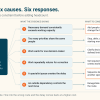
Strategy execution turns strategic choices into coordinated decisions, work and business results. When a priority stalls, the explanation may lie in the strategy, its resources, necessary work that was never assigned, the work path, the conditions around execution, or something else.
Emergent Skills conducts focused operational investigations into one result at a time. We test competing explanations against the work and the evidence before recommending what should change.
Before you fund the fix, find the right problem.
This page maps eleven roles that can contribute to execution. It shows what each contributes, what to check, and how to investigate approvals, handoffs, queues and rework without assuming they explain every delay.
 Request the Stalled Priority Snapshot
Executive summary One stalled result. Several possible explanations. A specific way to investigate.+
A strategy needs workable commitments: who decides, what gets funded, which people are available, and what each function must deliver. Execution happens at every level, including the executive decisions that make daily delivery possible.
The work path is one place to investigate a missed result. A trace can reveal waits, repeated reviews and conflicting commitments. It can also reveal a necessary control, a quality problem or a dependency that requires a different response.
The Stalled Priority Snapshot is a focused investigation of one result. The 90 minutes is the working session, not the whole investigation: written input and available records are reviewed around that session. The written read arrives within 24 hours with the reconstructed path, supported estimates and uncertainties, and a proposed 14-day experiment when the evidence supports one. Fixed scope, \$1,500.
The situation
The strategy was approved. What happened to the work?
Consider a familiar situation: a priority appears in the company plan and the departmental objectives, but a milestone keeps slipping. One team is waiting for a decision. Another has returned the work for clarification. Both need the same specialist. Those observations give you places to look. They do not yet tell you why the result is late.
Execution requires more than announcing objectives. NIST’s Baldrige guidance connects action plans with resources, workforce plans, aligned work processes and performance measures. Its framework also calls for adapting plans when conditions change. Read the NIST guidance.
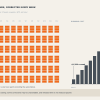
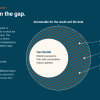
In research published in January 2026, Bain surveyed nearly 1,000 executives and employees who had experienced a reorganization. Eighty-eight percent of leaders expected the new structure to achieve its goals; 36 percent of employees agreed. These are confidence measures, not a measurement of execution loss or proof of its cause. Bain also emphasizes workflow clarity, decision rights, training, coaching and tools. Read Bain’s findings.
ES does not assume the work path is the cause. We check the result and its prerequisites, whether necessary work was identified and assigned, where work is getting stuck, whether conditions around execution are contributing to errors or rework, and other plausible explanations the evidence supports. The broader question remains open: why projects fail and what to check first.

The role map
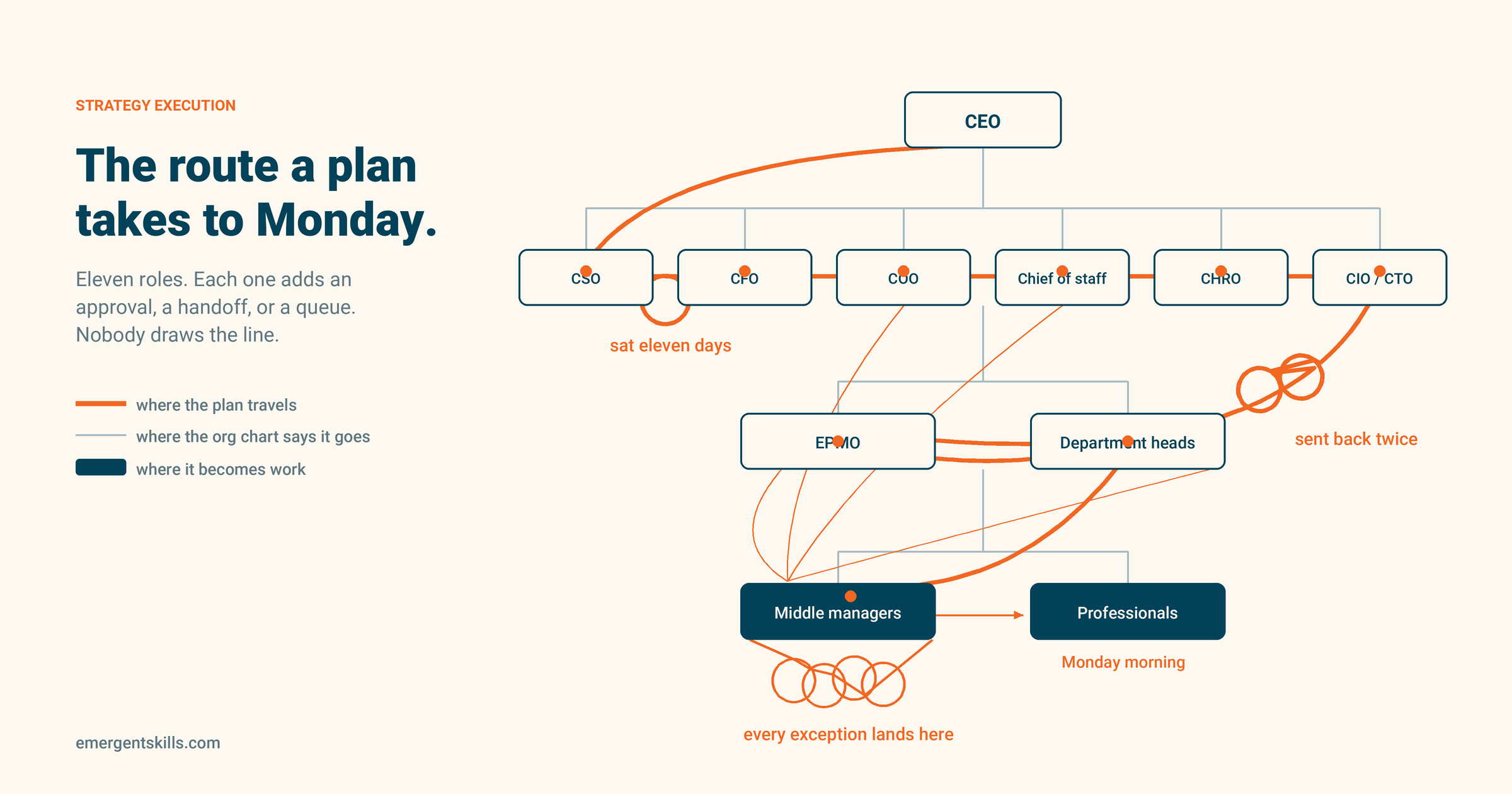
Eleven roles. Different responsibilities. Shared dependencies.
This is an illustrative responsibility map, not an eleven-step approval chain or a complete reporting chart. Companies combine titles and assign authority differently. Board oversight, commercial leaders, product leaders and control functions also matter. A particular result may involve only some of these roles.
Every group contributes to execution. The colors distinguish areas of emphasis. Select a role to see its contribution and a question to investigate. The failure descriptions are possibilities to check, not findings about everyone who holds that title.
CEO
Contributes to strategy
Chooses where the company will compete, the value it intends to deliver, and the activities it will decline.
Contributes to execution
Commits money and leadership attention, resolves conflicts between business priorities, and revisits the strategy when evidence changes.
Question to check
Have we named what must stop, who can make the critical decisions, and what would change our minds?
Where execution can break
A priority can be announced without the resource decisions or trade-offs needed to act on it. The strategic choice itself can also be wrong.
Why this matters to the role
Distinguish a weak strategic bet from an execution obstacle before asking the organization to push harder.
Chief strategy officer
Contributes to strategy
Examines customers, competition and strategic alternatives; makes the assumptions behind the proposed choices explicit.
Contributes to execution
Connects strategic priorities to business plans and helps leaders review whether the expected results are appearing.
Question to check
Can each priority be translated into decisions, commitments and measurable outcomes?
Where execution can break
Objectives can align on paper while implementation dependencies remain unresolved. Evidence may also challenge the original business case.
Why this matters to the role
Use the work-path findings to refine the plan, alongside customer and financial evidence. A clear framework still needs workable commitments.
CFO
Contributes to strategy
Tests the economics, capital requirements and downside of the strategic choices.
Contributes to execution
Connects budgets to commitments and checks whether reported benefits justify the investment.
Question to check
Does the budget match the people and time actually committed, including existing operating obligations?
Where execution can break
A funded initiative can lack available specialists or approval capacity. A completed initiative can also fail to deliver the expected economic benefit.
Why this matters to the role
Separate elapsed delay, extra labor and financial effects. The cost estimate should identify its inputs, assumptions and limits.
COO
Contributes to strategy
Tests whether the proposed offer can be delivered through the company’s operating processes and capabilities.
Contributes to execution
Resolves operating conflicts, coordinates commitments across functions, and maintains service and quality requirements.
Question to check
Are owners, decision rights, handoff criteria and available capacity clear along this result’s path?
Where execution can break
An operating plan can look workable inside each function while the shared handoffs or scarce resources remain unresolved.
Why this matters to the role
Trace one late result to identify a specific decision or condition that can be changed within the relevant authority.
Chief of staff
Contributes to strategy
Helps the executive team maintain a coherent priority list and identify unresolved choices.
Contributes to execution
Follows up executive decisions and coordinates selected initiatives that cross reporting lines, within the role’s mandate.
Question to check
Does the named initiative owner have commitments from the people whose work is required?
Where execution can break
Follow-up can become repeated chasing when ownership exists in name but authority or resource commitments remain unclear.
Why this matters to the role
Bring a precise trade-off or decision request to the executive team, rather than another general status update.
CHRO
Contributes to strategy
Tests workforce and capability needs and helps shape roles, incentives and performance expectations.
Contributes to execution
Supports staffing, development and changes in working practices with the business leaders who own delivery.
Question to check
Do people have the skills, tools, time and expectations needed for the work being assigned?
Where execution can break
A performance problem can be attributed to motivation before capability, workload, incentives and work conditions have been examined.
Why this matters to the role
Investigate the evidence for each explanation. A route review can complement workforce development without assuming either one is the answer.
CIO / CTO
Contributes to strategy
Tests technology requirements and feasibility. A CIO typically focuses on enterprise systems; a CTO may own product technology. Mandates vary.
Contributes to execution
Coordinates the relevant technology portfolio, integration work and operational reliability with the leaders making business commitments.
Question to check
Do the promised dates account for shared engineers, integrations, maintenance and technical dependencies?
Where execution can break
Several initiatives can depend on the same specialist or platform. Reordering one backlog may leave those competing commitments unchanged.
Why this matters to the role
Make the dependency visible so leaders can choose among sequencing, scope, investment or a different technical approach.
Transformation office / EPMO
Contributes to strategy
Helps turn strategic priorities into a portfolio with intended benefits, sponsors and dependencies, where this function exists.
Contributes to execution
Maintains a review process that surfaces decisions and follows delivery through to benefit ownership.
Question to check
Do reported milestones correspond to usable outputs and the intended business results?
Where execution can break
An initiative can finish its deliverables while adoption or benefits lag. A red status may reflect several causes and needs investigation.
Why this matters to the role
Use review time to decide what to investigate, change, fund or stop. Preserve accountability for benefits after the project closes.
Department / business-unit heads
Contributes to strategy
Translate strategic choices into function or business-unit plans and challenge assumptions that do not fit the work.
Contributes to execution
Commit resources, agree dependencies, set priorities and own the relevant delivery or business results.
Question to check
Can our commitments coexist with those of the functions and customers that depend on us?
Where execution can break
Local targets can encourage choices that create delay or rework elsewhere. Resource, capability or market problems may also explain a miss.
Why this matters to the role
Check a specific result before assigning a cause. Resolve changes within your mandate and escalate those requiring another owner’s decision.
Middle managers
Contributes to strategy
Bring evidence about practical constraints and customer needs into planning, and check that priorities are understood.
Contributes to execution
Schedule work, coach people, handle exceptions and coordinate with other teams.
Question to check
Can the team carry the assigned demand, and are the priorities clear when work conflicts?
Where execution can break
Work can collect around a manager who must approve or resolve too many items. Unclear instructions, skill gaps and competing demand need separate checks.
Why this matters to the role
Make the queue and the competing commitments visible. Identify whether relief, clearer authority, better tools or development would address the observed problem.
Professionals
Contributes to strategy
Surface customer and work evidence that can confirm or challenge the assumptions in the plan.
Contributes to execution
Build, sell, implement, support and improve the products and services customers use.
Question to check
Are the expected result, acceptance criteria, access, skills and available time sufficient?
Where execution can break
Work can stall on missing inputs or decisions, return for correction, or fall short because of capability or quality problems.
Why this matters to the role
Show what happened to the work. The finding may call for a route change, additional support, development or another response supported by the evidence.
The question across these roles is who can resolve a dependency when it crosses their boundaries. Bain’s RAPID framework distinguishes the people who recommend, provide input, agree to required conditions, decide and implement. A job title alone does not settle those responsibilities. Read Bain’s decision-role guidance.
Use the evidence you already have
A status report is a starting point for a trace.
Work-management tools can contain useful evidence. Jira’s control chart, for example, reports time spent in selected workflow statuses and can account for reopened work. The available view depends on the workflow and recorded data. See Atlassian’s documentation.
For one result, ask whether the available record covers the relevant decisions and handoffs, including work outside the system. Compare it with the accounts of the people involved. Mark missing or disputed steps as uncertain. A diagram reconstructed from memory is a working account to check, not a complete audit.
Completing the deliverable is also different from realizing its intended benefit. PMI’s benefits-management framework connects projects with strategic benefits that must be delivered and sustained. A route that moves faster still needs to produce a usable result. Read the PMI framework.
Before changing the route
Check the result and its conditions first.
These are ES screening questions. They help decide what to investigate and should be considered for every result, whatever the questionnaire below returns.
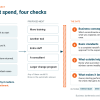
- Outcome: Is the intended result clear, still useful and measurable?
- Priority: Is it still a chosen commitment, and what should give way when work conflicts?
- Means: Are the necessary skills, staffing capacity, information, tools, funding and authority available?
- External dependencies: Is a customer, supplier, partner or other outside condition setting the pace?
A gap in any of these can explain part of the delay. It may coexist with friction in the work path. Record it rather than forcing a choice between a people explanation and a process explanation. Also check whether all the work needed to produce the result was identified and assigned to a named owner.
If execution remains in scope, ES then examines two execution routes, which can occur separately or interact. They are part of the investigation, not the whole investigation. Route 1 is the work path. Work waits in an approval queue, comes back for another review or sits behind a specialist with conflicting commitments. The people involved can all be working well and the result is still late. The four questions below look for this kind of evidence.
Route 2 asks whether surrounding demands, such as interruptions, frequent switching or competing decisions, contribute to errors, reversed decisions, rework or missed handoffs. These demands can arise independently of a work-path problem or interact with one. Being busy or interrupted alone is not proof; the evidence must connect the demand to an observable execution failure. When a capacity effect is suspected, ES uses the Four Tests: baseline shift, load signature, shared conditions and reversibility. Reversibility requires evidence from changed conditions. A work-path finding can stand without a Route 2 finding.
One result to examine
Which result would you least like to explain at the next review?
Choose one milestone, decision or deliverable that should have moved. The questions below collect observations. A yes identifies something to examine; it does not establish a bottleneck or justify removing a control. A no does not rule a work-path problem out.
What is happening to this result?
Answer from the information you have. Choose Not sure when a record or another participant is needed.
Automatic feedback requires JavaScript. You can still use these four questions with the screening checks above; no score or cutoff is needed.
Test one explanation
Change a specific condition and examine the result.
Suppose work repeatedly waits for the next review meeting. A proposed experiment might give a named decision-maker a scheduled review slot, with complete inputs and clear acceptance criteria. The relevant owner must authorize the change and preserve required controls.
For a 14-day experiment, agree the baseline, the change, the measure and a decision rule. Check that enough relevant work will pass through the step during that period. Compare waiting and completion with quality, rework and any other changes in demand or staffing.
If performance improves, that supports the explanation that the changed condition contributed. It does not establish that skill, incentives or other factors played no part. If performance does not improve, revisit the hypothesis, implementation and observation period. The result may weaken a specific explanation or remain inconclusive.
What the delay costs
Separate elapsed waiting from extra labor.
-
Elapsed waiting
-
How long the result waited between relevant events. This is a duration; it is not automatically paid labor or lost revenue.
-
Extra labor
-
Time spent chasing, repeating reviews, correcting avoidable errors or restarting work. Use supported time estimates and identify any uncertainty.
-
Financial effect
-
Estimate extra labor cost using an agreed rate. Treat delayed cash, lost margin and other consequences separately, only where the evidence supports them. Do not count the same loss twice.
A shorter wait can be useful even when a reliable financial estimate is not available. The read should say what is known, what is estimated and what remains unresolved.
One result. A 90-minute working session. A written finding you can examine.
The Stalled Priority Snapshot brings together up to three people who move, approve or unblock one result. Written input and available records are reviewed around the session. We check the result and its prerequisites, necessary work and ownership, reconstruct the work path, examine conditions around execution, and compare competing explanations against the available evidence.
When the issue crosses teams or the explanation is disputed, an outside investigation can also give the result owner an independent finding to take back across the organization.
What you receive
- Written input from typically 6–8 contributors, plus one 90-minute session with up to three participants focused on a named result.
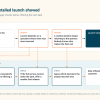
- A work-path map showing decisions, handoffs, waits and returns, with uncertain steps marked.
- Elapsed delay reported separately from supported extra-labor estimates, with arithmetic and assumptions shown.
- A written read within 24 hours of the session, setting out what the evidence supports, what remains unresolved and the recommended next step. That may be a management decision, an optional 14-day experiment with an owner, measure and decision rule, or a specific next evidence step.
- A 15-minute walkthrough and follow-up after an agreed test or evidence review.
- \$1,500, fixed scope. No required follow-on engagement.
How the scope stays clear
- The session examines the work and its requirements. It does not rate individuals. If the evidence establishes a capability, conduct or individual performance issue, the read states it.
- Participants can consult records they are authorized to use.
- The read distinguishes participant accounts, supporting records and estimates. A short reconstruction cannot establish every cause.
- A proposed change requires the relevant authority. The Snapshot itself does not change controls, compensation or reporting lines.
- If the evidence points elsewhere or is insufficient, the read says so. Further work is a separate decision.
Where this connects
Follow the question the evidence raises.
Explore the manager’s workload in Span of Control, unresolved decisions in Slow Decision-Making, or conflicts between commitments in Competing Priorities. The Five Capacity Taxes provide ES’s vocabulary for examining related costs.
If similar observations appear across a team or operation, the Work Demand Diagnostic examines the wider pattern. The next step follows the evidence from the first result.
Sources and scope of the claims
- NIST: Baldrige Criteria Commentary. Guidance on connecting strategy, resources, workforce, work processes and results.
- Bain: Reorganization confidence survey, January 29, 2026. Nearly 1,000 respondents; the reported percentages describe confidence, not a causal diagnosis of delay.
- Bain: RAPID Decision Making, October 13, 2023. A practitioner framework for clarifying decision responsibilities.
- Atlassian: View and understand the control chart. Product documentation for time in workflow statuses and reopened work.
- PMI: Benefits Realization Management Framework. Guidance connecting project work with strategic benefits.
The role descriptions, screening questions and proposed experiment are ES’s application of these ideas. They are not a validated diagnostic scale or a claim that all companies follow the same structure.
Start with one result
Investigate what is holding up one priority.
Bring the milestone, decision or deliverable that should have moved. Start with the work record, test the competing explanations, and choose the next change — or next evidence step — the evidence supports.

 Projects stall, results fall short, and problems keep coming back. Trace what happened, test the explanations against the evidence, and decide what’s worth changing.