The Great Manager Flattening - Decision Rights
Span of Control: 97% of Managers Are Doing Two Jobs
New Gallup research reveals a design risk. When spans of control widen without moving decision rights or reducing managers' individual workloads, decisions can queue at the manager.
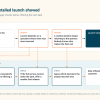
Start the Stalled Priority Snapshot Run the Execution Drag Calculator
Executive summary Fewer layers did not mean fewer decisions. It changed where they wait.+
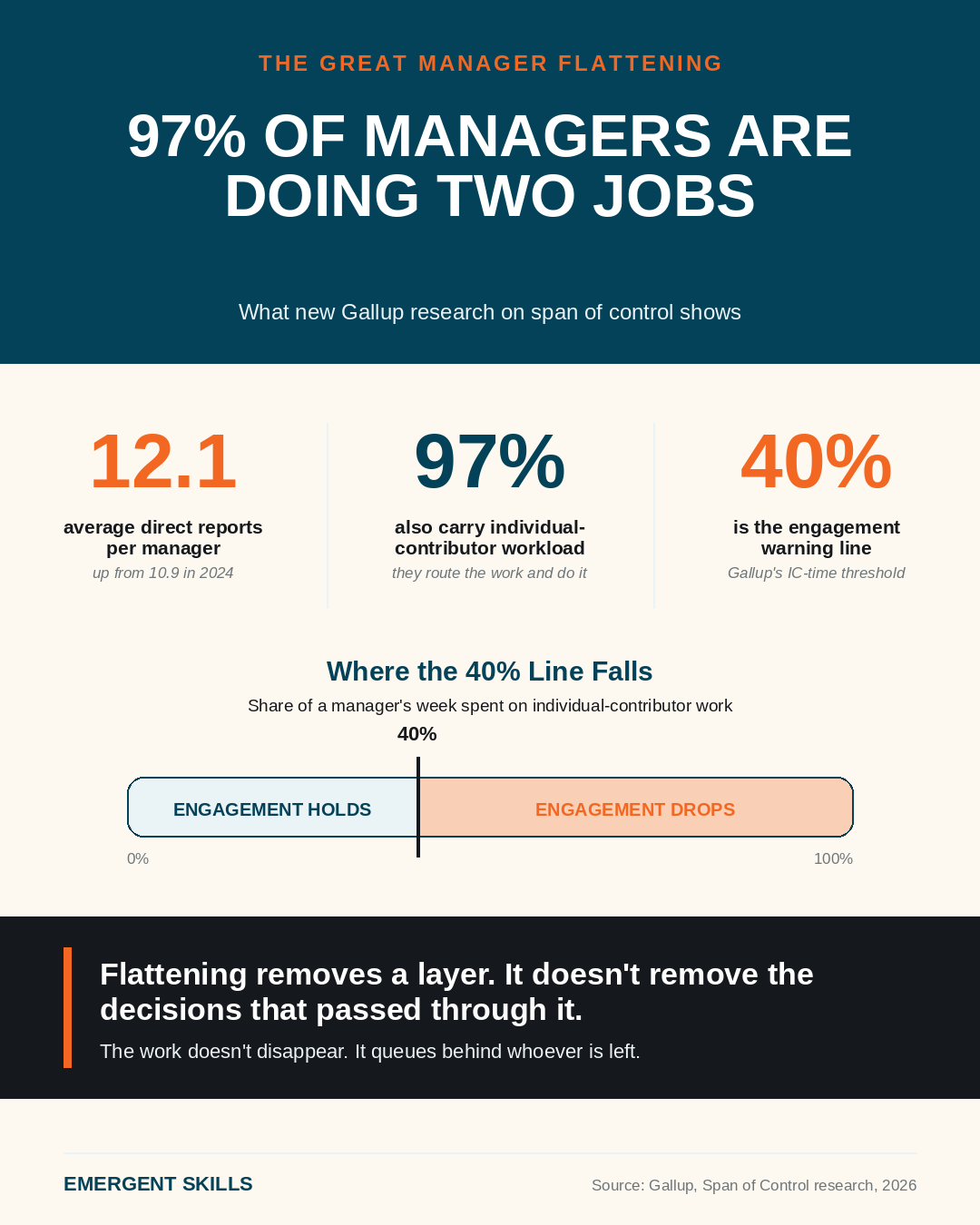
Gallup's new span-of-control study puts the average manager at 12.1 direct reports, up from 10.9 in 2024, and 97% of managers say they also carry individual contributor work. Companies are flattening on purpose. Amazon and Meta have both said they want fewer approval steps and faster decisions. The decisions, exceptions and coordination that ran through a removed layer do not leave with it. If nothing reassigns, eliminates or automates that work, the remaining manager inherits it on top of a full individual workload.
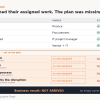
Gallup's warning line is 40%. Above 40% of the week on individual contributor work, manager engagement dropped, and the drop grew with team size. Gallup measured engagement, not queues. The queue is my operating read of what a player-coach with no management time left produces: approvals waiting, decisions sitting, work that does not fail but stops. That is the manager bottleneck form of execution drag.
Larger teams can work. Gallup names four conditions for it, and the 40% line is one of them. Rajan and Wulf, studying more than 300 large U.S. firms, found that flatter hierarchies came with changes in authority and incentives, not just fewer boxes on the chart. The right span also depends on the work. McKinsey's archetypes run from three to five reports for a player-coach to 15 or more for highly standardized work, so a single number set for the whole company misses most of that range.
The org chart shows team size and hides decision concentration. Six reports and every exception crossing one desk can be a heavier routing load than 15 experienced reports who decide for themselves. Workflow bottlenecks form around managers who carry all three: heavy individual work, concentrated decision rights and a steady stream of escalations. The fix starts before the layer comes out. List what it clears, decide where each decision goes, and measure afterward whether approvals, exceptions and rework pile up around particular managers.
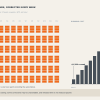
The average manager now oversees 12.1 direct reports. That's up from 10.9 in 2024 and nearly 50% higher than when Gallup first measured it in 2013.
But here's the stat that stopped me: 97% of managers report having individual contributor responsibilities in addition to leading others. They route the work and they also do the work.
Companies are deliberately removing management layers. Amazon set a goal of increasing its ratio of individual contributors to managers by at least 15%. Meta described its own plan as "flatter is faster." Both companies want fewer approval steps and faster decisions.
That can work. But removing a layer does not, by itself, remove the decisions, coordination and exceptions that passed through it.
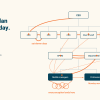
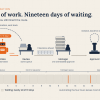
A layer came out. If its work was not reassigned, eliminated or automated, that work stacks behind whoever is left, in line behind that person's own deliverables.
The 40% Warning Line
The average team size tells only part of the story. Gallup reports that the median team is still about five to six people. A minority of very large teams pulls the average upward: 13% of managers now oversee 25 or more people.
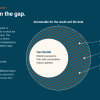
Gallup found that managers spending less than 40% of their time on individual contributor work maintained higher engagement regardless of team size. Managers spending more than 40% on IC work had lower engagement, and engagement declined further as their teams grew.
Engagement is what Gallup measured. It did not measure approval time, decision queues or rework. The queue is my operating interpretation of what can happen when a player-coach runs out of management time.
The mechanism is not new. Research has long described the firm as an information-processing system. In The Firm as a Communication Network, Patrick Bolton and Mathias Dewatripont show that communication consumes time and that overloaded decision-makers must delegate. Luis Garicano's research on knowledge hierarchies explains why routine problems should be solved close to the work while harder exceptions move to specialized problem-solvers.
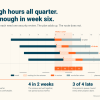
Put those ideas together and the operational risk becomes visible. Approvals, exceptions and escalations converge on a manager who is heads-down on an individual deliverable. The work may not fail. It waits.
This is what Capacity Intelligence™ (CI) examines: where demand routes, what happens while it waits and whether the route should change.
Larger Teams Can Work, With the Right Conditions
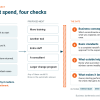
Gallup is not saying that flattening is inherently bad. Larger teams can work, but the result depends on four conditions:
The Four Conditions for Success
The team is already engaged
Widening spans is unlikely to repair an engagement problem that already exists.
Managers spend less than 40% of their time on IC work
Gallup found that the combination of heavier IC work and larger teams was associated with lower manager engagement.
Managers have the right talent for the role
Gallup found that manager engagement held up better among people it rated as having stronger management talent, even as teams grew.
Employees receive meaningful feedback regularly
Gallup found much higher engagement among employees reporting meaningful feedback during the previous week.
Large teams do not perform the same way everywhere. Gallup found that the connection between engagement, productivity and turnover varied by industry for teams of 20 or more. The type of work and the support around the manager matter.
Widening the span without redesigning the work around it is what breaks the system, not team size on its own.
Span Depends on the Work
A single company-wide span target is too blunt. The right number depends on what the manager and the team actually do.
McKinsey's span-of-control research separates managerial work into five archetypes. A player-coach doing substantial expert work may reasonably manage only three to five people. A coach may manage six to seven. A supervisor working with more standardized processes may manage eight to ten, while managers of highly standardized work may lead 15 or more.
The number changes with the manager's own workload, how standardized and varied the work is, and how independently team members can operate.
Independent research points in the same direction. A multilevel study of 434 public-sector managers found that larger spans were unfavorable for most of the managerial job demands examined. A study of frontline managers in 14 Canadian hospitals connected span of control with role overload, work control, job satisfaction and adverse unit outcomes.
But smaller is not automatically better. Research in public organizations found that both narrow and broad spans were associated with lower employee-perceived leadership and job satisfaction than spans in the middle.
Span of control is not a headcount formula. It is a work-design decision.
"Our Meetings Became Transactional"
One middle manager, Yvonne Lee-Hawkins, described to Business Insider what happened after she went from zero to 21 direct reports:
"Our meetings became transactional."
Only the most urgent items fit. Questions, advice and career-development conversations fell off the agenda. She eventually left the job.
I see transactional meetings as a queue symptom. When the only thing that fits is what is on fire, everything else moves onto a waiting list that may not be visible anywhere.
Gallup found that employees who reported receiving meaningful feedback during the previous week were substantially more engaged, regardless of team size. A separate field study across multiple organizations also found that more frequent feedback was associated with performance and job satisfaction.
Frequency alone is not enough. A major meta-analysis of feedback interventions found that feedback improved performance on average, but more than one-third of the interventions reduced it. The conversation must be useful, specific and connected to the work.
Two of the five capacity taxes can appear here at once. The Meeting Tax consumes the week. The Manager Load Tax prices the work sitting behind it.
When Flattening Moves the Bottleneck
Flattening can remove approval steps, reduce bureaucracy and move decisions closer to the work. There is credible evidence for that side of the argument too.
In The Flattening Firm, Raghuram Rajan and Julie Wulf examined reporting relationships in more than 300 large U.S. firms. They found that flatter hierarchies were accompanied by changes in authority, status and incentives. Flattening was not merely an org-chart exercise. Decision rights moved too.
Amazon's stated plan follows that logic. Andy Jassy described long chains of managers reviewing work and "pre-meetings for the pre-meetings for the decision meetings." But he also said the goal was to drive decision-making closer to the front line, not simply hand every old decision to fewer managers.
Meta also acknowledged the tradeoff. Its efficiency plan argued that fewer layers could reduce latency, while stating that managers generally should not have more than ten direct reports.
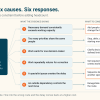
Flattening works when decisions, work and support move with it. Strip a layer out without moving any of the three, and the queue just relocates.
Before removing a layer, name what that layer actually cleared. Decide which work disappears, which decisions move to the front line, and which exceptions move upward or get standardized and automated. Otherwise, the hierarchy gets shorter while the manager's queue gets longer.
Span Is Only Part of the Routing Problem
The question is not only how many people a manager oversees. It is how much of the organization's decision flow must pass through that one person.
A manager with 15 experienced, independent reports and clear decision rights may have less routing load than a manager with six reports who must approve every exception. Team size is visible on the org chart. Decision concentration usually is not.
Gallup's 40% finding is a useful warning line, not a universal law. Once individual work consumes a large share of the week, the manager has less room for approvals, coaching, exceptions and development. Whether that becomes a measurable bottleneck must be tested in the actual work path.
The managers most likely to become workflow bottlenecks are not simply the ones with large teams. They are the ones combining a heavy IC load with concentrated decision rights and frequent escalation demand.
Emergent Skills calls one possible result the Decision Density Tax: too many consequential calls compressed into too little high-quality decision time. The tax should not be assumed. It should be tested by looking for waiting decisions, reversals and rework around periods of concentrated demand.
What This Means for You
The managers who come through the Great Flattening will not necessarily be the ones who work hardest. They will be the ones who make the queue visible before it becomes the operating model.
If You're a Manager
- Track your IC versus management time. Treat 40% as a warning signal, not a diagnosis.
- List every approval, exception and decision waiting on you right now.
- Mark which decisions genuinely require your judgment and which could move closer to the work.
- Watch for meetings that handle only urgent transactions. Ask what has disappeared from the agenda.
If You're a Leader
- Before removing a layer, name the work and decisions it currently clears.
- Widen spans only with a plan to reduce IC load, delegate decisions, standardize work or add support.
- Set spans by work complexity and team independence, not one company-wide number.
- Measure whether approvals, exceptions and rework concentrate around particular managers after the change.
Find the Decisions That Are Waiting
A manager bottleneck appears up close as slow approvals, stalled priorities and decisions that return later as rework. The first move is not adding another dashboard. It is naming where the work stops and why it must stop there.
Sources and Further Reading
- Gallup: Span of Control - What's the Optimal Team Size for Managers?
- Bolton and Dewatripont: The Firm as a Communication Network
- Garicano: Hierarchies and the Organization of Knowledge in Production
- Rajan and Wulf: The Flattening Firm
- Wallin, Pousette and Dellve: Span of Control and Managers' Job Demands
- Wong et al.: Span of Control and Manager Job and Unit Outcomes
- Jacobsen et al.: Not Too Narrow, Not Too Broad
- McKinsey: How to Identify the Right Spans of Control
- Amazon: Manager Team Ratio and Organizational Layers
- Meta: Update on the Year of Efficiency