AI workflow automation · Operational Payoff - Find out what's wrong.
You Bought AI to Save Time. Why Is Your Team Busier?
AI workflow automation can shorten a task while adding work around it. Before spending more, check the time, cost, and quality of the completed work.
 Investigate one AI rollout
The AI system is producing work faster. Your team is spending more time checking it. What happened to the time you expected to save?
Perhaps the old spreadsheet is still running, exceptions need manual correction, and the manager who was supposed to gain time has become the final reviewer. Those are possible explanations. More demand, temporary setup work, or changes in the kinds of cases the team handles could also explain a busier week.
Start with what changed in the work. Are people handling more cases, spending longer on each one, or both?
In Your AI Marketing Transformation Will Get Harder Before It Gets Easier, Michelle Taite and Will Fernandez describe companies adding expertise, engineering, and oversight while existing work and costs continue. Their examples concern marketing. The question is useful for other operations too: what work has to happen around the automated task?
Count the work around AI workflow automation
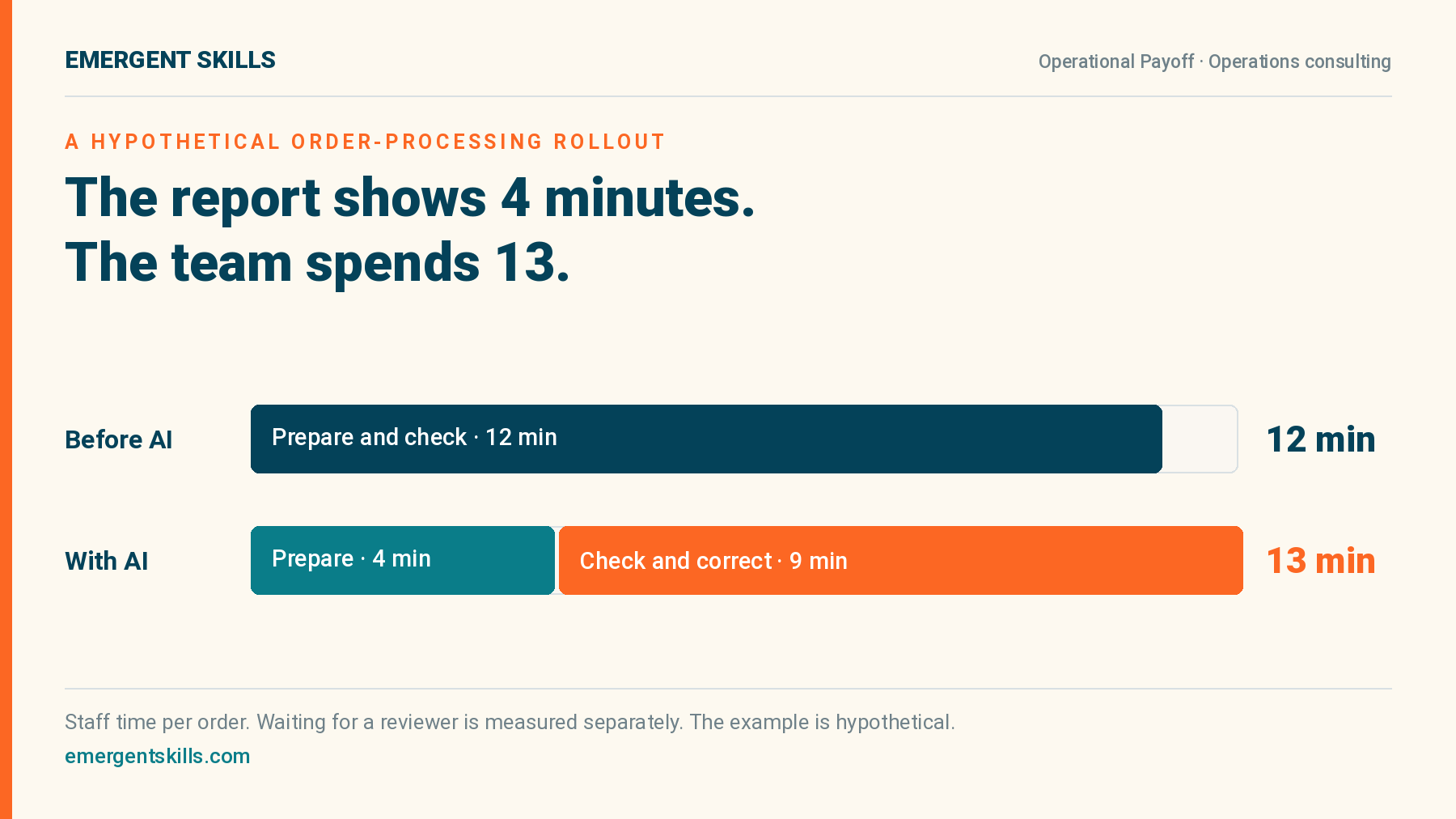
Consider a hypothetical order-processing rollout. Preparing and checking an order used to take 12 minutes of staff time. With AI, preparation takes four minutes, but checking and correcting the result takes another nine.
| Staff time per order | Before AI | With AI |
|---|---|---|
| Prepare | 12 min, checks included | 4 min |
| Check and correct | Counted above | 9 min |
| Total | 12 min | 13 min |
Staff time is now 13 minutes per order, up from 12. A report showing only the four-minute preparation step misses the increase in total effort. Waiting for a reviewer can add a workflow bottleneck on top of that, but it needs to be measured separately.
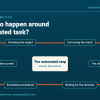
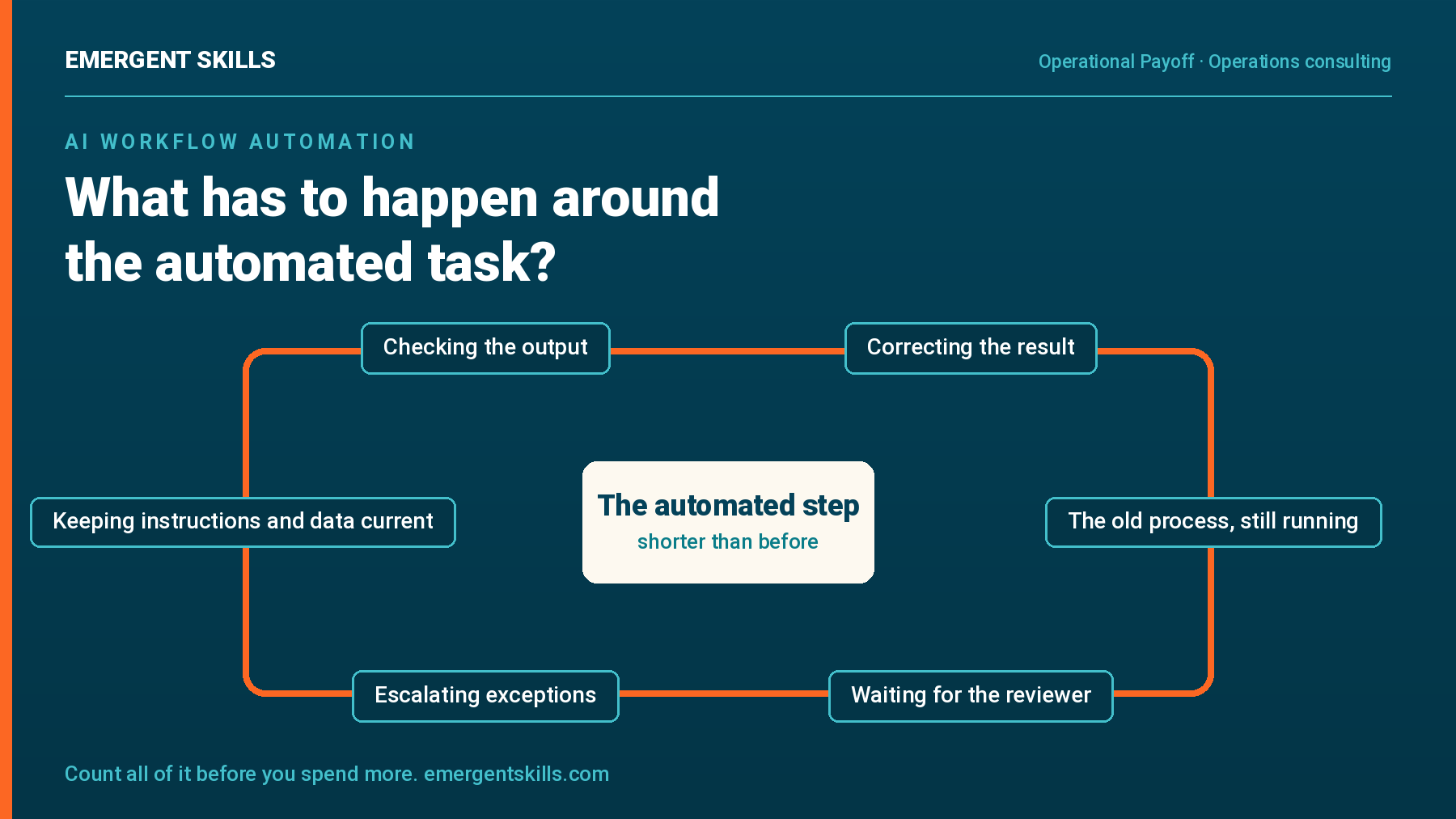
Trace a few recent orders through to completion. Record the checks, corrections, escalations, and waiting. That is the execution drag around the automated step. Include the work of keeping instructions and data current, without counting that shared effort again for every order. Establish who is responsible for each part and what other work they put off to do it.
The extra effort may be worth it if it prevents costly errors or lets the team handle cases it couldn't serve before. Compare completed orders of similar difficulty, including time, cost, and quality. A few cases can show where to look. They don't establish the average across the operation.
The missing instruction may be an unmade decision
The HBR authors distinguish strategy choices that were never settled from expertise that was never made explicit. Those need different fixes.
A decision nobody made
If sales and operations disagree about which delivery promises are acceptable, someone with authority must settle the rule. Repeatedly rewriting the AI instructions won't resolve that disagreement.
Expertise nobody wrote down
If an experienced employee already knows when an order needs special handling, review actual orders with them. Identify the information they checked and the circumstances that justified an exception. Use those cases to test which parts the system can handle reliably and which still need a person's judgment.
Then establish who will maintain the rules, handle exceptions, and authorize changes. An unclear answer is a reason to check the assignments, not proof that nobody owns the work.
Not sure which one you are looking at? The Stalled Priority Snapshot traces the work between an approved initiative and the result it was supposed to produce, and reports what the evidence supports.
Decide what can stop and what must stay
A company can pay for AI while keeping its old software, outside support, and manual checks. Running both processes for a while can be sensible. Some controls may need to stay.
For work expected to end, agree what the new process must demonstrate, who can authorize the change, and when any contract can end. If both processes must continue, include their continuing costs in the business case.
A freed hour can have value when it goes to work that needs doing. It becomes a payroll saving only when payroll spending falls.
The same care applies to staff time. If the case rests on avoiding a hire, establish how much additional demand the current team can handle at the required quality and service level.
Temporary effort needs evidence of progress
The authors describe an initial period of higher cost before benefits emerge. That is a possible explanation for disappointing early results. On its own it says nothing about whether this investment will pay off.
Before the next spending decision, agree what should improve and when to review it. That might mean:
- Fewer corrections
- Less reviewer time per completed case
- An old contract ending
Name the person responsible for collecting the evidence and the person who can act on it.
Compare similar work over a period that covers the relevant work cycle. Check whether an improvement in one place added effort or delay somewhere else. If the expected improvement doesn't appear, revisit the explanation before expanding the rollout.
Buying another tool or adding more AI agents commits more money and operating effort. The next purchase needs a supported case of its own.
Find out what the extra work is buying you
If the result is falling short and the explanation remains unclear, Emergent Skills' Stalled Priority Snapshot investigates one important result. The fixed fee is $1,500 for a 90-minute session with up to three people and a written readout within 24 hours of the session. Written contributor input is optional. The readout sets out what the evidence supports, what remains uncertain, supported costs, and the recommended next step.
Before buying, renewing, or expanding an AI system, Decision Challenge tests whether the evidence supports the commitment, including the cost and operating work needed to produce the expected result.
Source
Taite, Michelle, and Will Fernandez. Your AI Marketing Transformation Will Get Harder Before It Gets Easier. Harvard Business Review, October 19, 2026. The order-processing example is hypothetical.

 Projects stall, results fall short, and problems keep coming back. Trace what happened, test the explanations against the evidence, and decide what’s worth changing.