Operational Payoff · Business process improvement
Investigate and fix recurring operational problems
An invoice gets corrected, and the next batch comes back with the same errors. A customer onboarding delay gets escalated, and the next customer stalls at the same handoff.
Fixing one case didn’t stop the next. Emergent Skills finds where the work gets stuck and whether the pressure around it is causing the mistakes. Then we tell you which changes the evidence supports.
Where recurring operational problems show up
Some recurring problems start upstream, in how strategy gets communicated and turned into daily work. Others show up in the invoices and requests your teams handle every day. A problem is worth investigating when it breaks customer commitments, costs real money, or keeps good work from getting done.
| Area | What keeps happening | What may be at stake |
|---|---|---|
| Strategy communication and implementation | Leaders announce a strategy. Teams walk away with different priorities, or no clear idea what they’re supposed to change or stop. Questions and constraints don’t reach the people who decide, and revised decisions don’t reach the people who act. | Effort goes to the wrong priorities, work gets redone, and the business result never arrives. |
| Customer onboarding | Customers repeat the same information to sales, implementation, and service, then wait between them. | Time to first use, plus support hours nobody budgeted. |
| Finance operations | Invoices come back for correction. Approvals stall. The same disputes recur. | When you get paid, and whether the books are right. |
| Service delivery | Cases reopen, escalations bounce between teams, and handoffs get missed. | Service commitments and customer confidence. |
| Procurement | Requests arrive incomplete, and routine purchases wait on someone’s decision. | Rush orders you shouldn’t need, and supplies that aren’t there when people need them. |
| Sales operations | Quotes go through round after round of revisions. Closed deals sit waiting for the next team. | How fast customers hear back, and whether delivery is ready when the deal closes. |
| IT and internal systems | Tickets get reassigned again and again, or the same incident comes back after a temporary fix. | Downtime, users left waiting, and the same fix done twice. |
Two routes to investigate
Where the work waits and why it comes back
Route 1 · The work gets stuck
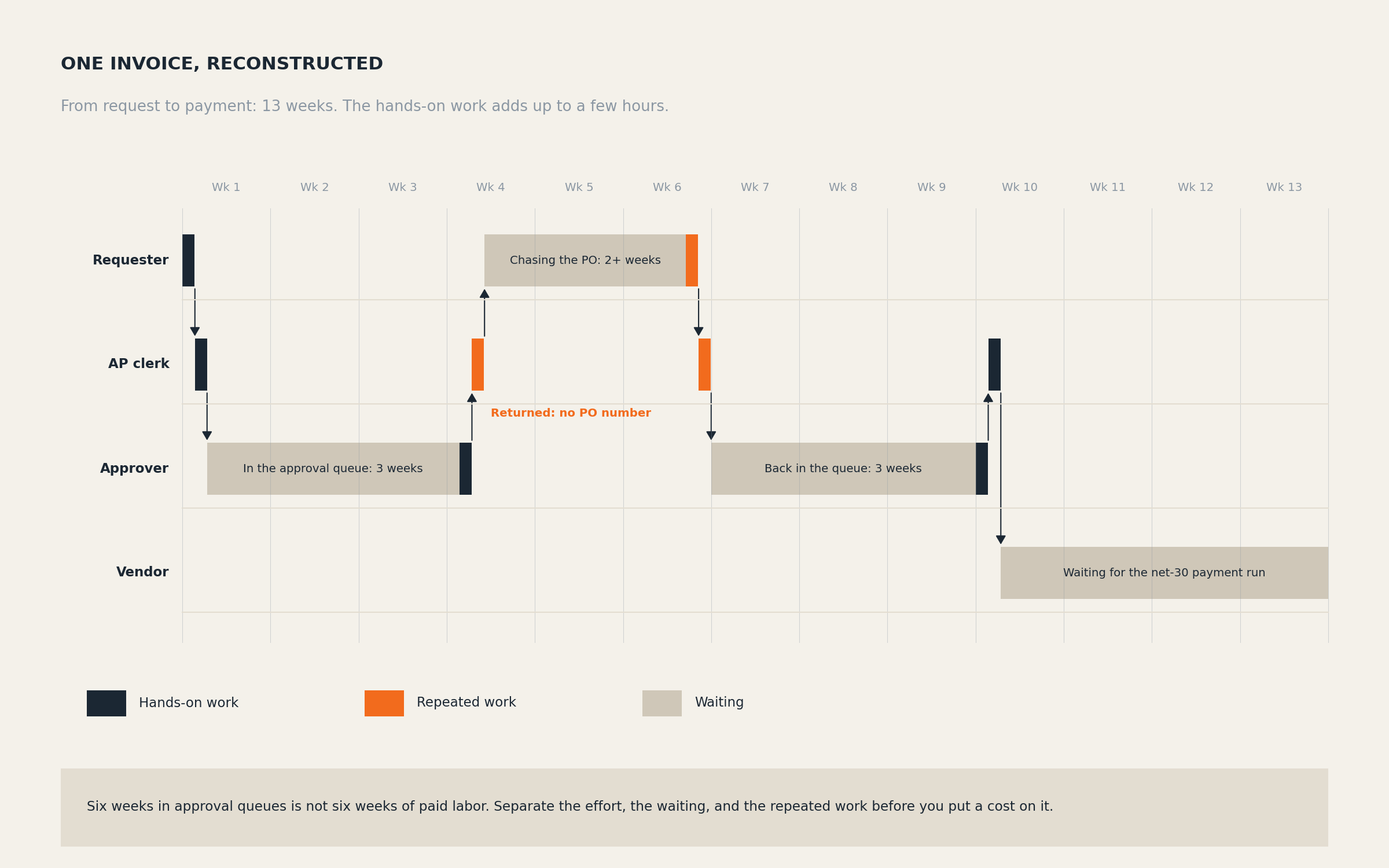
Work sits in queues and approval loops, or falls between teams at a handoff. Some of it goes back through the same steps twice. We rebuild the path it took and find where it stopped.
Take an invoice waiting for approval. We ask what the approval is for, who’s allowed to give it, and what’s keeping them from deciding. See Accountability without authority: why work still waits.
Route 2 · Demands affect execution
Someone gets pulled off an invoice to answer a message, then pulled again for a meeting, then asked for a decision that isn’t theirs to make. Skilled people make mistakes under that kind of load. Errors creep in, work gets redone, and handoffs slip.
If invoice errors keep recurring, we look at what was going on when they happened and compare it with invoices that went through clean. Your Team Is at Capacity. Find Out Where the Capacity Is Going. looks at where demand piles up before you hire.
Often it’s both. Shorten the approval queue and the errors can keep coming. We check both routes before recommending anything.
And it may be neither. Missing information, fuzzy standards, skill gaps, thin staffing, a system fault, or an outside dependency can explain it better. A busy team isn’t proof that workload caused the mistake.
How we investigate a recurring problem
-
Define the shortfall and check the basics
Agree what should happen, what actually happens, and how often. Name the business priority it serves. Then check the basics. Is the result still worth producing? Are expectations realistic? Has anyone settled the competing priorities? Do people have the information, skills, authority, and resources to deliver? Are there outside dependencies, and are the standards clear and workable?
Ask the people doing the implementing what result they’re after, why it matters, what comes first, and what they’ve been told to change or stop. Compare that with the direction leadership gave. Then follow a question from the front line up to a decision maker, and see whether the answer makes it back down.
-
Reconstruct what happened
In Count the Wolves, Paul Stansik shows how layers of management distort a leader’s view of what’s really happening. We put leadership’s picture next to frontline accounts and the records. We look for conflicting instructions, unanswered questions, and constraints that never made it into a report.
We pull together what people doing the work tell us and what the records show: instructions, priority changes, request dates, approval history, revisions, handoffs, completion times. For a communication failure, we line up what was said, what people understood, and what they did. We separate hands-on effort from waiting and rework. Where accounts conflict or evidence is missing, we mark it. Workflow analysis uses that record to find where work waits, loops, and comes back.
-
Compare occurrences and test explanations
Where the scope allows, we compare the problem cases with similar work that went fine. Do errors cluster around certain interruptions, task switching, or a pileup of decisions? Do other people under the same conditions make the same mistakes? We check for changes in volume and complexity before concluding anything.
-
Estimate the consequence and recommend a next step
We estimate the extra labor from quantities the evidence supports, and name the delivery or financial consequences. You’ll see the assumptions and how sure we are. The recommendation might be a management fix, a small test, or more evidence before you commit to a change.
You get a written assessment you can act on: the path the work took, the evidence for each explanation, the costs we can support, and the next step with the role that owns it. Gaps in the evidence stay visible.
Test the change and check whether it holds
If more work is justified, ES helps the responsible manager design and run an authorized change, then checks the result. The finding decides the change. The table shows possible tests. It isn’t a package of standard fixes.
| If the evidence points to | A change worth testing | What to watch |
|---|---|---|
| Incomplete requests | Agree what information is needed before work starts, and who chases missing details. | How often requests come back for clarification, how long they take, and how many get abandoned. |
| Approval queues | Clarify who decides, name an authorized backup, or review independent items in parallel. | Waiting time, reopens, and whether the required controls still work. |
| Errors around interruptions | Send urgent requests through one designated person, and protect time for work that needs focus. | Errors per completed item, when interruptions happen, and whether urgent requests still get handled fast. |
| Competing decisions and priorities | Agree who breaks ties, and limit how much runs at once where the evidence supports it. | Completions, reversals, rework, and whether another queue starts growing. |
Before a test, agree on an owner, a baseline, what success looks like, and what would make you stop. Compare enough work to judge the result. Faster only counts if quality and the necessary controls hold.
If the change works, write the new responsibility or procedure down and check later that it stuck. If it doesn’t, find out whether it was actually carried out before you revise the explanation or drop the change. And smoother flow doesn’t prove workload was hurting performance. That claim needs its own evidence.
Is this problem worth investigating?
Start with what’s still at stake. How much repeated work could you realistically avoid? Which customer commitments or useful work are affected? Weigh that against the investigation fee, your team’s time, and the cost of any change. Before You Spend More on a Project That Isn’t Delivering lists the questions to answer before you fund another fix.
Keep the numbers separate. An approval waiting three days is not three days of paid labor. Late payment isn’t lost revenue. Hours freed from rework aren’t cash in the bank. We report what the evidence supports and tell you what each estimate rests on.
When an outside investigation adds value
If the cause is obvious and someone can fix it, an internal review may be all you need. Bring us in when the problem crosses teams, people tell different stories, or it’s been fixed three times and keeps coming back. We pull the records and perspectives together and check both routes. When Project Problems Need a Deeper Investigation covers when that extra work pays for itself.
Start with a scope small enough to investigate
The Stalled Priority Snapshot starts with one specific result: an onboarding that ran late, an invoice that won’t resolve, a service handoff that failed. We’ll confirm the case fits before you book. One case can point to a useful next step. It can’t tell you how widespread the pattern is.
$1,500 USD. Written input from 6–8 contributors, then a 90-minute session with up to three participants. You get a written report within 24 hours and a 15-minute walkthrough with the manager. No follow-on commitment.
If the question covers many transactions or a whole team, the Work Demand Diagnostic looks at the pattern. A Capacity Audit goes deeper when the evidence justifies it. Implementation and evaluation are scoped separately. A Snapshot tells you what the evidence says and what to do next. Proving a fix works takes observation after the change.
Related reading
Business Process Mapping: How to Map the Work That Actually Happens
Map the real handoffs and decisions before you change the process.
Before You Spend More on a Project That Isn't Delivering
Check the business consequence, the basics, and whether the next intervention is worth it.
AI Workflow Automation: Fix the Process First
Look at approvals, handoffs, and waiting before you pay for automation.
Start with the recurring shortfall
What keeps coming back?
Tell us what should happen, what actually happens, and what the gap costs the business. We’ll tell you whether a Snapshot is the right place to start.
