Operational Payoff · Operations consulting for stalled projects and recurring execution problems.
Stalled Priority Snapshot: find what is holding back one critical result.
A project is late, keeps returning for review, or launched without the expected uptake. A recurring operation, like customer onboarding, keeps coming back for corrections. What does that shortfall mean for revenue, customer delivery, or other valuable work, and what can still be protected?
Your first option may be to ask a project manager, operations leader, or analyst inside your organization to investigate. They know the work and may be able to resolve the problem.
If the explanation remains unclear, the Snapshot runs three checks, in order.
First
Was the work ever assigned?
Four jobs sit around every initiative: making it work with your data and exceptions, getting the teams it touches to agree on handoffs, switching off the old process, and settling who absorbs the cost of the change. A plan can be run perfectly and still fail if one of them has no owner.
Route 1
Where work gets stuck
Queues, approvals, handoffs, and rework.
Route 2
Whether interruptions, switching, or competing decisions contribute to errors and rework
The conditions around the work, checked against the record.
You get
- A manager’s decision brief
- The work-path map, the missing-work check, and evidence behind the finding
- An action plan naming the first step, owner, approval needed, and effort to confirm
If the evidence points to capability, funding, or a dependency, we say so.
$1,500 USD
Fixed scope
Written input
From people involved in the work (typically 6–8)
90-minute session
With up to three participants
Written report
Within 24 hours of the session
15-minute walkthrough
With the result owner
Follow-up
After an agreed test or evidence review
No follow-on commitment. Remote or in person, with location and travel agreed before booking.
Led by Jim Wilde, founder of Emergent Skills. Nine years as lead consultant at the MTA on mta.info and the NYC subway countdown clocks. Decades in enterprise systems before that.
Your side of the cost: up to 4.5 person-hours in the session, plus time for written input, preparation, and the walkthrough. We agree on the contributors and session participants before booking. Tell us the result, your PO or quote needs, and your preferred date. We reply within one business day. Scope and the session date are confirmed separately.
Two routes into execution drag
One result falling short. Two routes to check.
A project or operating result can fall short for more than one reason. The Snapshot checks both routes against the record, along with the competing explanations.
Route 1. The work gets stuck.
Waits at approvals, loops back for rework, queues at a gate, gaps at a handoff. What the work record itself explains.
Route 2. Do work demands disrupt execution?
Do interruptions, repeated switching, or competing decisions make it harder for capable people to catch errors, decide consistently, or complete handoffs? Waiting behind a busy person can still be a work-path finding. A capacity effect needs its own evidence.
The diagram illustrates demand conditions to investigate. The evidence may support one route, both, or neither. The readout says what the evidence supports, what remains uncertain, and the next step.
The sample read
Read a finished readout before you buy one.
Northline Group is a fictional company with about $2B in revenue and roughly 9,000 employees. All figures are invented to demonstrate the report, not customer results. Use the sample to see how a finding connects to the work record and a proposed action. Your report follows the evidence available for your result.
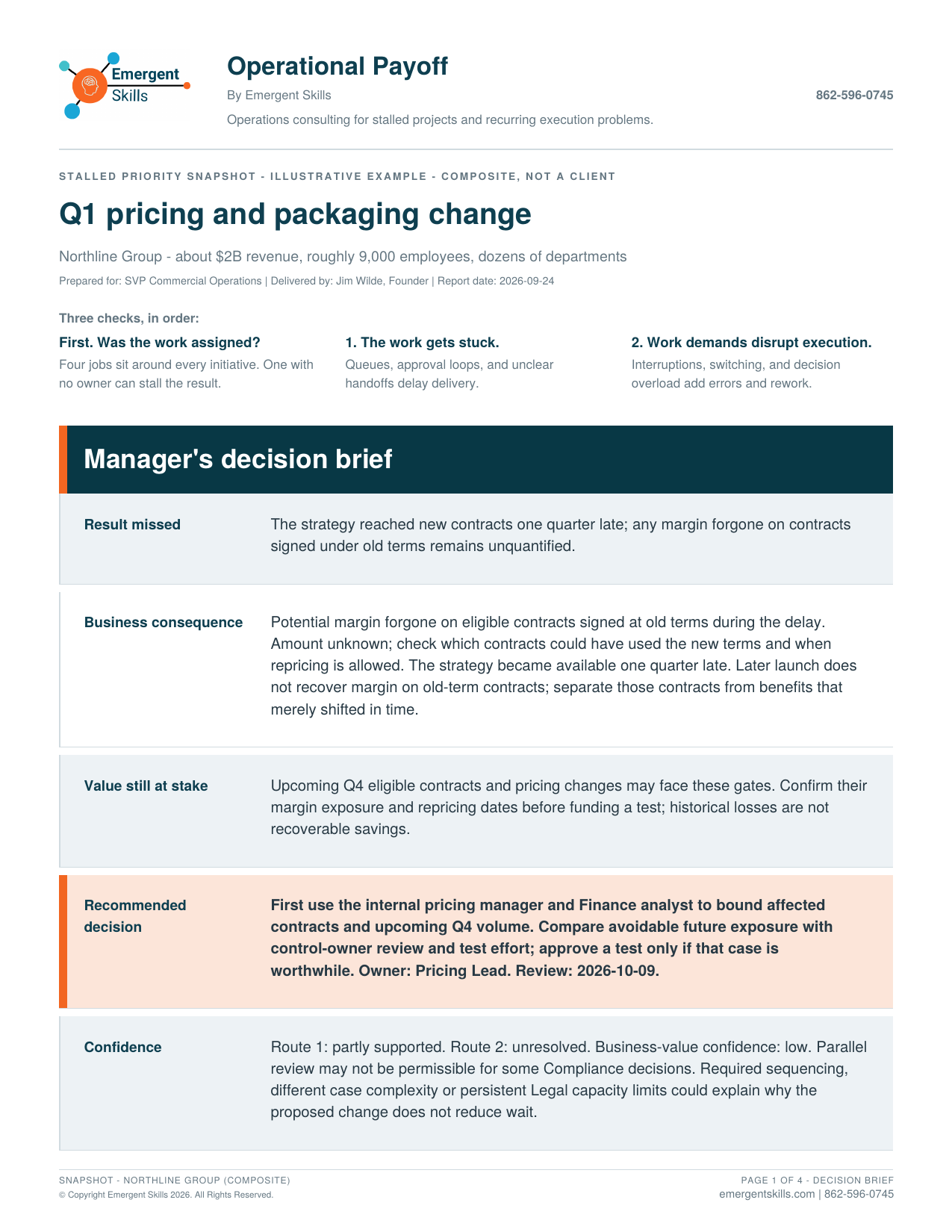
The invented case is a pricing and packaging strategy intended to improve realized margin on eligible new contracts by the end of Q1. It reached those contracts one quarter late. The report separates the potential commercial consequence, which is not yet quantified, from the additional labor used to move the work through review.
Start with the decision brief below: the result missed, business consequence, value still at stake, recommended decision, and confidence. The next pages explain the evidence, set out the action plan, and provide the work-path map and labor calculation. The work-path explanation is partly supported. The work-demand contribution remains unresolved.
See a mixed-results Snapshot: launched on time, adoption below target.
Sample findings
What the four-page report supports, and what must be confirmed before acting.
The business consequence: a strategy one quarter late
Eligible contracts may have been signed under old terms during the delay. The report does not assign a dollar loss: Finance must establish the affected contracts, incremental margin, timing, and repricing rights. Upcoming Q4 contracts determine what a better decision could still protect. Historical losses are not recoverable savings.
The finding: Route 1 partly supported; Route 2 unresolved
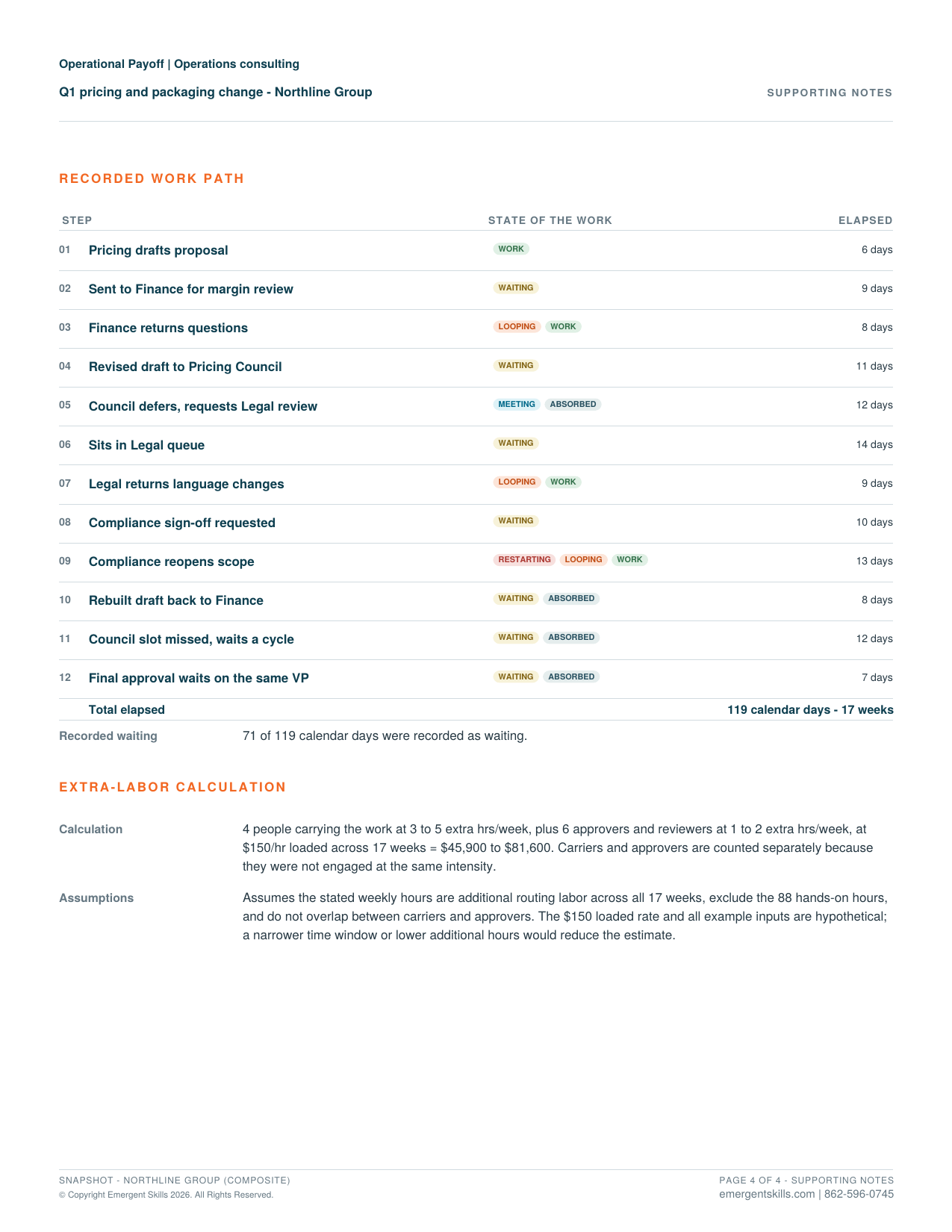
The fictional gate log records 12 steps over 119 calendar days, including 71 days of waiting. Sequential reviews and work returning through the same gates partly explain the shortfall. The record does not yet link demand pressure to errors or rework. Pricing complexity, required Compliance work, and unclear scope remain competing explanations.
The first action: establish the commercial case and review permissions
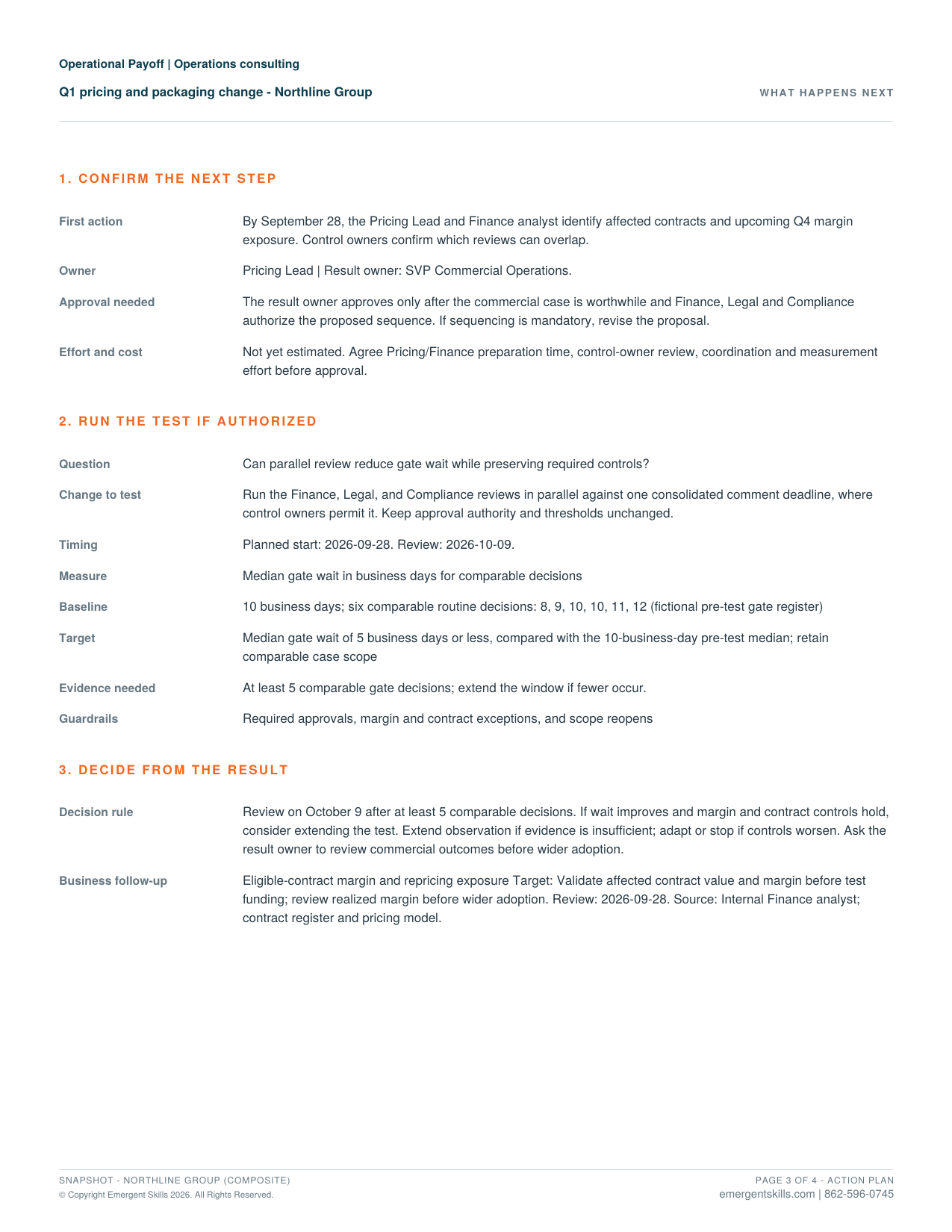
By September 28 in the sample plan, the internal Pricing Lead and Finance analyst identify affected contracts and upcoming Q4 margin exposure. Control owners confirm which reviews may overlap. The result owner should authorize a test only after the commercial case is worthwhile, the review sequence is permitted, and preparation and measurement effort are agreed. That effort has not yet been estimated.
The conditional test: parallel review with controls preserved
If authorized, Finance, Legal, and Compliance review in parallel against one comment deadline. The proposed target is a median gate wait of 5 business days or less, against a fictional baseline of 10. The Pricing Lead reviews the result on October 9 after at least five comparable decisions. Extend observation if evidence is insufficient; adapt or stop if controls worsen. Review commercial outcomes before wider adoption.
The supporting calculation: $45,900 to $81,600 in extra labor
Page four shows the twelve-step map and calculation: four people at three to five additional hours a week, plus six reviewers at one to two, over 17 weeks at a hypothetical $150 an hour. The estimate excludes the 88 hands-on hours and assumes no overlap between the two groups. It is one cost component, not total business impact or promised savings.
The full written read Open all four pages of the sample report
Read the report in this order: the manager’s decision brief; what we found; what happens next; and supporting notes. The action plan begins with the evidence and permissions needed before any test. The detailed map and extra-labor calculation appear on page four.
Report length follows the evidence. Business consequences remain visible when labor or financial data is missing. Unknown value stays unknown; longer work paths or supporting records can add pages.

Why bring in ES?
What a focused outside investigation adds
Your own team may resolve this with the records it already has. An outside review earns its place when explanations are disputed, nobody has time to investigate, or you can't tell whether both routes have been checked. Compare what each review would give you: scope, evidence, and the next decision.
The Snapshot investigates both routes and connects the findings to the business consequence and the next decision. Jim checks the available evidence, considers competing explanations, and identifies what still needs testing. You receive a written assessment of what happened, what value remains at stake, and what to do next:
Convene the room
Bring the right perspectives into one conversation and keep attention on the result and its path.
Check both routes
Check where work was obstructed and whether interruptions, switching, or competing decisions contributed to errors or rework. A stronger capacity-effect claim needs its own evidence. State what remains uncertain and what could change the finding.
Resolve the record
Reconcile conflicting accounts where possible and mark unresolved steps or dates as uncertain.
Agree the next step
Help the responsible people agree on a practical next step, the authority it needs, and the evidence that would justify continuing.
If your team can do this confidently itself, use the sample and the cost-of-stalled-work calculator to build and check an estimate.
Jim leads every session and prepares the written readout. View Jim's experience on LinkedIn.
What you get.
- Written input from people involved in the work (typically 6–8), then a 90-minute facilitated session with up to three participants, focused on one result and the gap between expected and actual.
- A work-path map showing work, handoffs, approvals, waiting, and rework, with uncertain steps marked.
- A two-route evidence assessment: whether the work needed for the result was ever assigned, what the work path explains, whether work demands contributed to errors or rework, which other explanations remain plausible, and what could change the conclusion. The report names the first action, owner, approval needed, effort to confirm, and review date.
- Business consequences and value still at stake: lost value, delayed benefits, customer or operating effects, and additional costs where supported. Estimates show the affected population, period, sources, assumptions, and gaps. Extra labor is one component. Overlapping amounts are not added together.
- The business case for the next step: what the evidence could change, the value that decision could still protect, and the fee and internal effort involved. A straightforward internal correction may be enough.
- A proposed local experiment when warranted: question, change, required approval, owner, baseline, metric, target, evidence threshold, guardrail, and decision rule. A capacity-effect test also tracks the associated capacity pattern. If a test is premature, the report names the next question to investigate.
- A brief written report within 24 hours and a 15-minute walkthrough with the result owner.
- A brief follow-up after an agreed test or evidence review to decide what comes next.
$1,500 USD, fixed scope. The full $1,500 is credited toward the Work Demand Diagnostic if booked within 30 days.
Is this the right fit?
What if the chokepoint turns out to be me?
Then we look at what that approval does, why it exists, and whether the work could move differently without losing the control it provides. Any test needs the relevant authority and must preserve required controls. The subject is how the work moves and what can change. The Snapshot does not rate individual performance.
You decide who sees the report within your organization. No HR records, system credentials, or data exports are required; we use the work description, dates, estimates, and purchasing information needed for the engagement, and participants share only what they're authorized to share.
Best fit: one important result in a project or recurring operation is falling short across functions or decision points. Delays, repeated errors, missed handoffs, or adoption below target have a meaningful business consequence. A manager or leader owns the result and can act on the next step, whether that means gathering evidence, resolving a management decision, or authorizing a local test.
Is the result worth the investigation? Identify what the shortfall means for revenue, customer delivery, or other valuable work. The $1,500 fee and your team’s time should be justified by the value still at stake. Money already spent is context. Any proposed change needs its own case; a straightforward internal correction may be enough.
How the session runs
90 minutes to test what is holding back one result.
Before the session, we typically ask 6–8 people involved in the work to write up what they handled, what they waited for, what came back, and what changed. Up to three people then join the 90-minute session to reconcile the route, check the evidence, and agree what happens next. Include someone who does the work directly and, where possible, someone who can authorize a change. For an adoption shortfall, include someone who knows how users get access and make the switch. We agree on the people needed to cover the relevant work before booking; a simpler route may need fewer contributors.
Light preparation. Bring the expected result, the actual result as of a stated date, and the main steps or waits you know, with a note on where the figures came from. Approximate dates are fine. For mixed results, say who owns the target and how progress is measured. Where authorized, have calendar invitations, ticket or approval history, and revision dates for the route at hand, and an approved blended loaded hourly rate if you have one. No presentation, system credentials, or data export is required; the preparation sheet explains what will help. Nothing leaves your environment except what you choose to bring.
Allow for internal time. With up to three people attending for 90 minutes, allow up to 4.5 person-hours for the session, plus time for the agreed written contributors, light preparation, the result-owner walkthrough, and any agreed test. Those internal costs are additional to the fee.
Initial Investigation Checks
We begin with the result and the conditions needed to deliver it.
1. Outcome validity
Is the result still worth pursuing?
2. Priority choice
Is it genuinely a chosen priority?
3. Delivery prerequisites
Are capability, information, authority, and funding available?
4. External dependency
Is something outside the organization controlling progress?
These checks may settle the next decision on their own. A problem here doesn't, by itself, rule out either route. We also check whether known, workable standards are being followed before blaming the route; if the evidence supports an ordinary management correction, we say so and recommend it.
Missing Work Check
Every initiative arrives with four jobs that rarely make the plan. A project manager can run everything on the plan perfectly and still fail if one of these has no owner. We ask for a name, not a department.
1. Producible here
Who is making it work with your data, volumes, and exceptions? "The vendor" means nobody.
2. Fits the interfaces
Who got the teams it touches to agree on definitions and handoffs? A meeting held once means nobody.
3. Old process removed
What old process has been switched off since this started? If nothing, the new tool is bolted onto the old way of working.
4. Disruption settled
Who lost something in this change, and what did they get for it? If nobody can name a loser, the losers are slowing the work quietly.
Missing work is a different failure from stuck work. The readout names the unowned job, the person best placed to own it, and, where the record supports it, what leaving it unowned is costing per week.
The Four Tests
Does the evidence support a capacity effect? These tests examine whether demand conditions are affecting how reliably capable people perform.
1. Baseline shift
Are people performing below a level they sustained over time?
A peak held through unsustainable effort is not automatically the baseline.
2. Load signature
Do errors, reversals, delays, or rework cluster under identifiable demand conditions?
3. Shared conditions
Do multiple capable people exposed to the same operating conditions show the pattern?
4. Reversibility
When those conditions change, do the agreed operating metric and associated capacity pattern improve without replacing the people?
The first three tests can support a capacity-effect hypothesis. Reversibility tests it. The Snapshot reviews the available evidence and names any gaps. Reversibility takes evidence from changed conditions. A 90-minute discussion can't establish it, and a 14-day window needs enough relevant observations to support a conclusion. Better flow alone doesn't establish a capacity effect either, since a change can improve the work path directly and other changes may explain the result.
Where this sits
Use the Snapshot for one result that is falling short.
The Snapshot finds a local next step. Where the question spans a team or function, the Diagnostic examines the wider pattern. A Capacity Audit establishes the baseline and evidence for a proposed change. The Pilot tests an authorized change against agreed operating measures and, where relevant, the associated capacity pattern. The License supports wider use where the evidence justifies it. All use the same execution gap analysis at different scopes. The next step depends on the evidence.
The investigation checks begin with the business result and its consequence. The Five Capacity Taxes organize supporting cost questions. Lost value, delayed benefits, extra labor, and future exposure remain distinct, with sources, assumptions, and uncertainty visible.
Want to explore the fit first? The Execution Drag Checklist walks through the opening questions used to frame a result that has not moved. Download the checklist.
Request and schedule
Start with the priority. We will confirm the fit and arrangements.
1. Send the request
Describe one result: what was expected, what happened, and by what date. For a rollout with low uptake, include the target and observed adoption. Suggest the participating roles and give your preferred date and session format. A few sentences are enough.
2. Tell us your purchasing status
Have a PO ready? Include its number and any purchasing instructions. Need a quote to obtain a PO, or expect the PO to follow? Select that option. We will coordinate any PO documentation, supplier registration, invoicing requirements, and payment terms with you.
3. Confirm the session
We reply within one business day, then confirm fit, scope, contributors, participants, purchasing, and a date. We decline when the answer is already clear and further investigation would add little, the group can't cover the relevant work, or no owner can act on the next step. That step may be gathering evidence, resolving a management decision, or authorizing a local test. Once agreed, we send the preparation sheet and session details.
Submitting the form does not charge you, accept PO terms, reserve a date, or confirm a booking. Your date is a preference until we agree the session with you.
Start with one result
Bring one important result that is falling short.
$1,500 USD, fixed scope. Written report within 24 hours of the session.
