Stalled priorities wait for permissions
Accountability without authority: why work still waits
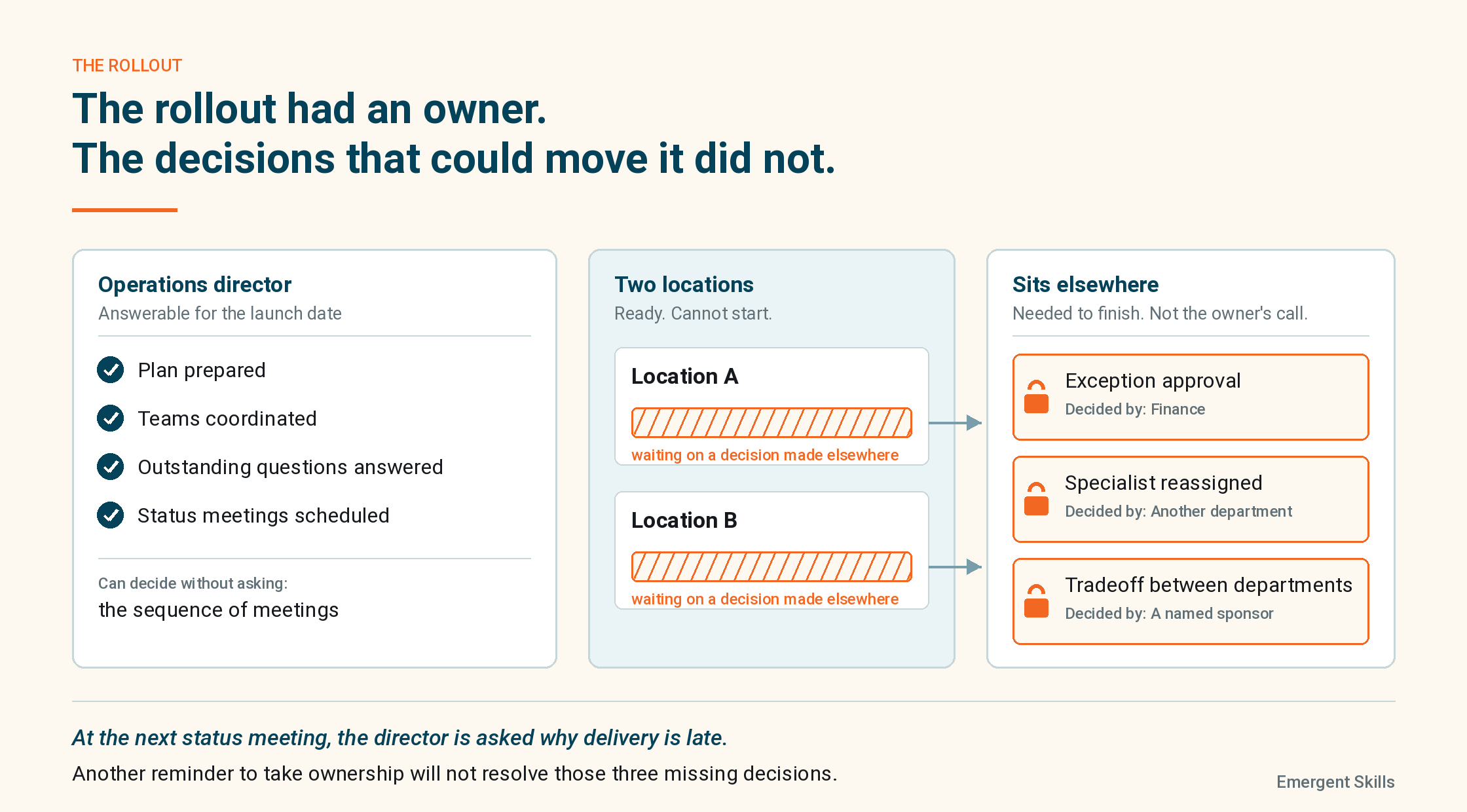
The rollout had an owner. The decisions that could move it did not.
Executive SummaryOwnership without decision rights, and how to test one rule.+
A named owner is not enough when the decisions that move the work sit in other departments. Accountability without authority leaves a manager answerable for a deadline while the exception approval, the shared specialist, and the cross-department tradeoff stay out of reach.
Start with one delayed result. Trace one decision holding it up: who could make it, when it was ready, and what caused the wait. A request nobody answered may have been incomplete, or may have raised a real problem.
More authority fixes only part of it. Delegation does not create additional hours, and a shared specialist still has to be sequenced by someone.
Test one decision rule for 14 days with a boundary, a measure, and a stopping condition agreed in advance. At the review, check whether the decision happened sooner or the queue simply moved downstream.
The Stalled Priority Snapshot is a $1,500, 90-minute working session. It reconstructs one result from the available records and returns a written readout within 24 hours with a recommended next step.
Consider a rollout with a named owner and an agreed launch date. The operations director has prepared the plan, coordinated the teams, and answered the outstanding questions. Two locations still cannot start. Finance must approve an exception, and another department has reassigned the specialist needed for the rollout.
At the next status meeting, the director is asked why delivery is late.
Before the director can answer that, there is another question: what could they decide without asking anyone?
What is accountability without authority?
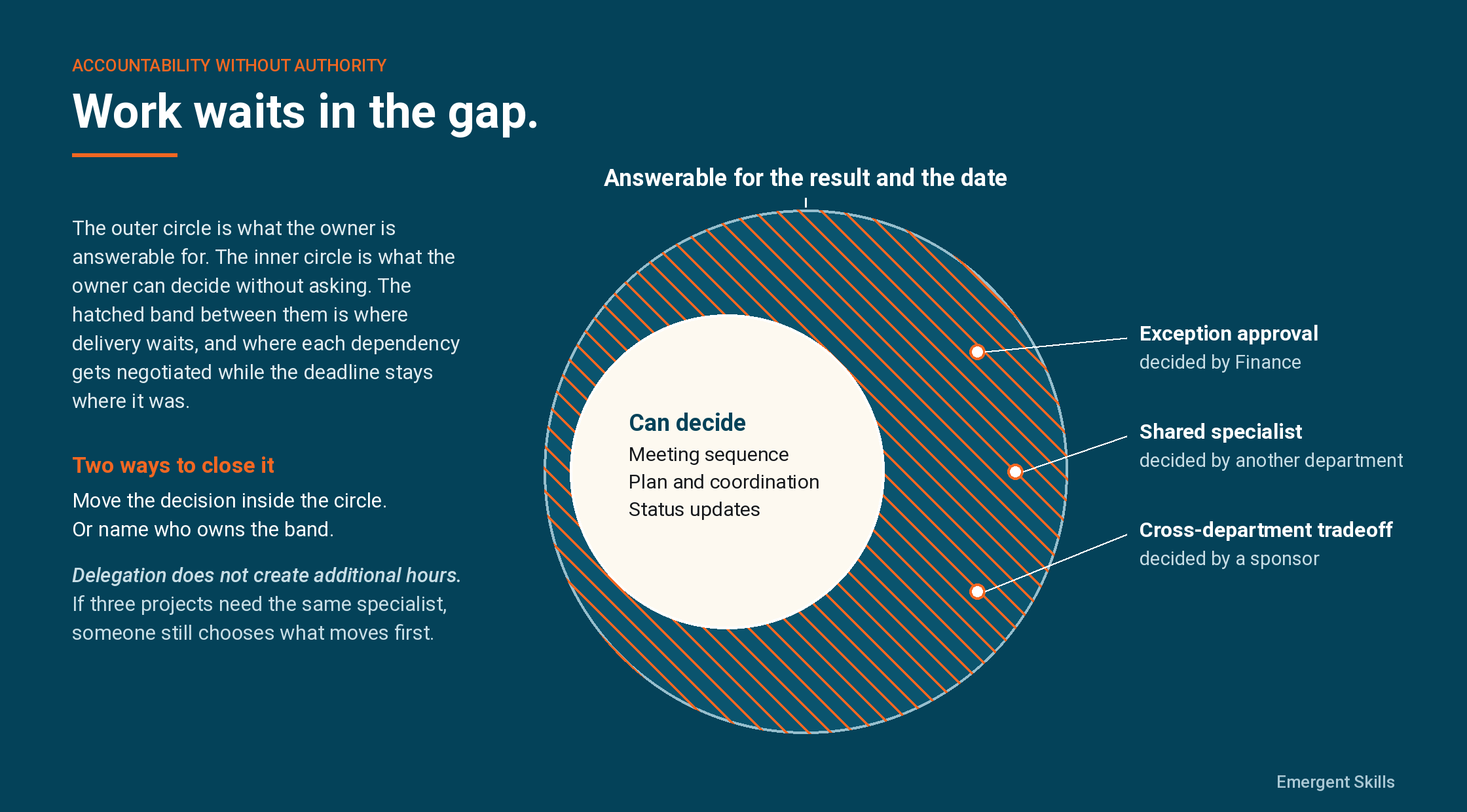
Accountability without authority means being answerable for an outcome while lacking the decision rights needed to deliver it. It can leave a manager responsible for the deadline but unable to approve an exception, secure a shared resource, or settle a conflict between departments. It is often described as responsibility without authority.
Another reminder to take ownership will not resolve those missing decisions.
Decision rights
A named owner can still be waiting for permission
In The Octopus Organization: A Guide to Thriving in a World of Continuous Transformation, Phil Le-Brun and Jana Werner describe an organization that combines shared direction with distributed decision-making. The practical question for an operating leader is how that combination changes an ordinary working day. See the authors' overview of The Octopus Organization.
If the rollout owner can schedule meetings but cannot resolve the issue discussed in them, the assignment is incomplete. The person has coordination duties. The authority needed to finish the work sits elsewhere.
That arrangement may be intentional. A project manager should not automatically control another department's budget or bypass a necessary review. But someone must own the decisions that cross those boundaries, and the delivery commitment needs to reflect how those decisions will be made.
Otherwise, the owner is left negotiating each dependency while the original deadline stays in place.
Trace the wait
How to check decision rights behind project delays
Start with one result that should have moved. Choose a delayed milestone, an unfinished part of a rollout, or a change people were expected to adopt.
Use workflow analysis to reconstruct what happened from the records. Then examine a specific decision holding it up:
| Question | Evidence to look for |
|---|---|
| What could the delivery owner decide without further permission? | The agreed remit, delegation rules, and decisions previously accepted. |
| Who could approve, reject, or reopen this decision? | Approval history, review comments, and escalation messages. |
| When was the request ready for a decision? | The date required information was supplied, including any later corrections. |
| What caused the wait? | Missing information, unavailable authority, competing work, a required review, or disagreement about the result. |
| Who could settle a conflict across departments? | A named sponsor or leader with authority over the tradeoff. |
A request that sat unanswered may have been incomplete, or it may have exposed a problem nobody had settled. And "waiting on Finance" says nothing about whether Finance is reviewing it, waiting on information, or has no slot for it.
Our article on slow decision-making and project delays examines how to separate those conditions.
Competing priorities
More authority will not fix every constraint
Suppose the operations director receives permission to set the rollout sequence. That helps only if the specialist is available for the agreed work.
If three projects depend on that same person, someone still has to choose what moves first. Delegation does not create additional hours. The issue now involves competing priorities, and the person authorized to settle that competition needs to make the tradeoff explicit.
For shared specialists, resource leveling addresses the scheduling conflict. This is where Emergent Skills connects authority with work demand and execution delays. Can the owner make the necessary call? Can the people involved carry it out alongside their existing commitments? Does each exception create another round of chasing, explanation, and rescheduling?
That chasing is real work, and you can count it. Whether it also wears down anyone's judgment is a separate claim. A late approval by itself does not prove it.
Small experiment
How to test a clearer decision rule
The authors' book overview emphasizes small experiments and decentralized decisions with overall coordination. For the rollout described here, that suggests testing a limited change in decision authority before expanding it.
Applied to the illustrative rollout, a sponsor might authorize the operations director to change the sequence of already-approved locations, provided staffing commitments and the approved scope remain intact. Changes affecting those conditions still go to the sponsor. Required reviews remain part of the route.
The test would answer a narrow question: does removing a repeated sequencing approval help ready locations start sooner?
Before trying it, agree on:
- The boundary: which decisions the owner can make and which require escalation.
- The measure: time from a complete sequencing request to a confirmed decision, compared with comparable recent requests.
- The stopping condition: what would require the sponsor to pause or revise the arrangement.
- The workload tradeoff: which existing follow-ups or meetings the new rule replaces.
A 14-day test tells you more when the decision comes up several times. If it comes up once, or every case is different, you will not learn much.
At the review, check for consequences elsewhere. Did the decision happen sooner? Did another team inherit more corrections or scheduling work? Did the agreed result move closer, or did the queue simply move downstream?
Keep elapsed waiting separate from additional labor. A week awaiting approval is not a week of full-time labor lost by everyone involved.
Execution drag
Bring the decision that keeps coming back
The next time a leader asks someone to take ownership, make the assignment usable: specify the result, the decisions they can make, and who will resolve the dependencies outside their control.
If an important result is still falling short and the explanations do not agree, the Stalled Priority Snapshot provides a focused investigation. In a $1,500, 90-minute working session, Emergent Skills examines one result and reconstructs what happened from the available records.
You receive a written readout within 24 hours and a recommended next step. Where the evidence supports it, that includes a proposed 14-day test. The recommendation may instead be a resource decision, a change in priority, or a specific piece of evidence to gather before changing the work path.
Have a result in mind?
Tell us what should have happened and what did. You can upload a PO or request a quote. Purchasing arrangements and the session date are confirmed separately.