Operational Payoff · Operations consulting for stalled projects and recurring execution problems.
The productivity paradox: why finished projects still fall short
The system is live. The project is closed. The expected business result hasn't arrived. Before buying another tool or blaming adoption, ask who was supposed to change the work around it.
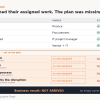
The plan itself may be missing work
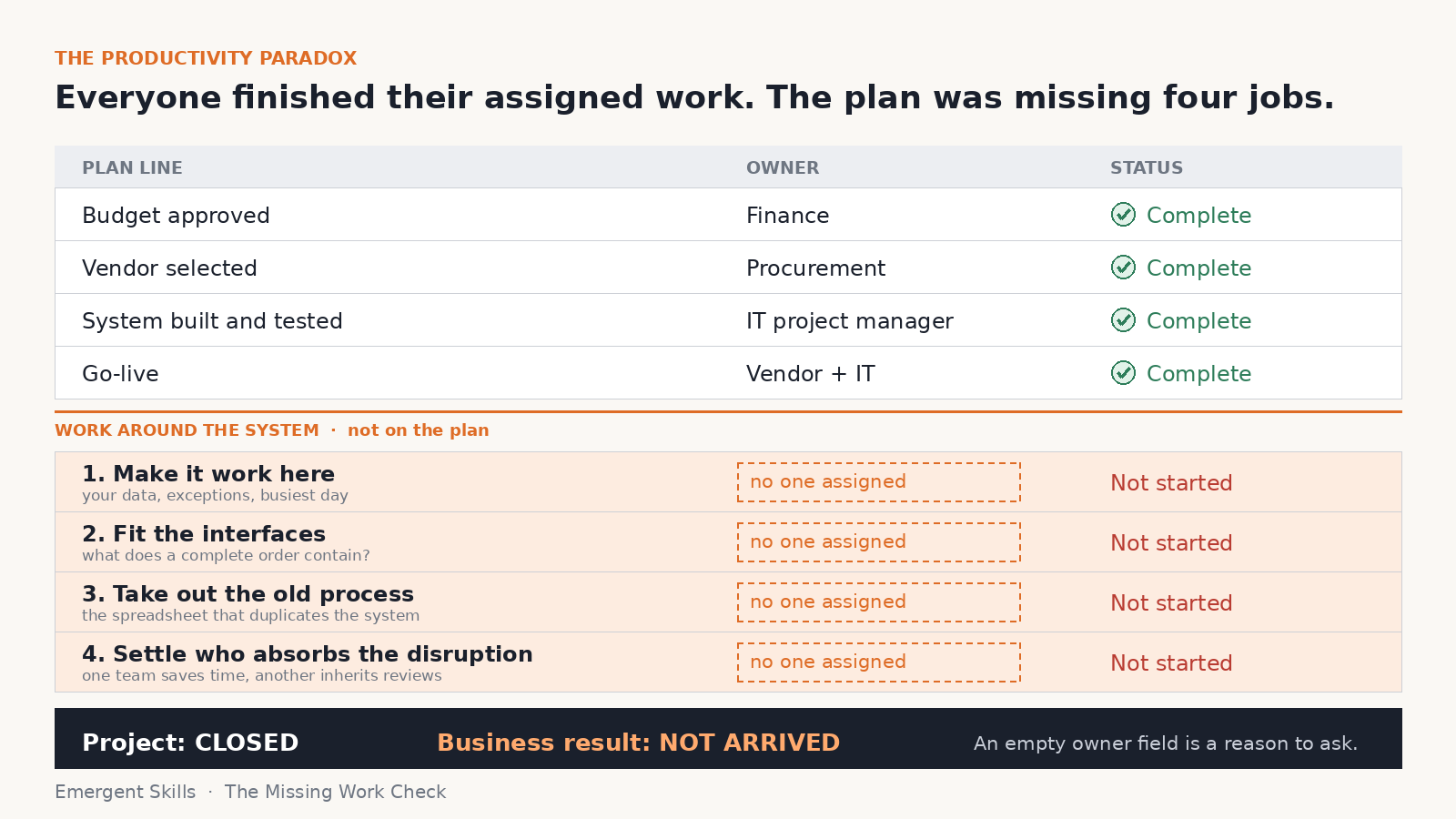
A project can have a budget, a manager, a vendor and a go-live date. Everyone can complete their assigned work, yet the result still falls short. The plan itself may be missing work.
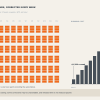
In Fast Company, Greg Satell describes innovation as discovery, engineering and transformation. Putting a breakthrough to use takes time, learning and changes around it. That helps explain the productivity paradox: advances in technology can arrive well before measurable productivity gains.
For an operating leader, that raises a practical question. Who was assigned to remove the old approval, settle the handoff between departments or decide which work could stop?
Those jobs can be absent from an otherwise detailed plan. Emergent Skills calls the investigation into that gap the Missing Work Check.
Four jobs that need an owner
ES uses four jobs to examine what must happen around a delivered system. These are our working questions, drawn from the wider argument about turning technology into useful results.
1. Make it work here
A good demonstration leaves plenty unanswered. Can the tool handle your data, awkward exceptions and busiest day? Someone needs time to work through those details. Satell's penicillin example makes the point: Fleming's discovery still needed scientific and manufacturing work before treatment became available at scale.
2. Fit the interfaces
Sales marks an order complete. Operations sends it back because delivery information is missing. Both teams followed their own rules. Who has the authority to agree what a complete order must contain?
3. Take out the old process
Economist Paul David describes in The Dynamo and the Computer how individual electric motors freed factories from arrangements built around shafts and belts. Reorganizing production helped realize the gains.
ES calls this taking out the shaft. The modern version might be a spreadsheet that duplicates the new system. Somebody must decide which old steps can end and which still serve a purpose.
4. Settle who absorbs the disruption
One department saves time while another inherits extra reviews. That burden needs a decision: who will do the work, what can they stop doing, and who can authorize the tradeoff?
An empty owner field is a reason to ask. Confirm what's missing against the assignments and the accounts of people doing the work. Keep the source of each finding; leave disagreements and gaps marked unresolved.
Missing work first, then both routes
The Initial Investigation Checks come first: is the result worth pursuing and still a priority? Are the necessary skills, information, authority and funding available? Is progress controlled by an outside dependency?
If the investigation is justified, we examine three things:
First: Missing Work Check
Was the necessary work designed and assigned? An owner needs enough authority and time to carry it out.
Route 1: The work gets stuck
Follow the actual sequence of events through queues, approvals, handoffs and work sent back. Where did progress stop, and why?
Route 2: Work demands disrupt execution
Look at the demands around errors, reversed decisions, repeated work and missed handoffs. Did interruptions or competing decisions contribute? Compare what happened under different working conditions, then test a specific change. Being busy alone doesn't establish the cause.
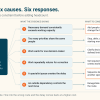
A weak business case, insufficient staffing, unsuitable tools or a workable standard that isn't followed can also explain the shortfall. Those answers belong in the investigation too.
Eight minutes saved. The customer still waits.
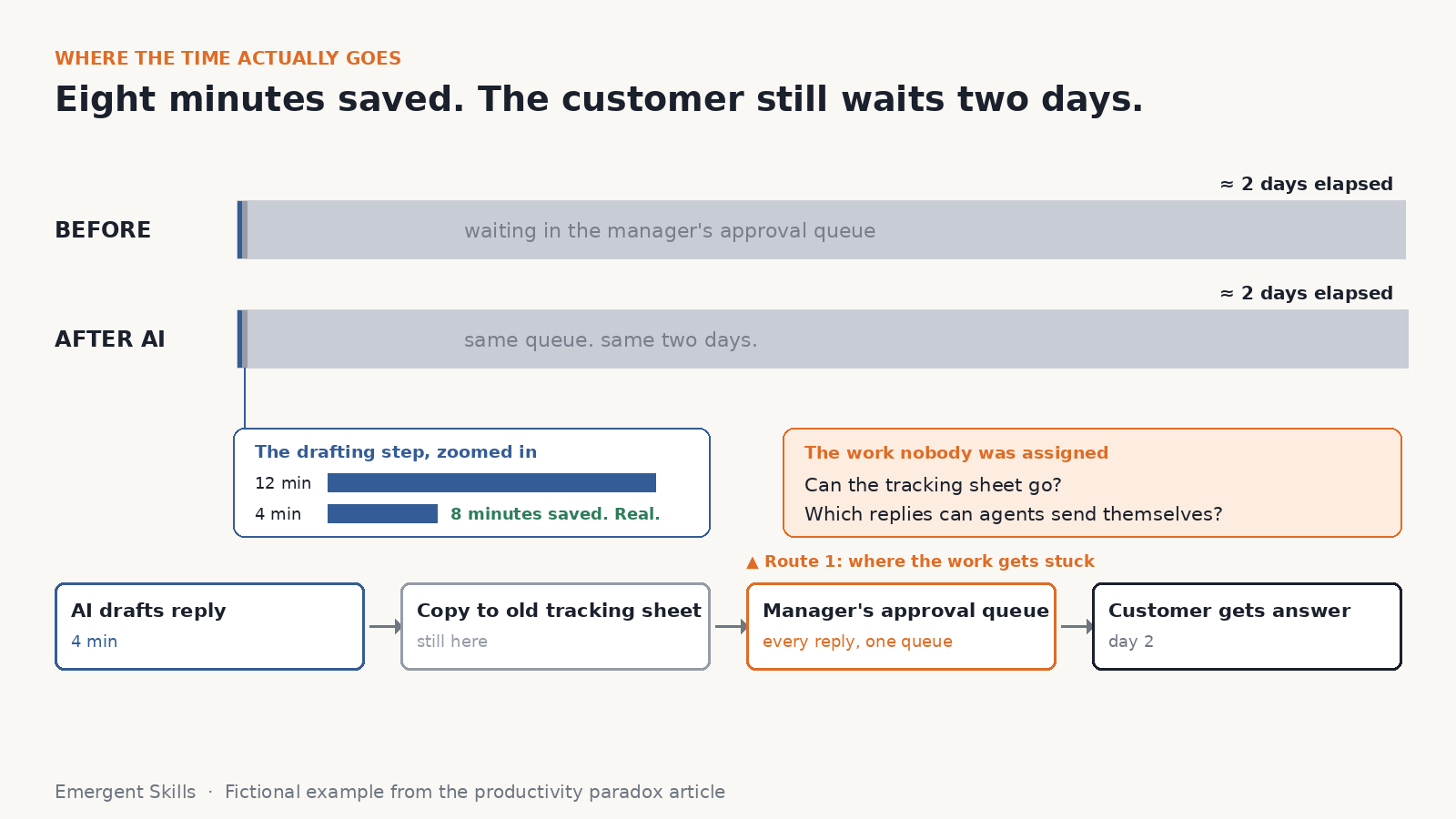
Imagine a customer-service team introducing AI to draft replies. This is a fictional example.
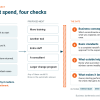
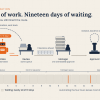
A draft that took 12 minutes now takes four. Staff use the tool, the rollout closes, and customers still wait two days for an answer.
Following a request reveals why. The agent copies the reply into the old tracking sheet, then sends it for approval. Every reply joins the same manager's queue. Nobody was assigned to decide whether the sheet could go or which replies agents could send themselves.
The missing work is the decision about how the service should operate after launch. The approval queue is Route 1.
Suppose agents also report losing their place while switching between drafts, chat requests and urgent calls. Some replies need correction. That gives Route 2 something specific to investigate: when the errors occurred, what interrupted the work, and whether accuracy improves when the interruptions change.
The eight-minute drafting gain is real within this example. Its value depends on the total effort per request, the quality of the answer and how quickly it reaches the customer.
Give the next change a fair test
In that example, the service manager might authorize agents to send one defined category of routine replies. Try it for two weeks, with an agreed quality standard and a clear rule for exceptions.
Compare waiting time, total handling time and corrections with the starting position. Note changes in request volume, difficulty or staffing. Decide beforehand what would justify keeping, adjusting or stopping the change, then see whether any improvement holds once the extra attention eases.
The financial case needs the same care. Count extra labor separately from elapsed delay, avoid counting the same consequence twice, and treat promised benefits as estimates until they appear.
Sometimes a straightforward internal correction is enough. If the remaining benefit no longer justifies the effort, stopping deserves consideration.
What this adds to Emergent Skills
The Missing Work Check extends what ES examines before recommending a change. It brings unassigned work into view alongside delays and the demands that disrupt execution.
The longer-term product goal is to help a manager follow an investigation through to its outcome: what was found, what changed, and whether the business result improved. Over time, those records could help identify which fixes are worth trying under similar conditions, including lessons from attempts that failed.
That capability is a development goal. For now, the question I want answered is concrete: what work still needs to happen for this investment to pay off, and who can get it done?
Sources and related reading
- Greg Satell, Despite the hype, innovation isn't getting any faster. Here's why, Fast Company, September 21, 2026. The starting argument and penicillin example.
- Paul A. David, The Dynamo and the Computer: An Historical Perspective on the Modern Productivity Paradox, American Economic Review, May 1990, pages 355–361. Factory electrification and changes in production.
- Why projects fail and what to check first
The four jobs and their use in the Missing Work Check are ES's interpretation.
Bring one result that hasn't arrived.
The Stalled Priority Snapshot examines one result through the Missing Work Check and both routes. A 90-minute working session, a written readout within 24 hours and a next step supported by the evidence. $1,500. No follow-on commitment.