Operational Payoff · Operations consulting + Proprietary AI Tools
Before you fund the fix, find the right problem.
The Priority Snapshot finds out why one late or underperforming project isn't delivering. Online, for US$495. This process saves you time and money.
A project keeps slipping, keeps coming back for review, or launched and nobody's using it. A recurring operation, like customer onboarding, keeps needing corrections. Meanwhile revenue, customer commitments or other valuable work are at risk, and you're being asked what to fund next.
Everyone already has an explanation: the process, the people, training, priorities, workload or the system. Any of them could be right. Fund a hire, a course or new software on the first plausible one, and you can spend more without getting the project back on track.
Emergent Skills builds proprietary AI tools to find the cause before you fund the fix. We run the investigation for you. The Snapshot asks the right questions one at a time, gets separate accounts from you and your colleagues, and checks them against your records. We handle the follow-ups, the chasing and the write-up. You answer what only you know, then decide.
US$495
Per investigation, paid by card
Online
Answer when it suits you. No session to book.
Up to 12 questions
Over a few days, to you and your colleagues
Up to 8 colleagues
Each answers their own question by email link
Written readout
The decision, an action plan and the full record
Review-date check-in
We ask what happened
No booking, session or follow-on commitment. One Snapshot is one investigation. Download the one-page handout (PDF) · Questions? Help and FAQ
Method designed by Jim Wilde, founder of Emergent Skills. Nine years as lead consultant at the MTA on mta.info and the NYC subway countdown clocks. Decades in enterprise systems before that.
Your options
Your own team may be able to work out what's wrong.
Your PMO, operations team, project manager or analysts know the organization and may already hold the records. If they have the time to gather the evidence, challenge the competing explanations and recommend a next step, use them. You don't need a Snapshot.
The Snapshot earns its place when the explanation is unclear or disputed, nobody has time to rebuild what happened, the problem crosses teams, or the sponsor needs a finding built on evidence rather than opinion.
A consulting firm suits broad, company-wide work. For one stalled project, you'd still scope an engagement, agree fees and schedule interviews before anyone starts looking.
ChatGPT or another AI chat is fast and good at organizing notes. But someone still has to work out the questions, get separate accounts from colleagues, follow up and check the answers against the records. The Snapshot does that part.
If your team does it in-house, the sample readouts show what to aim for, and the cost-of-stalled-work calculator helps you build and check an estimate.
What good looks like
Five things to expect from any investigation, internal or ours.
1. The people who did the work
Accounts from the people closest to each part of the work, not one person's view.
2. Evidence that's checked
Figures traced to the record they came from and recalculated, not repeated from memory.
3. Explanations kept open
Competing explanations tested against the evidence, not just the first plausible one, with the unresolved ones named.
4. A limited demand on your team
A clear limit on the effort, and the chasing done for you.
5. A decision you can act on
Next steps with owners, the approval each needs, a measure, a review date and a point at which to stop.
The Priority Snapshot
An online investigation of one important result, for US$495.
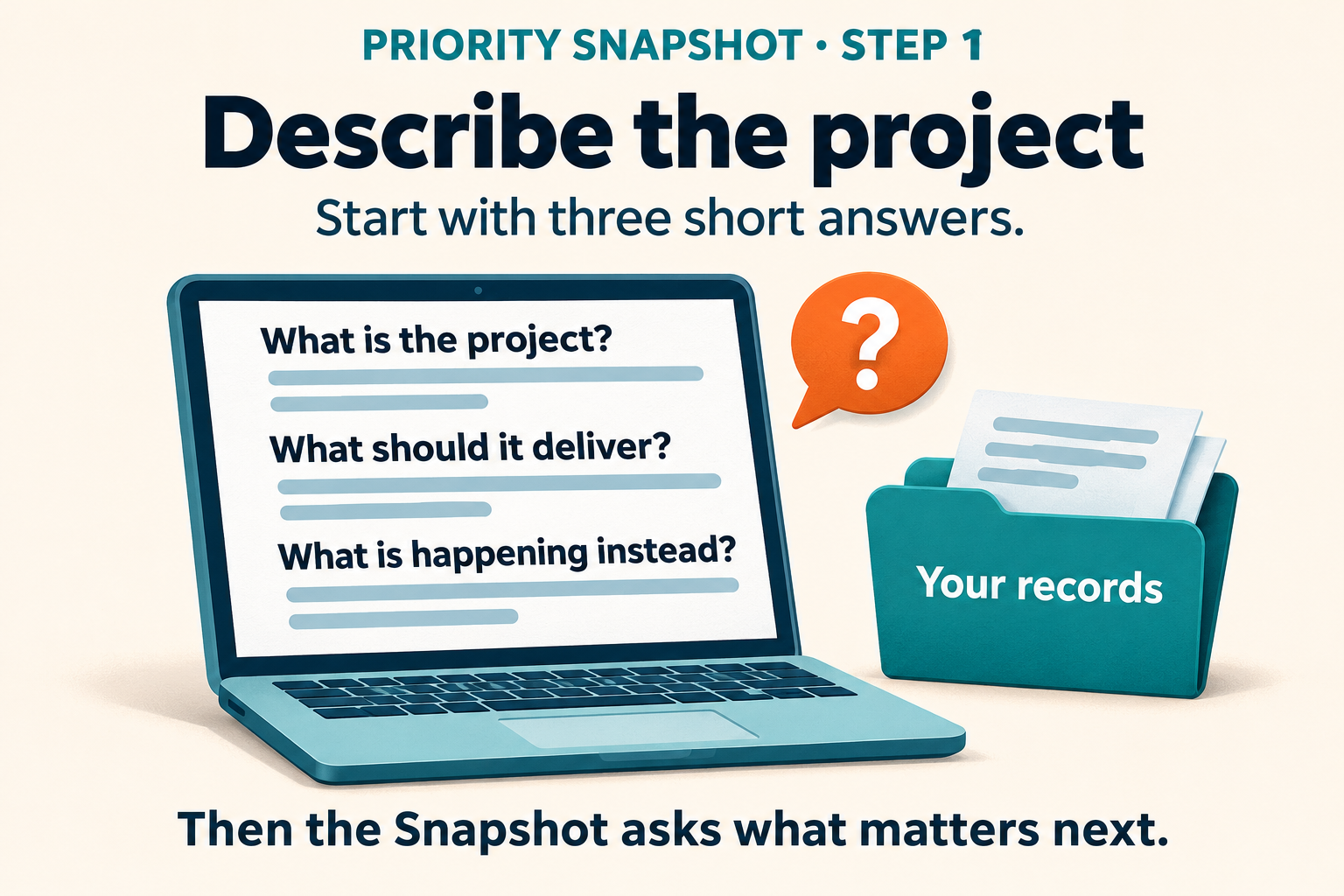
You describe the result that's falling short. Then the Snapshot works in rounds: it asks for one piece of evidence at a time, from you or a colleague, checks each answer against the record, updates which explanations still hold up, and chooses the next question. It's a proprietary AI investigation that follows a method designed by Jim Wilde, and it delivers all five of the things above.
1. It asks the people who know
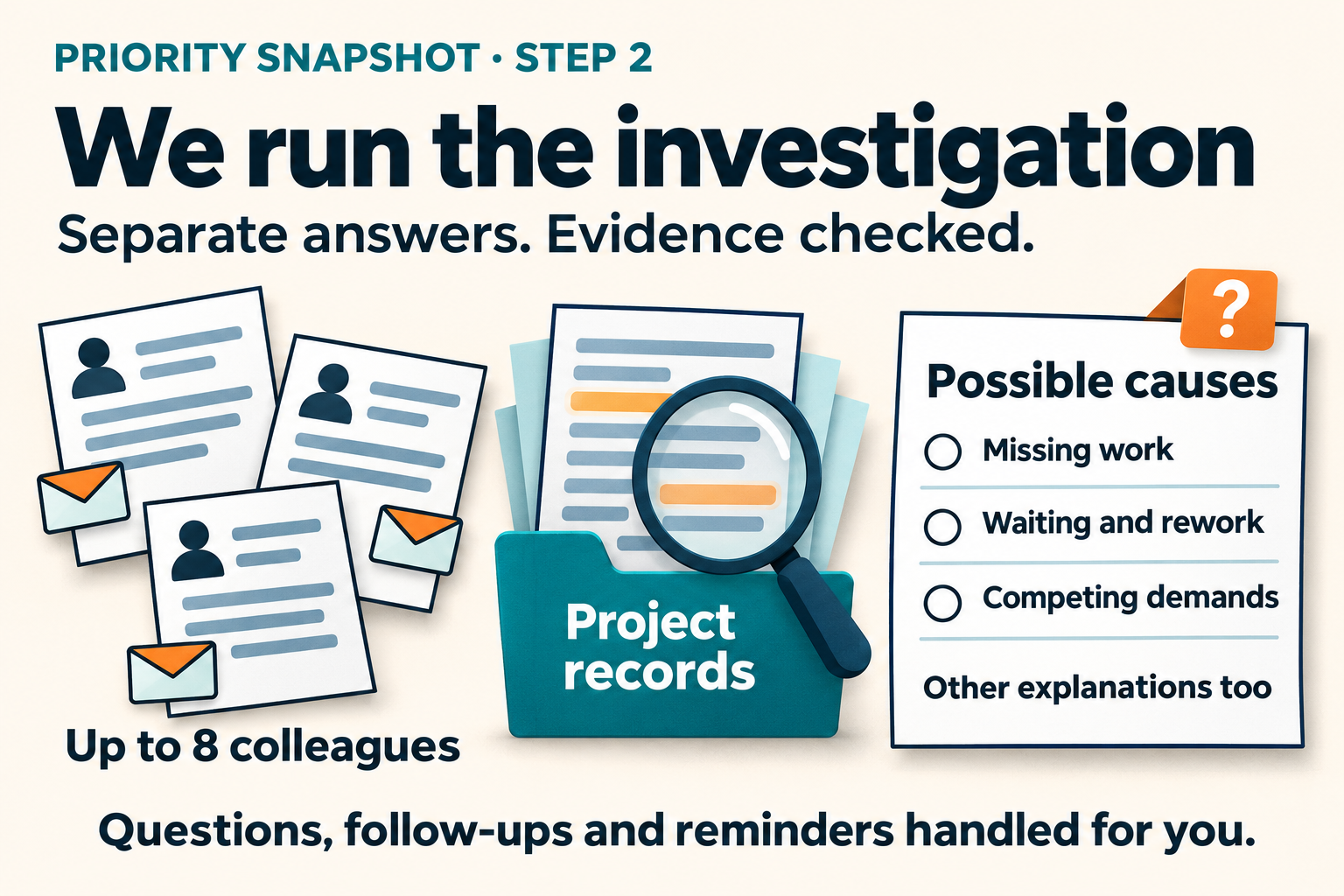
Up to 8 colleagues answer their own question by email link, with no account and no meeting. The record covers the work as it happened, not one view of it.
2. It checks the evidence
When someone gives a figure from memory, it asks for the record behind it. Figures are recalculated in code, and anything not established is marked that way.
3. It keeps explanations open
First it checks that the result is still worth pursuing, really a priority, resourced, and not held up by an outside party. Then it looks at the work itself: necessary work nobody owns, where the work stalls (Route 1), and whether work demands add errors and rework (Route 2), alongside any other credible explanation.
4. We manage the investigation
We write each colleague's question, send it, remind them after 2 days, tell you if there's still no answer, and keep track of who said what. You don't coordinate any of it. Up to 12 questions, with no more than 3 out at once, so you answer in short sessions over a few days.
5. It ends in a decision
A decision brief with next steps, each with an owner, the approval it needs, a measure and its starting point, a review date, and the result that would show it's wrong. When a cause is plausible but unproven, a limited test. Always a point at which to stop. Around the review date, we ask what happened.
If the evidence points somewhere else, such as the business case, capability, authority, incentives, an outside dependency or ordinary execution discipline, the readout says so.
What running a Snapshot is like
We run the investigation, so you don't spend weeks chasing answers.
This process saves you time and money. You don't have to work out which questions to ask, chase colleagues or reconcile conflicting stories. We do that, and keep what needs you in one place. And because it checks the basics first, you don't spend money on a fix until the evidence supports it.
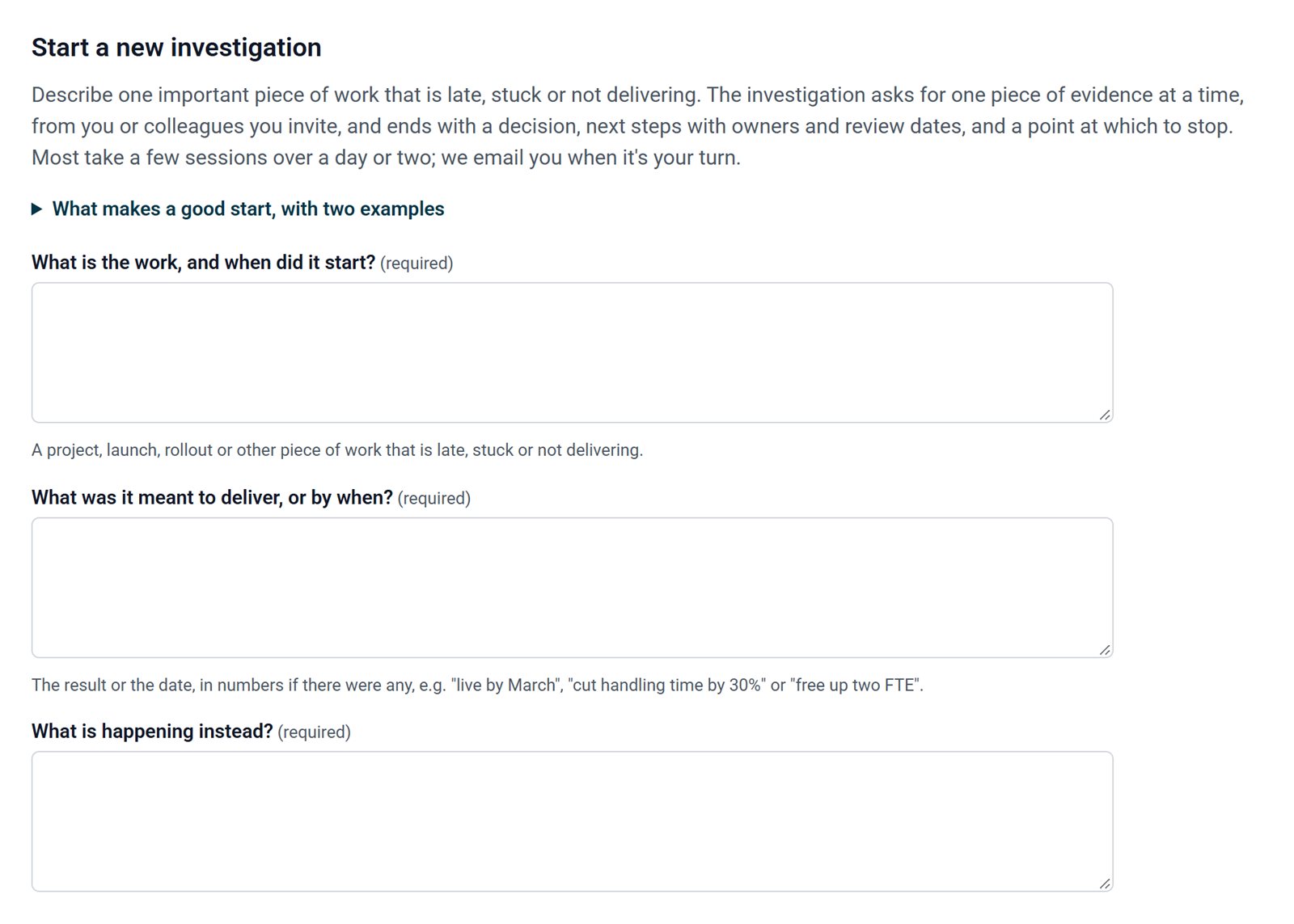
Describe it in a few minutes
Three short questions: what the work is, what it was meant to deliver, and what's happening instead. Paste in anything else you already have.
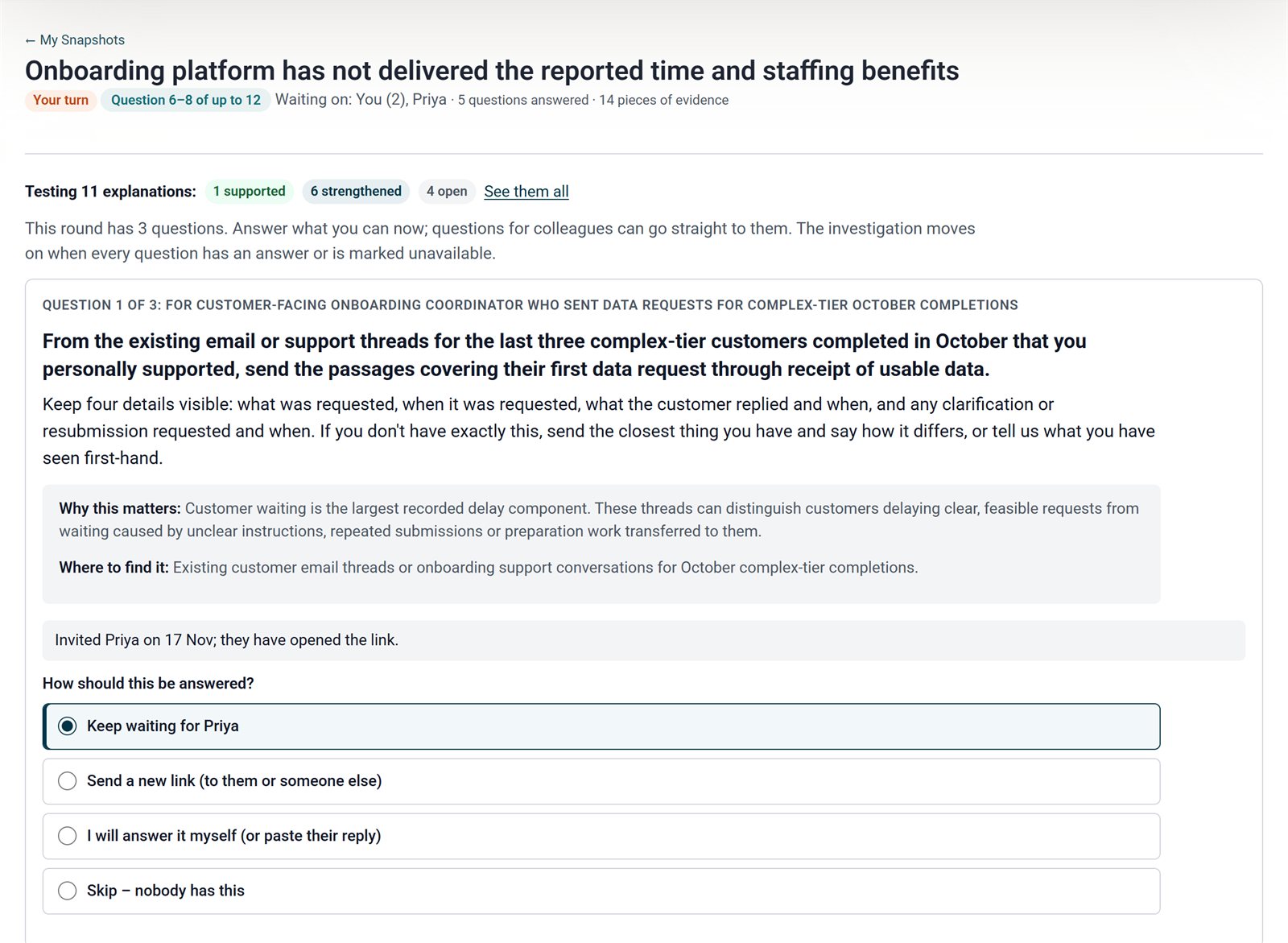
It asks the right questions
Each question is chosen from what the evidence shows so far, and says why it matters and where to find the answer. You can see how far along you are and which explanations are gaining or losing support. Answer it yourself, attach an export, say you don't have it, or send it to a colleague.
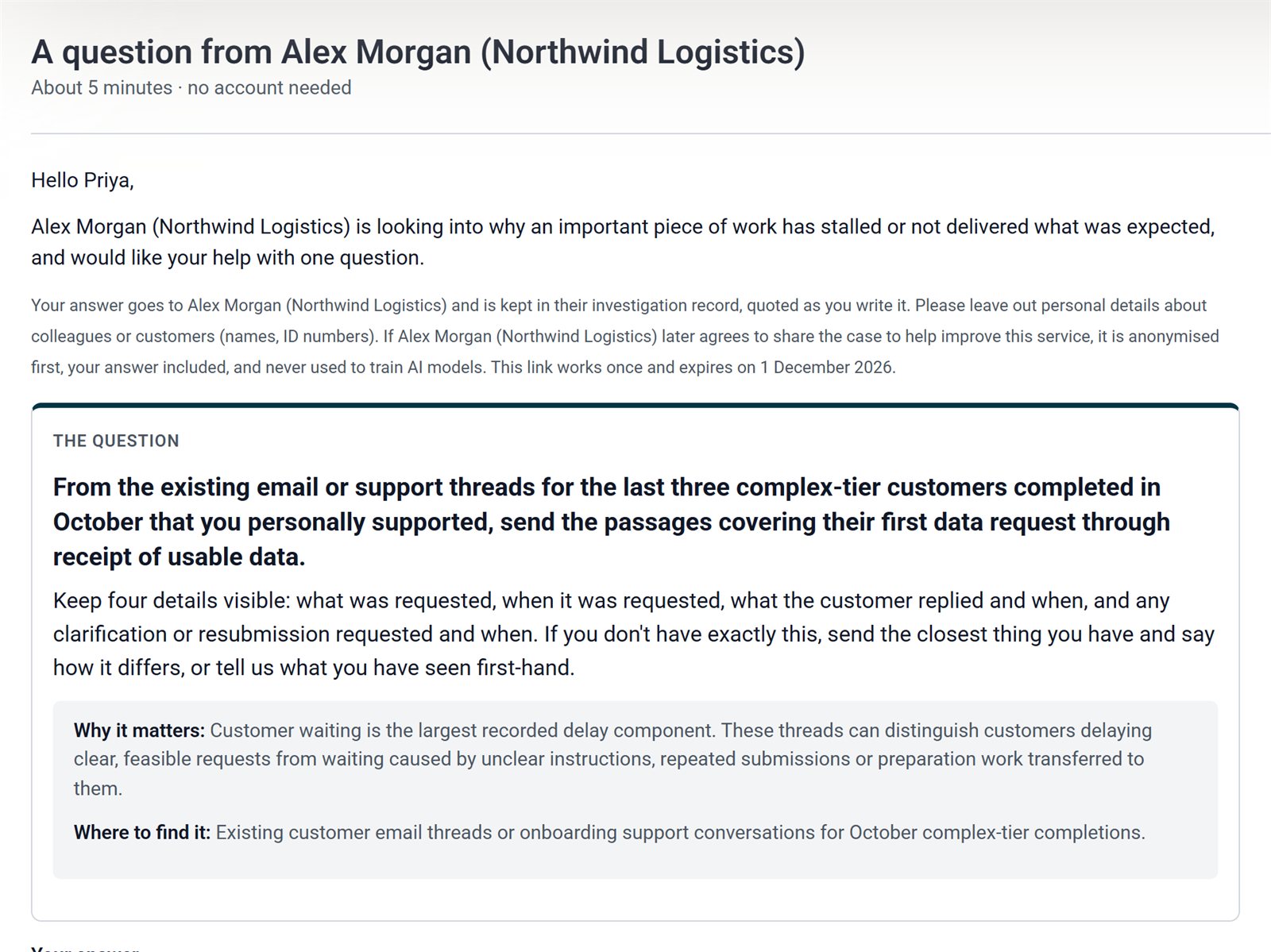
It gathers the answers for you
A colleague gets their one question by email link, with no account to create. We write their question, remind them after 2 days, and tell you if there's still no answer.
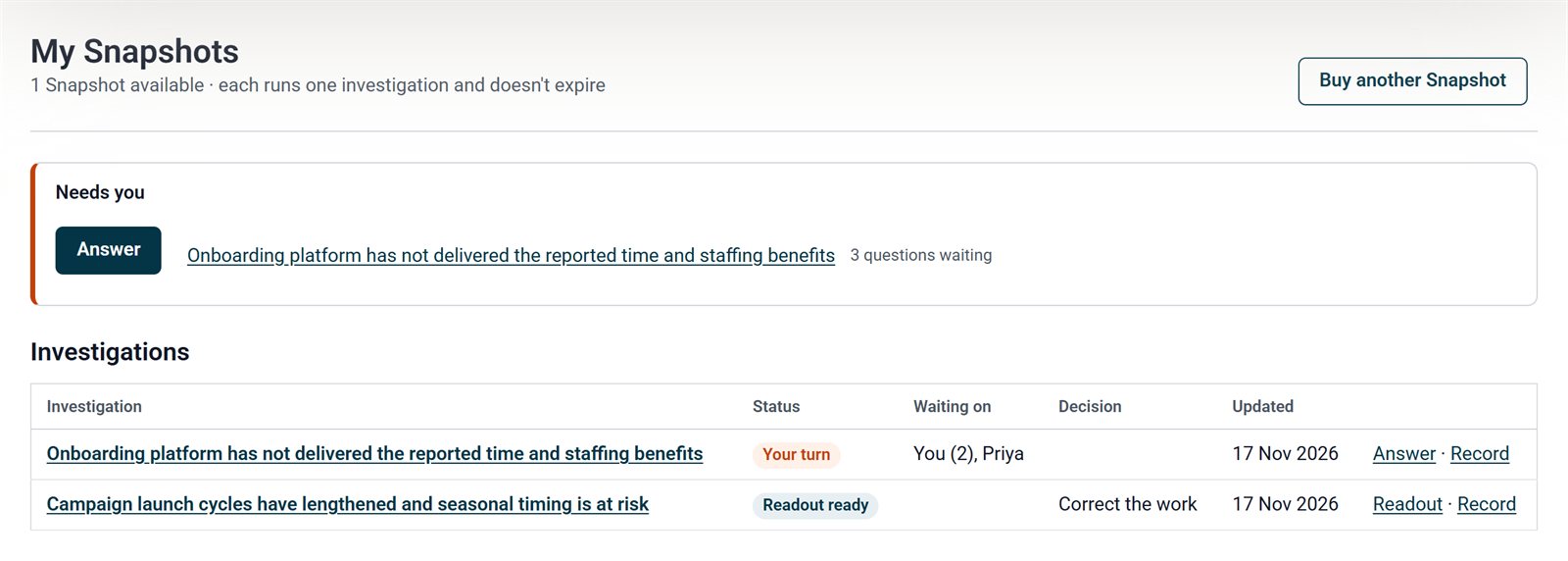
Quick to manage
We email you when it's your turn, and My Snapshots shows what's waiting on you and on whom. Answer when it suits you. Approximate figures are fine, and you can wrap up with what you have at any point.
A readout you can act on
The decision first, with the next steps, who does each, a review date and a point at which to stop. The evidence behind every claim follows.
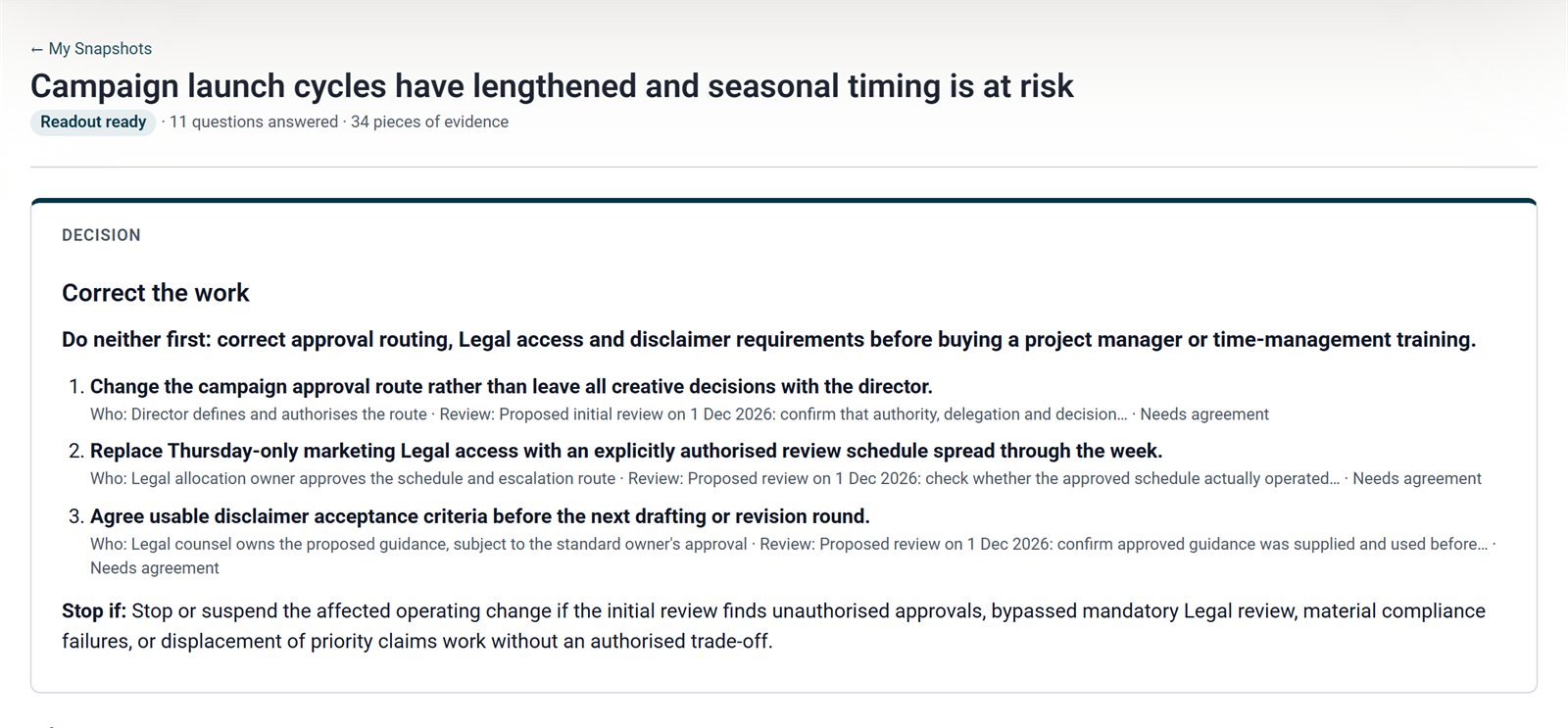
Screens from a fictional demo case. Click a screen to see it full size.
Evidence first, then the two execution routes
Start with the result. Keep competing explanations open.
The Snapshot first checks whether the expected result is still valid, really a priority, has what it needs, and isn't held up by an outside party. If the work itself is still in question, it tests both routes against the record.
Route 1. The work stalls.
Waits at approvals, loops back for rework, queues at a gate, gaps at a handoff. A long wait shows where the work sits, not why, so the reason needs its own evidence.
Route 2. Do work demands disrupt execution?
Do interruptions, constant switching or competing decisions make it harder for capable people to catch errors, decide consistently or complete handoffs? Waiting behind a busy person can still be a work-path finding. A capacity effect needs its own evidence.
The diagram shows the two execution routes, not the whole investigation. The evidence may point to missing work, Route 1, Route 2, another explanation, several conditions working together, or none of them. The readout says what holds up, what's still uncertain, and the next step.
Sample readouts
Read a finished readout before you buy one.
Two fictional cases, run through the Snapshot as it works today. The organizations, people and figures are invented, and the manager and colleagues were simulated from a written case file. So these show how the Snapshot works, not customer results. Everything from the decision onward is the readout exactly as the Snapshot produced it; nothing in it was edited.
A stalled priority
Campaign launches went from two weeks to five
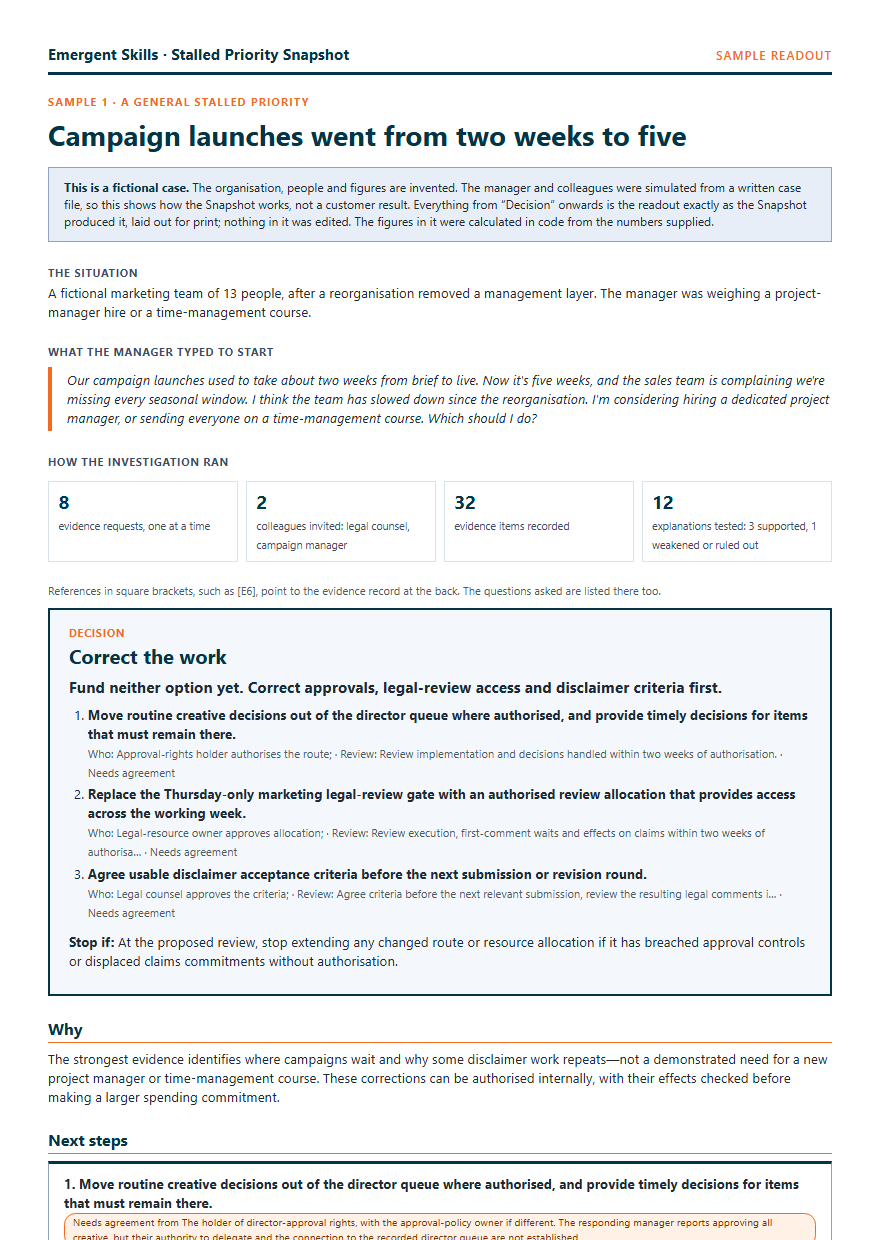
The manager thought the team had slowed down and was weighing a project-manager hire or a time-management course. Eight evidence requests and two invited colleagues later, the readout says to fund neither yet: approvals were queuing at the director (a median of 9 days against 1), legal review happened only on Thursdays, and the disclaimer standard had never been written down. Drafting and build times hadn't changed.
From the readout, with the evidence it cites:
Finding. Director-approval waiting has a median of nine days, against one day a year earlier. The time from brief to first draft, and from build to live, is unchanged. [E6, E7]
Finding. Marketing shares legal counsel with claims work and is reviewed only on Thursdays. Submissions wait a median of six days for first comments. [E8, E9]
One of the next steps. Replace the Thursday-only legal review with review time spread across the week. The legal-resource owner approves it. Measure: time to first comments, and any effect on claims work. Review within two weeks.
What it doesn't claim. The readout says the 18-day slowdown is elapsed delay, not proven labor cost or lost sales.
A rollout that hasn't paid off
A technician app that hasn't lifted first-time fix
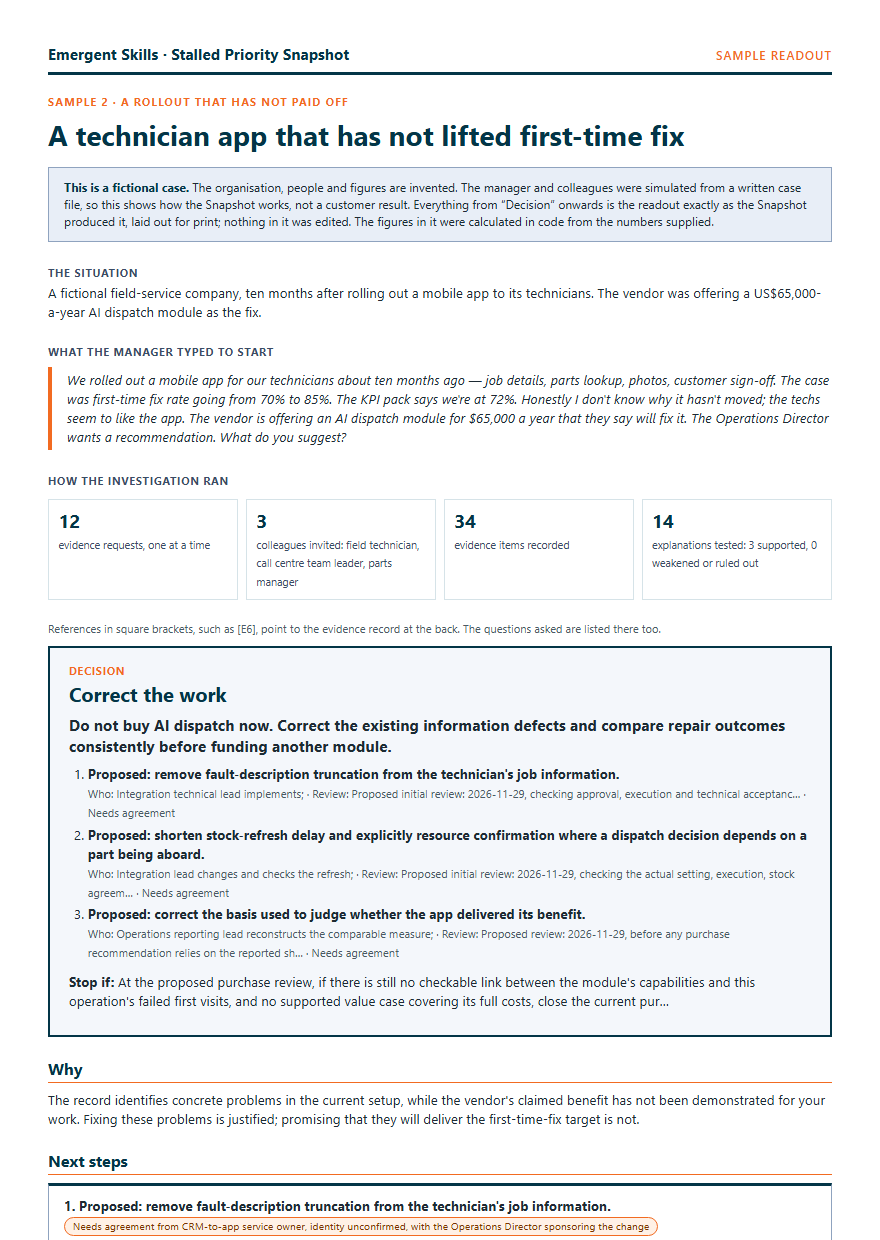
Ten months after the app went live, first-time fix was at 72% against a target of 85%, and the vendor was offering a US$65,000-a-year AI dispatch module. Twelve evidence requests and three invited colleagues later, the readout says not to buy it yet: the measure had changed definition partway through, the app cut fault descriptions off at 255 characters, and the van-stock display lagged behind the real stock.
What to look for in a readout
- The decision comes first, with the next steps and the point at which to stop.
- Each step says what changes, who does it, who has to agree, the measure and its starting point, a review date, and the result that would show it's wrong.
- Every explanation tested is listed with its status: supported, strengthened, weakened, ruled out or still open. Route 1 and Route 2 explanations sit alongside the others.
- Figures are calculated in code from the numbers supplied, and what isn't established or is still missing is stated plainly.
- The questions asked and the evidence record are at the back, so every reference such as [E6] can be checked.
Questions buyers ask
Before you start.
How much of my team's time does it take?
Less than running the investigation yourself, because the Snapshot does the legwork. It picks each question from the evidence so far, writes and sends your colleagues' questions, chases them and keeps the record. Your part is answering what only you know: up to 12 questions over a few days, in short sessions. Each question asks for one record or one first-hand account, from a quick answer to finding a report. We email you whenever it's your turn.
The Snapshot handles: writing each colleague's question in plain words, sending it by email link, reminding them after 2 days, telling you if there's still no answer, and letting them say "I'll check and come back" or "I'm not the right person, ask…".
What stays with you: choosing who to invite and telling them it's coming (a one-line heads-up from you gets better answers), finding the reports only you can reach, and deciding what to do if someone doesn't answer: answer it yourself, send it to someone else, or skip it. Approximate figures are fine if you say so, and a missing record is evidence too.
Who runs it, and who checks the readout?
The Snapshot is our proprietary AI investigation, following a method designed by Jim Wilde. Your readout is written and checked automatically. Staff open your case only to fix a system error or answer your request for help.
Before you see it, every readout is checked twice against the evidence record: in code, which recalculates every figure from the numbers you supplied, and by a separate AI review, which checks that the findings are supported and flags anything that isn't. Every claim points to the evidence behind it, so treat the readout as a well-sourced draft to judge, not a verdict to accept. (Checking AI-drafted analysis is a skill we also teach: Reviewing AI work.)
Who sees the answers?
Answers aren't anonymous. Each colleague's answer comes back to you under their name and stays in the case record, and the invitation tells them so before they write anything. They see only their own question, not the case, your notes or anyone else's answers. You decide who in your organization sees the readout.
Once sent, an answer can't be edited. If someone wants to correct their account while the investigation is running, include the correction in your next answer and say whose it is. No HR records or system passwords are needed; share only what you're authorized to share.
What happens to our information?
Each colleague sees only their own question, and their answers come to you. Your content isn't used to train AI models, and it's sent to our AI provider with the provider's response-storage option turned off. Delete an investigation at any time and everything recorded for it is removed. See How we use investigation data and the Snapshot terms.
What if someone disputes a finding?
Email [email protected] and we'll explain how the readout reached a finding, from the evidence it cites, at no charge. Need to take it to your director or sponsor? Book a 60-minute findings briefing with a qualified staff consultant for US$350. A briefing explains the evidence and reasoning; it isn't an independent audit, and the decision stays yours.
What if the chokepoint turns out to be me?
Then the Snapshot looks at what that approval does, why it exists, and whether the work could move differently without losing the control it provides. Findings are about how the work moves, not about people. A readout can say "approvals waited a median of 9 days at director level." It won't say who was slow, and it doesn't rate anyone's performance.
How does it end, and what are the limits?
Each Snapshot includes up to 12 questions across you and your colleagues. After the 12th, it writes the readout from the evidence it has. If it needs a few more answers to finish the readout, it may ask up to 3 follow-up questions at no extra charge. There are no other charges and no top-ups.
- When the evidence is enough. The usual ending: a decision, next steps and a point at which to stop.
- When you call it. "Wrap up with what you have" writes the readout now.
- When the decisive evidence can't be found. The readout says so and names it, and the decision becomes "get this evidence" or "run a limited test": a specific next step with an owner.
- When a colleague never answers. Their link expires after 14 days, and the readout treats the question as a gap, not a finding.
What if the readout fails its checks?
A readout that fails is repaired. If the evidence can't support a full decision, you get a narrower readout: what the evidence establishes, what's still missing, and the next step to close the gap. That's a completed investigation, not a failed one.
In the rare case that a readout still can't pass its checks, we correct it at no charge, and if we can't, we give you a free Snapshot to use on this or another priority.
Is my problem a good fit?
Best fit: one important result in a project or recurring operation is falling short across functions or decision points. Delays, repeated errors, missed handoffs or adoption below target have a real business consequence, and a manager or leader owns the result and can act on the next step.
Is it worth it? The US$495 fee and your team's time should be justified by what the shortfall means for revenue, customer delivery or other valuable work. Money already spent is context, not a reason. If a straightforward internal correction will do, make it. Not a fit: investigating an individual's conduct or performance, legal or regulatory matters, or safety incidents.
Can I pay by invoice, and can I get a refund?
Pay by card at checkout; you create your account as you pay. For an invoice or purchase order, email [email protected]. A Snapshot is used when you start the investigation. One you haven't started can be refunded on request. Once started, it isn't refundable, except that a readout that fails its own checks is corrected at no charge or replaced with a free Snapshot. See the Snapshot terms.
The method
For readers who want the detail.
The investigation runs the same checks every time. Open any section to see what it asks.
First checks
We start with the result and what it needs to be delivered.
1. Outcome validity
Is the result still worth pursuing?
2. Priority choice
Is it really a chosen priority?
3. Delivery prerequisites
Are the skills, information, authority and funding available?
4. Outside dependency
Is something outside the organization controlling progress?
These checks may settle the next decision on their own. We also check whether known, workable standards are being followed before blaming the route. If the evidence supports an ordinary management fix, we say so and recommend it.
Necessary work and who owns it
Necessary work with no named owner is different from work that's merely stalled. For implementation and rollout work, these four jobs are common places to look, not universal requirements. We ask for a name, not a department.
1. Make it work here
Who owns making it work with the real data, volumes, exceptions and operating conditions?
2. Fit the handoffs
Who owns getting the affected teams to agree on definitions, handoffs and dependencies?
3. Take out the old process
Who owns retiring the old process, or deciding when it has to stay?
4. Settle the disruption
Who owns the work of absorbing the change across the affected roles and teams?
The Four Tests, when a capacity effect is suspected
1. Baseline shift
Are people performing below a level they sustained over time? A peak held through unsustainable effort isn't automatically the baseline.
2. Load signature
Do errors, reversals, delays or rework cluster under particular demand conditions?
3. Shared conditions
Do several capable people under the same conditions show the same pattern?
4. Reversibility
When the suspected conditions change, does the effect change in the expected direction?
The first three tests can support a capacity-effect hypothesis; reversibility tests it, and needs evidence from changed conditions. Better flow alone doesn't establish a capacity effect, because the change may have improved the work path directly.
Where the Snapshot sits among our services
The Snapshot finds a next step for one result. Where the question spans a team or function, the Diagnostic examines the wider pattern. A Capacity Audit sets the baseline for a proposed change, the Pilot tests an authorized change, and the License supports wider use. All use the same execution gap analysis at different scopes. The Five Capacity Taxes organize the cost questions.
Want to check the fit first? The Execution Drag Checklist walks through the opening questions for a result that hasn't moved.
More questions? Search the help and FAQ, or email [email protected].
Start
Start with the priority.
Buy a Snapshot
US$495 by card at checkout; you create your account as you pay. Invoice or PO: email [email protected].
Describe the result
What was expected, what happened, by what date, and the decision in front of you. A few sentences are enough to start.
Answer and invite
Answer each round when it suits you and invite up to 8 colleagues by email. We email you whenever it's your turn, until the readout is ready.
Start with one result
Bring one important result that's falling short.
US$495 per investigation. We run it; you answer what only you know. You get a written readout with a decision, an action plan and the record behind it.
