Operational Payoff · Operations consulting for stalled projects and recurring execution problems. We investigate why important work is not producing the expected business result.
When important work should have moved by now, find out why.
A priority is late. A decision keeps reopening. A rollout launched, but the expected value never showed up. Before you reorganize, add headcount, buy another tool, or blame the team, trace what actually happened.
Trace the work. Change the condition. Measure the result.
ES runs three checks, in order: whether the work needed to produce the result was ever assigned to anyone, friction in the work path, and demand conditions that may be reducing access to existing skill. Any of them can stand alone. They can also reinforce each other.
Built for the leaders accountable for demanding knowledge work: COOs, business-unit leaders, functional executives, VPs of Operations, and Chiefs of Staff.
Executive SummaryWhat Emergent Skills does.+
Emergent Skills starts with one business result and follows the work that was supposed to produce it. We reconstruct the waits, decisions, approvals, handoffs, queues, rework, and elapsed time before choosing a fix.
Before blaming the route, we check four simpler explanations: whether the outcome is still valid, whether leadership still treats it as a real priority, whether the team has the capability, information, authority, and funding it needs, and whether an outside dependency controls the pace. Then, before either route, we check whether the work needed to produce the result was ever assigned to anyone. Four jobs sit around every initiative: making it work with your data and exceptions, getting the teams it touches to agree on handoffs, switching off the old process, and settling who absorbs the cost of the change. A plan can be run perfectly and still fail if one of them has no owner.
If a job has no owner, ES names it, the person best placed to own it, and what leaving it unowned costs per week. If the route is the problem, ES changes the route. If the same conditions also appear to be reducing access to judgment, focus, communication, or creativity, ES tests that claim separately before adding manager or individual support. If neither explanation holds, the finding says so.
The engagement path is deliberately staged. The Snapshot investigates one result. The Diagnostic checks whether the pattern is broader. The Audit replaces assumptions with operating evidence. The Pilot changes supported conditions and measures the result. The License turns what worked into an ongoing operating discipline.
Each step can support, redirect, or stop the next. You do not have to buy the full system to find out whether it applies.
How Emergent Skills Works
Trace. Test. Change. Measure.
Start with the work, not an assumption about the people doing it. ES separates what the work path proves, what the capacity evidence supports, and what still needs to be tested.
No predetermined answer: the problem may be work that was never assigned to anyone, an approval queue, unclear authority, too much work in progress, a demand condition affecting performance, or something outside the ES system.
1. Trace the actual route
Reconstruct the waits, decisions, approvals, handoffs, queues, rework, and elapsed time around the result.
2. Test the explanation
Separate work that was never assigned, direct work-path friction, a supported capacity effect, and other plausible causes.
3. Change and measure
Change the smallest supported condition, agree on the operating metric, and see whether execution improves.
A credible finding can be that a job was never assigned, that the route is not the problem, that the capacity claim is not supported, or that ES is not the right intervention.
The Four TestsHow we test the capacity effect.+
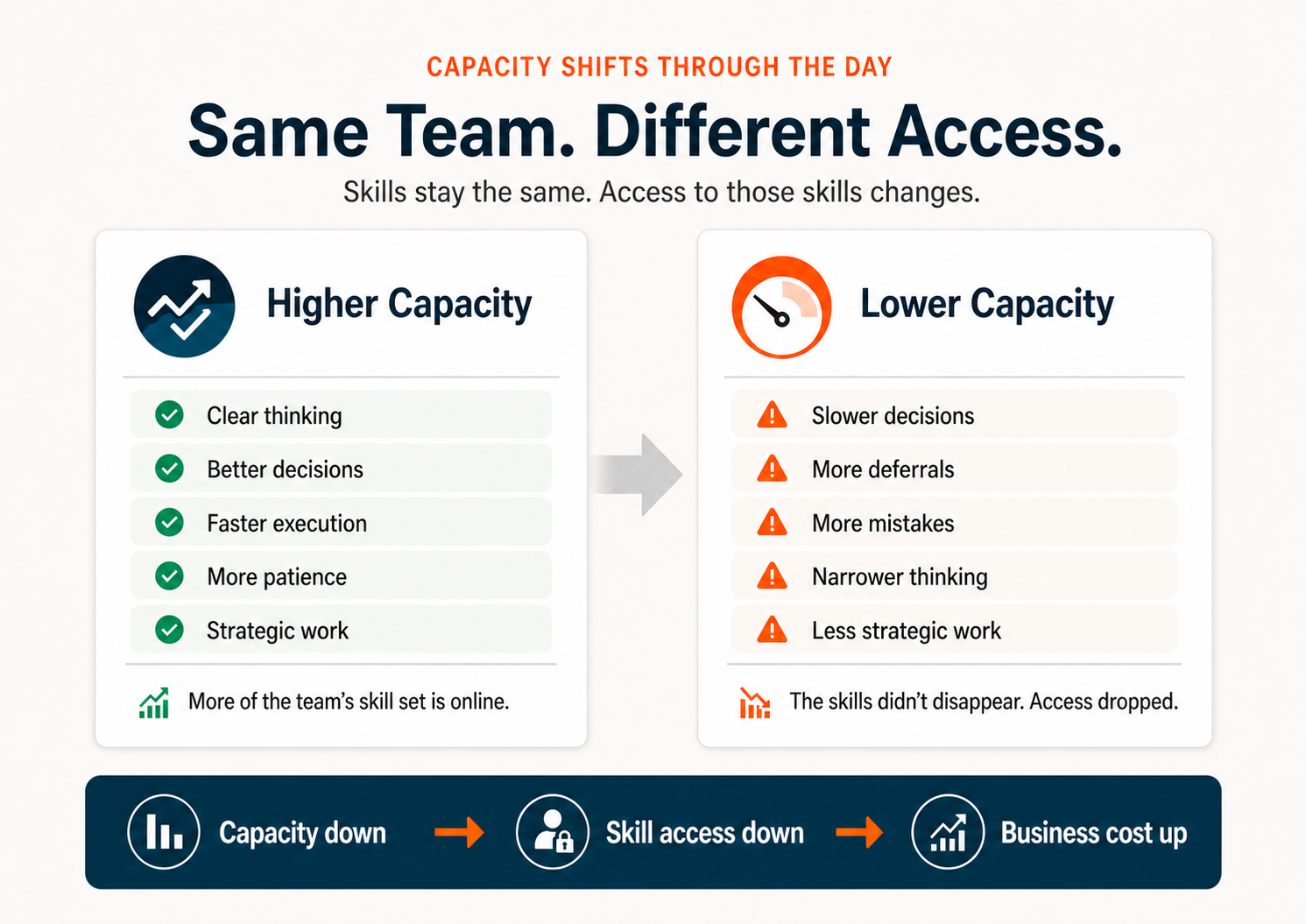
Work-path friction can slow execution on its own. The Four Tests answer a narrower question: are those conditions also reducing access to skill the people already have? ES makes that additional claim only when all four tests are supported.
These tests come after the earlier checks on outcome, priority, resources, authority, and external dependencies, and after the missing-work check. If one test fails, ES withholds the capacity classification. Any work-path evidence already established still stands.
01Baseline shift
Capable people are performing below a level they previously sustained. A short peak held together by exceptional effort does not count as the baseline.
02Load signature
Errors, reversals, delays, or rework cluster under identifiable demand conditions.
03Shared conditions
More than one capable person exposed to the same conditions shows the pattern.
04Reversibility
After the relevant condition changes, an agreed operating metric and the associated capacity pattern improve without replacing the people.
Where no sustained baseline exists, the claim is limited. Capacity Intelligence does not erase accountability. It improves the order of diagnosis.
Before You Pick the Fix
A reasonable solution can still solve the wrong problem.
A reorganization, another project manager, more headcount, new software, tighter controls, training, or individual support can all be right. The question is whether the choice addresses the condition producing the loss.
Fixing the people when the route is broken
If an approval queue accounts for most of the elapsed delay, asking the team to work harder, communicate better, or attend training will not remove it. The route has to change.
Fixing the process when demand is affecting performance
If the route is sound but sustained demand is affecting consequential decisions, another process map will not solve the whole problem. Manager practice and private individual support may also belong in the intervention.
Fixing the route when the work was never assigned
If nobody owns making the tool work with your data, agreeing the handoffs, or switching off the old process, a routing change moves work that does not exist. Name an owner for the missing job first, with the authority it needs, hours, and a date.
Trace first. Fix only the layers the evidence supports, then measure whether the result changes.
Where the Cost Can Show Up
Five Capacity Taxes
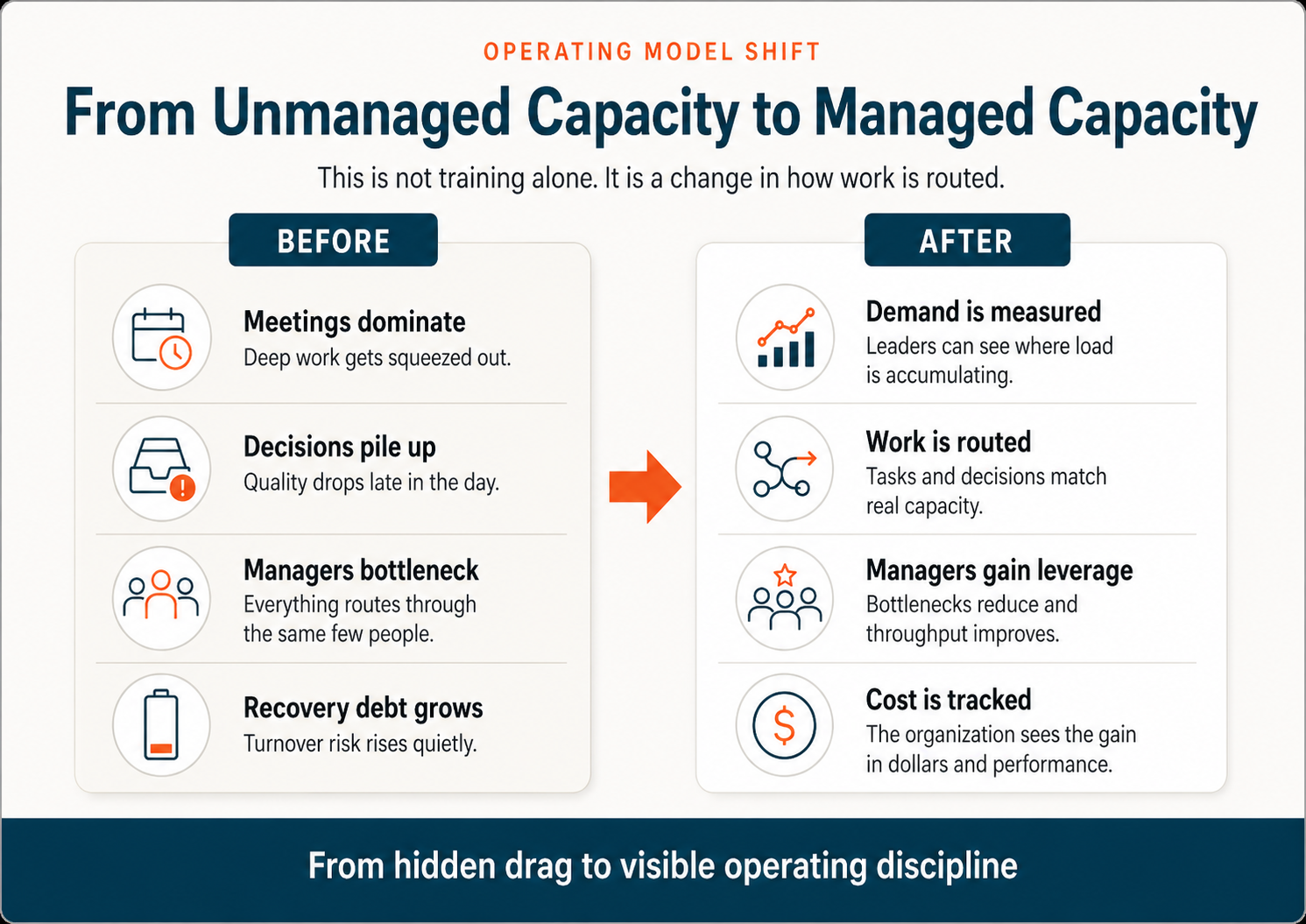
The Five Capacity Taxes are overlapping lenses for finding where execution loss is landing. They are not five root causes, and they are not five numbers to add together.
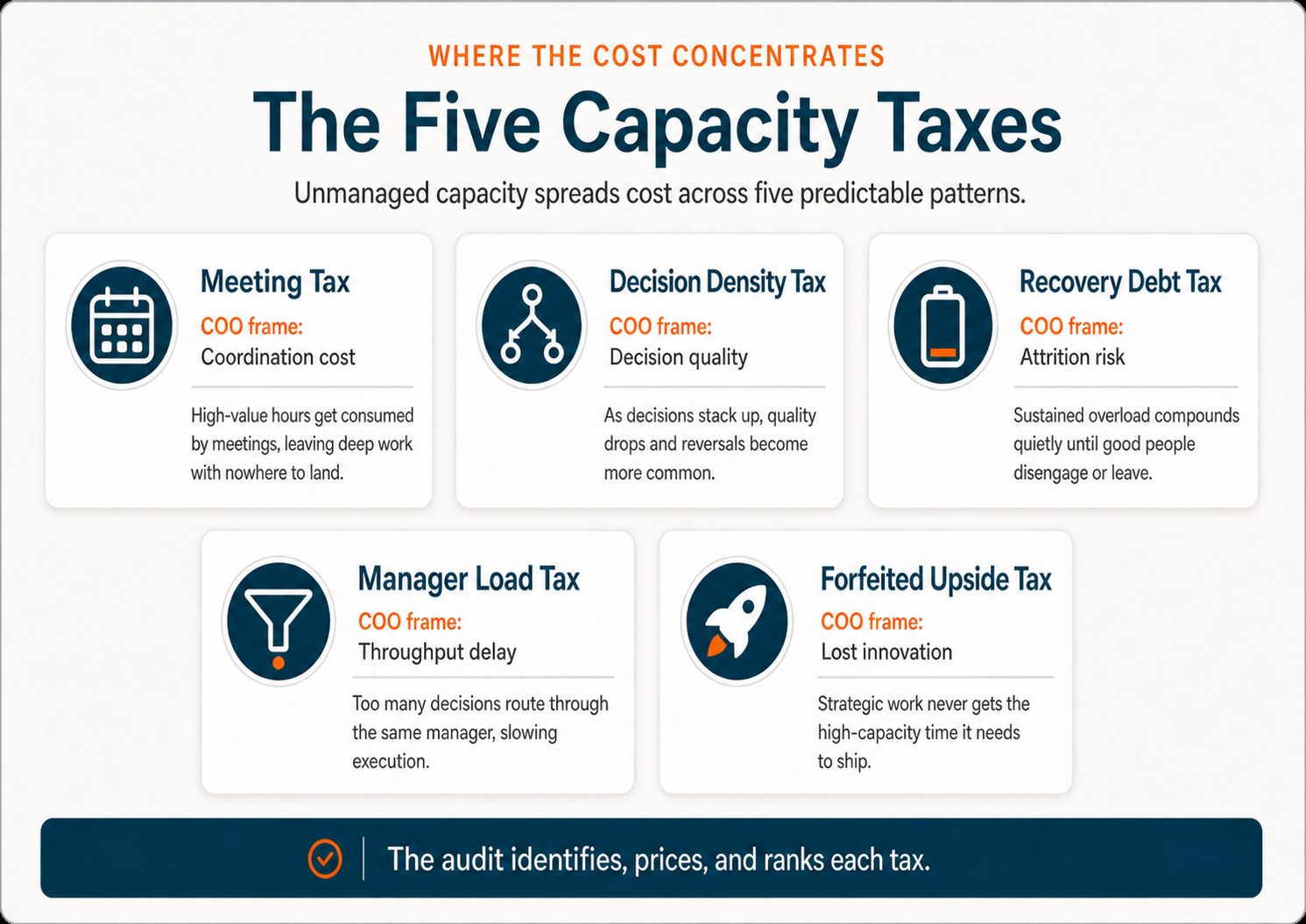
Meeting Tax (coordination cost)
Time, attention, and strategic work consumed by coordination.
Decision Density Tax (quality cost)
Decisions that wait, reopen, reverse, or require cleanup later.
Manager Load Tax (delay cost)
Too many approvals, exceptions, and decisions routing through too few people.
Recovery Debt Tax (attrition cost)
Longer-term exposure from sustained demand without enough operating margin or recovery.
Forfeited Upside Tax (innovation cost)
Strategic work, opportunities, and improvements that never receive a viable route to action, and the benefit of an initiative that closed green because the work around it had no owner.
Build the Cost Case
ES keeps three things separate: directly traceable extra labor, elapsed delay, and client-supplied opportunity value. Combining them into one large number would make the case look stronger than the evidence is.
The calculator creates a directional scenario from your assumptions. The Snapshot isolates what can be traced in one result. The Diagnostic looks for a broader pattern. The Audit replaces assumptions with operating data where possible.
Where Demand Can Concentrate
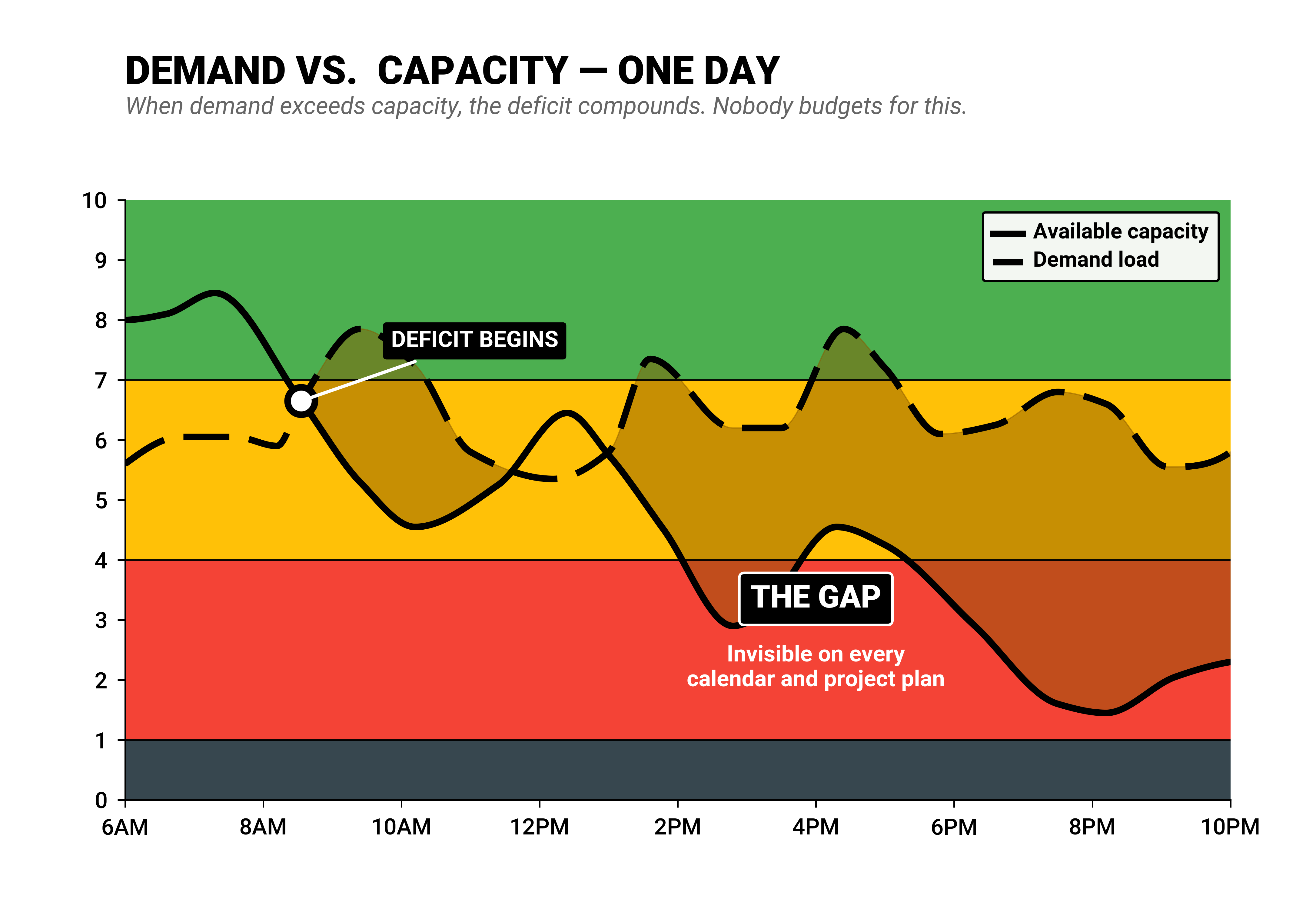
Some people become part of the route for almost everything.
Trusted managers, specialists, and experienced operators often receive the hardest decisions, the exceptions, and the rescue work. The result can be a queue that follows the person rather than the formal process.
Look for observable patterns: aging approvals, repeated escalation, rescue work outside the role, after-hours catch-up, and constant context rebuilding. These signals create a hypothesis. They do not prove the cause by themselves.
AI changes the demand profile. It does not predetermine the result. It may remove task work while adding verification, exception handling, oversight, and parallel processes. The net effect has to be measured.
When Emergent Skills Is Useful
Start where an important result is visibly not moving as it should.
A useful starting point is one result, team, department, function, or business unit doing demanding knowledge work where one of these patterns is already visible.
A strong first case
Late or repeatedly reviewed
A priority keeps missing dates, returning to the agenda, or waiting for the same approval.
Partly delivered
The work shipped in pieces, but the complete operating result or expected business value never followed.
Launched but underused
A rollout went live, but adoption, use, or realized value remains below plan.
Delivered, no result
The project closed and the status is green, but the business result never started. One of the four jobs around it has no owner.
Dependent on overloaded people
Decisions, approvals, exceptions, or rescue work repeatedly route through the same manager or specialist.
The industry matters less than the work. ES is built for environments where judgment, analysis, decisions, communication, and complex problem-solving materially affect the result.
What Can Change
Fix only the layers the evidence supports.
A direct work-path problem may need only a work-system change. When the evidence points further, ES can connect three levels without confusing them.
Organization: fix the recurring work path
Name an owner for work that was never assigned, sequence priorities, limit work in progress, clarify decision rights, remove unnecessary approvals, redesign handoffs, or restore operating margin. Additional staffing remains the right answer when verified demand is larger than the system can carry.
Manager: manage demand and consequence
Managers protect consequential work, reduce avoidable noise, clarify decisions, and stop becoming the route for every small choice. They decide whether the next demand should proceed, wait, pair, simplify, or move.
These choices use capacity an employee chooses to declare, observable workload, and the consequence of the task. Private app activity is never a manager input.
Individual: build, reset, and deploy capacity
Private tools help professionals work with the capacity available to them and develop the skills demanding work requires.
The app helps the individual recognize the state already present, use a state-matched intervention, and decide what the next piece of work can safely support. When capacity is available, Deploy Capacity mode directs it toward thinking, communication, pattern repair, creation, and preparation.
Individual app activity and Zone history remain private. Managers receive neither. Organizational reporting is limited to privacy-protected aggregate patterns and operating outcomes.
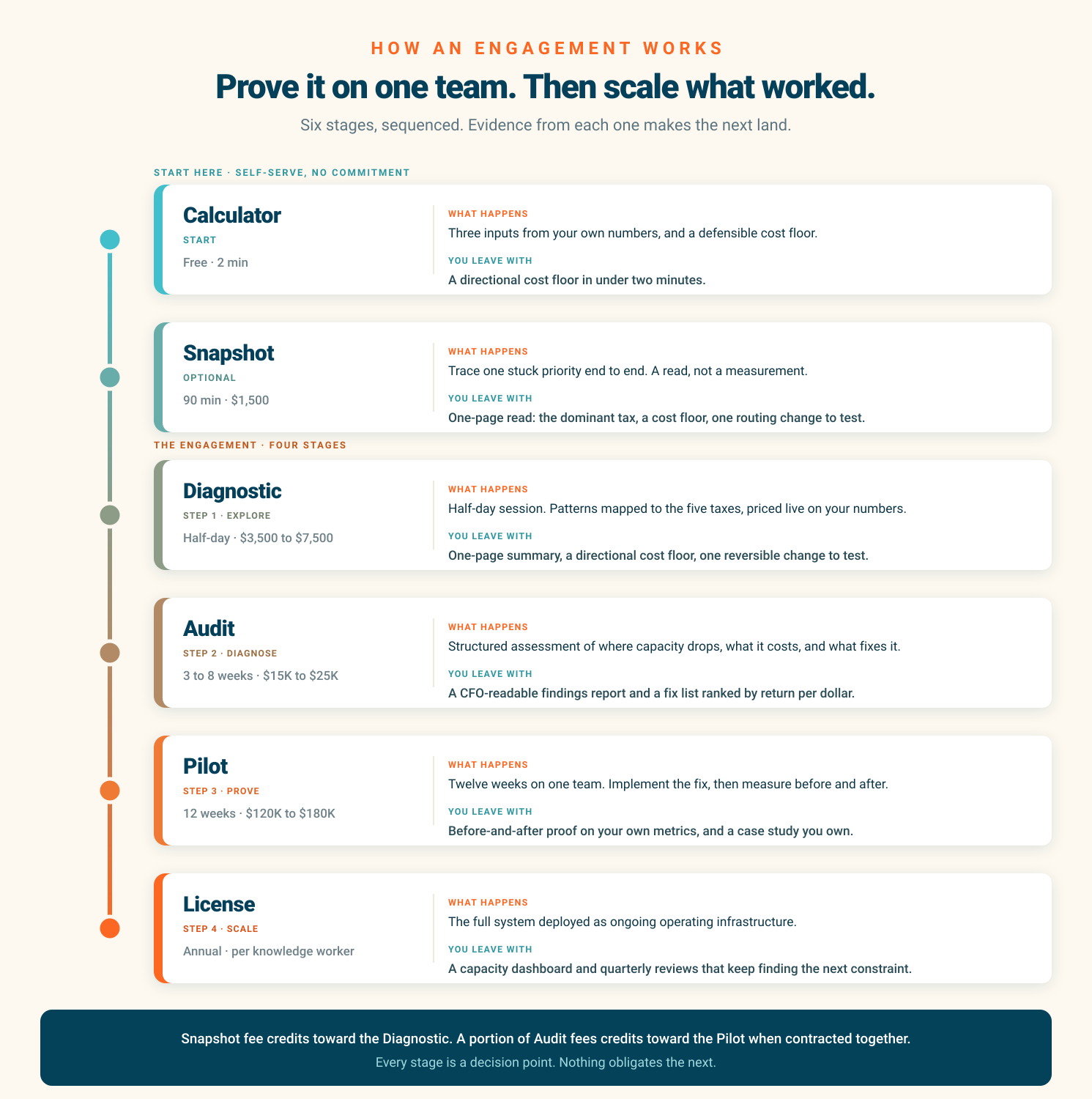
You can enter through the free Work Demand Calculator or the $1,500 Stalled Priority Snapshot. From there, each engagement has to earn the next: Diagnostic → Audit → Pilot → License.
The Snapshot is a 90-minute investigation of one result that should have moved. It first checks whether the work needed to produce the result was ever assigned to anyone, then reconstructs the route, separates working time from waiting and rework, and identifies the strongest explanation the evidence supports. You receive a written read within 24 hours and a 15-minute result-owner walkthrough. Where the evidence supports it, the read proposes one next step: a missing job to staff, or one 14-day routing experiment.
Work Demand Diagnostic
A half-day working session for managers and operating leaders when the problem appears broader than one result. It maps recurring work-path friction, screens for a supported capacity effect, builds a directional cost case, and decides whether deeper investigation is warranted. $3,500 to $7,500.
Capacity Audit
A structured assessment that replaces assumptions with operating evidence. It traces the work across a team, department, or function, builds the cost case, and produces a ranked intervention portfolio and Pilot plan.
Capacity-Aligned Execution Pilot
A 12-week measured intervention around one primary team and the bounded work route affecting its result. Change one or two supported conditions, measure the operating result, and complete a 30-day durability check before deciding whether to expand.
Organizational Capacity Intelligence License
An annual license that begins by reproducing what worked through the next connected work group. It combines work-path improvement, manager practice, private individual support, aggregate operating reporting, and quarterly executive review.
For your budget conversation
Stalled Priority Snapshot is $1,500: 90 minutes, remote or in person, one result, a written read within 24 hours, and, where supported, one next step: a missing job to staff or one 14-day routing experiment. The fee credits toward the Work Demand Diagnostic if booked within 30 days.
Work Demand Diagnostic is $3,500 to $7,500 when the drag extends beyond one result.
2026 Design Partner Cohort · Three Slots
Help test the system in real operating conditions.
Up to three Design Partner engagements are planned for 2026. Partners receive closer founder involvement, practical input into how the methodology develops, case-study consideration when the evidence and permissions support it, and 15% off the first engagement.
- Closer founder involvement at kickoff, findings review, and the executive readout.
- Practical input into the method while it is sharpened against real operating conditions.
- Results reported whichever way they land. A case study is considered only with measured support, your approval, and the required confidentiality.
Who Built This
Founder
Jim Wilde built the Emergent Skills methodology across decades of enterprise systems work, including nine years working on mta.info and related Metropolitan Transportation Authority systems.
That background shapes the basic ES approach: trace the system before blaming the person operating inside it. The broader argument is documented in CAPACITY: The Variable No One Measures.
Jim owns the methodology and reviews the judgment calls where the evidence does not fit a clean pattern.
Start with one result that should have moved.
Bring the milestone, decision, deliverable, rollout, or dependency that should be further along by now. We will check whether the work to produce it was ever assigned, reconstruct what happened, separate the explanations the evidence supports, and identify the smallest useful test.
You do not need to buy the full system to find out whether it applies.
