For Operations Leaders Facing Project Delays
When Capable Teams Can’t Move Important Work
Emergent Skills is built for mid-to-large organizations where project delays, rework, slow decision-making, or overloaded managers keep important work from moving.
The team may be capable and working hard. The work still waits, loops, returns for another pass, or routes through one person whose queue sets the pace for everyone else.
Emergent Skills traces what the work path is doing to the priority and tests what the same conditions may be doing to the people carrying it. Then we change one condition and measure whether execution improves.
Executive SummaryWhere important work gets stuck, and how we test it.+
Important work is waiting, looping, or routing through one overloaded person while the team is fully capable. That gap is execution drag. It usually comes from how work is routed, not from who is doing it.
Execution drag can arise from several conditions. Emergent Skills examines two recurring routes: friction in the work path and demand conditions that may reduce access to existing skill. Queues, unclear approvals, weak handoffs, and too much work in progress slow the work directly. The same conditions may spend the capacity people need to apply judgment, focus, and communication. The skill stays intact. Access to it can change.
The cost lands as project delays, workflow bottlenecks, slow decision-making, rework, overloaded managers, and stalled priorities. Most organizations then diagnose it as a people problem. Dashboards report the delay after the cost is spent. Engagement scores and resilience training leave the routing untouched.
Emergent Skills traces the actual work path, tests whether those conditions are also reducing access to existing skill, changes one condition, and measures the operating result. We call the discipline Capacity Intelligence™.
Not every miss is a capacity event. The Four Tests decide, and a failed test withholds the claim.
Emergent Skills sits in an unusual place. It is not a wellness program, an engagement survey, or a coaching tier. It is not ordinary process improvement either. Process work usually follows the work. People programs usually follow the person. We need to see what is happening to both.
This is about execution: why important work waits, loops, piles up, or misses, and why the same conditions can leave capable people with less access to the judgment, focus, communication, and creativity needed to move it.
What is slowing the work?
Work stalls even when everyone involved is capable and fully available.
Queues, unclear approvals, and weak handoffs create execution drag directly. Repeated review returns finished work. Too much work in progress fragments the week. One manager holding every decision sets the pace for everyone.
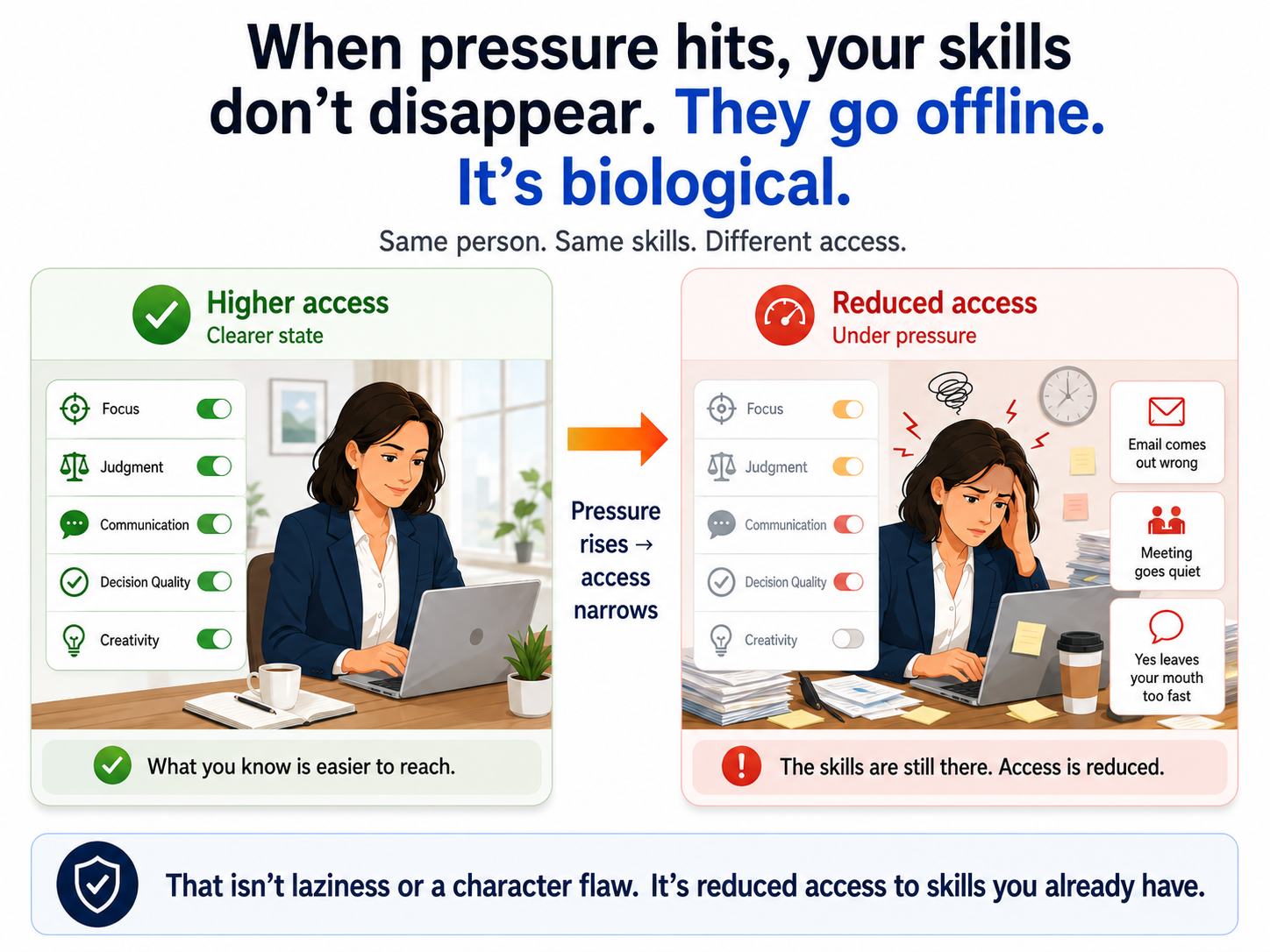
Those conditions also make the work harder to do well. People rebuild context all day. Decisions stack up. Open work stays open. By the time someone gets back to the important thing, they may not have the same judgment or attention they had earlier.
Capacity is variable access to existing skill in the moment. The intelligence, experience, judgment, communication ability, creativity, and technical skill can remain intact while access to them changes under accumulated demand.
The two sides reinforce each other. An approval queue forces constant switching. Switching makes the reviewer more cautious. Extra review enlarges the queue. The work slows further while the people carrying it lose more usable capacity.
The cost shows up as project delays and workflow bottlenecks: slow decision-making, avoidable rework, overloaded managers, stalled priorities, and strategic work that never gets protected attention. Build a starting cost scenario, then replace the assumptions with company evidence.
Some misses are capability, role fit, staffing, or strategy problems. Emergent Skills does not assume otherwise.
It looks like a people problem. Check the work path first.
Where Emergent Skills fits
Emergent Skills serves mid-to-large organizations with departments doing demanding knowledge work.
The practical starting point is usually one department, team, or business unit where execution drag is already visible and the output depends materially on:
- Judgment under ambiguity
- Analysis and decisions with consequence
- Communication and coordination across functions
- Technical, professional, or clinical expertise under pressure
- Creativity, pattern recognition, and complex problem-solving
That includes operations, finance, product, engineering, legal, R&D, clinical operations, consulting, strategy, and the leadership layers responsible for their results.
The buyer is usually the person who owns the result and keeps having to explain why it has not moved. That may be a COO, business-unit leader, functional executive, Chief of Staff, Head of Operations, or Managing Partner.
Does one important priority keep taking longer than the work itself?
Trace where it waits, who it depends on, how often it loops, and whether the same pattern is consuming the capacity needed to move it well. See where the cost may concentrate.
Where Emergent Skills does not fit
- Primarily procedural or scripted work where execution does not materially depend on judgment, analysis, communication, creativity, or complex problem-solving under pressure
- Organizations looking for an engagement score, wellness perk, or resilience workshop to substitute for work redesign
- Leaders seeking individual monitoring, a motivation program, or proof that the people are the problem
If you want a slide telling people to show more grit while approvals, queues, handoffs, and priorities remain untouched, this is not it.
Emergent Skills starts from a different premise: work-path friction creates drag directly, capacity fluctuates under demand, and both can be redesigned and tested.
That boundary decides where Emergent Skills helps and where it does not.
What dashboards and people data miss
What the dashboard does not show
- Work waiting between visible milestones
- Queues and rework hidden inside "in progress"
- One approval or decision point setting the pace for everyone
What the people data does not explain
- Skill can be real while access to it varies
- Load can degrade judgment, focus, communication, and creativity
- More effort cannot repair a recurring work-path failure
Why fixing one side falls short
- Process-only redesign can ignore depleted people
- People-only support can leave broken routing in place
- Training cannot guarantee access to skill in the moment it is needed
The simpler model:
Work enters a path. The path can slow the work and make it harder for the people carrying it to do their best work. Both eventually show up in execution.
That is why a capable team looks inconsistent for no visible reason. Work moves through overloaded queues, repeated review, and unclear decision points. The same conditions leave less judgment and attention available for the parts that need it.
Emergent Skills does not assume which side dominates. It finds the structural drag first, then tests the capacity effect.
Why I built Emergent Skills
To answer a question most operating models never ask:
What do you change when capable people are inside a work system that keeps stalling?
I learned part of this the expensive way. Before Emergent Skills, I built a sleep app. It asked exhausted people to do the structured work of well-rested people, and it failed for exactly that reason. I had designed it for someone who was already in good enough shape to use it. That was backwards.
Build for the floor and scale to the ceiling.
Organizations make the same mistake at scale. Process improvement efforts design tools, handoffs, decision rights, and expectations for ideal conditions, then treat breakdowns under real load as evidence that the people lost a step.
Emergent Skills starts by tracing the actual work path: what enters, how much stays open, where it waits, who it passes through, how often it loops or restarts, and where one person becomes the constraint. Then we test whether those conditions are also reducing access to existing skill.
The work-path mechanics explain how the loss is produced. The Five Capacity Taxes show where the cost lands. Meeting Tax, Decision Density Tax, Recovery Debt Tax, Manager Load Tax, and Forfeited Upside Tax are overlapping lenses on one loss, not five buckets to add up.
We call the operating discipline Capacity Intelligence™: connecting work-path evidence, capacity-effect testing, changes to the conditions, and measured operating results.
The Zones Framework™ is the private individual operating layer. It helps a professional identify the state already present, choose the intervention that state supports, and route the next work accordingly. The app supports Reset → Build → Thrive: restoring access or routing around degraded states, developing professional capability, and deliberately deploying Green capacity toward valuable work.
Managers do not receive private app activity, individual Zone history, or live individual-state monitoring. They act on capacity an employee chooses to declare, observable load, and the consequence of the task.
Why the problem is getting harder
The work path got denser
More work in progress, more approvals, more cross-functional handoffs, more coordination overhead, and more tools generating activity without necessarily improving flow.
The demand stopped letting up
Always-on communication. Faster cycles. More decisions per hour. Less margin for context reconstruction, recovery, and deliberate thinking.
The diagnosis stayed personal
When work slows or quality becomes uneven, organizations often blame motivation, capability, or attitude before examining queues, decision rights, rework, overload, and the conditions around the work.
I will not pretend the measurement is finished. We are early. External research supports the logic behind collaboration overload, interruption, decision pressure, and recovery. It does not prove Emergent Skills works. ES should be judged by whether changing a condition improves an agreed operating metric, and we report the result whichever way it lands.
How we test the explanation
Not every delay, error, or miss is a capacity issue. Queues, broken handoffs, unclear decision rights, and rework loops can be established directly from flow evidence. The Four Tests answer a narrower question: are those conditions also materially reducing access to existing skill?
The Four Tests
- Baseline shift: capable people are performing below a level they sustained over time. A short peak maintained through heroics is not automatically the baseline.
- Load signature: errors, reversals, rework, or delays cluster under identifiable demand or flow conditions.
- Shared conditions: multiple capable people exposed to the same work design show a similar pattern.
- Reversibility: changing the relevant demand or flow condition improves an agreed operating metric and the associated capacity pattern without replacing the people.
The Pilot tests reversibility. A failed test withholds the capacity-mediated claim. It does not erase structural drag already established in the work path or identify the alternative cause by itself. The issue may instead be capability, role fit, resourcing, or strategy.
What leaders usually notice first
Emergent Skills is for the leader who has said some version of this:
- "The team is capable. Why is this priority still waiting?"
- "Decisions take longer than the work. Where is the queue?"
- "Everyone is working hard. Why does completed work keep coming back?"
- "I don't need another score. I need one condition we can change and measure."
What has to change
Emergent Skills is not here to fix your people, and it is not ordinary process consulting. Work can stall because the path creates direct friction, because demand reduces access to existing skill, because both reinforce one another, or because another condition better explains the problem.
The organization has to fix recurring problems in the path. Managers have to make better decisions about what gets put through that path and when. Individuals need a private way to recognize what they can reliably take on in the moment. Then we measure whether the change improves operational efficiency and execution.
Fix the path first. Then test whether capacity was the limit.
Bring one priority that should have moved.
The Stalled Priority Snapshot traces where the work waits, loops, restarts, hands off, or routes through an overloaded decision point. Leave knowing what direct drag is visible and the first 14-day routing change to test. The Snapshot points at the first place to look. It does not prove capacity caused the stall. That comes later, if the evidence supports it.
