State vs. Trait
A performance change is not automatically
a character change.
When a reliable employee starts missing, familiar labels arrive quickly.
disengaged resistant to change not accountable checked out
Those labels may describe what you see. They do not explain why it changed.
A missed deadline can come from capability, role fit, or unclear ownership. It can also come from a blocked work path or reduced access to existing skill under load. Emergent Skills helps separate those possibilities before the organization acts on the wrong explanation.
Executive SummaryWhy the label arrives before the evidence, and what to check instead.+
A reliable person starts missing, and the vocabulary shows up almost immediately. Disengaged. Not accountable. Checked out. Those words describe what someone saw. They do not explain what changed. Once one sticks, it starts explaining everything that happens next.
The same person can hold the same experience, judgment, and technical skill while reaching less of it in the moment. Emergent Skills calls that capacity, and it is one of several conditions that produce a missed deadline.
Before anyone decides someone changed, there are simpler things worth checking first. The table below sets each trait label against the operating conditions that could produce the same behavior, and the question worth asking before deciding. Structural drag is the cheaper thing to establish, so check the path first. The further claim that the same conditions are reducing access to skill takes more than a plausible story.
The Behavior Changed. The Cause Is Still Open.
A change in behavior is evidence. It is not a diagnosis.
The skill can still be there even when the person cannot reliably reach it. Emergent Skills calls that variable access capacity.
Emergent Skills examines both sides of execution drag: friction in the work path and reduced access to skill in the people carrying it. Work can slow because it is waiting in a queue, bouncing through weak handoffs, carrying too much work in progress, or routing every decision through one manager. That structural drag can exist even when the people involved have full access to their skill.
The useful question is not "trait or state?" It is what changed, in the work path, the operating conditions, the task, or the person. Then look at the evidence.
Zones are private operating states
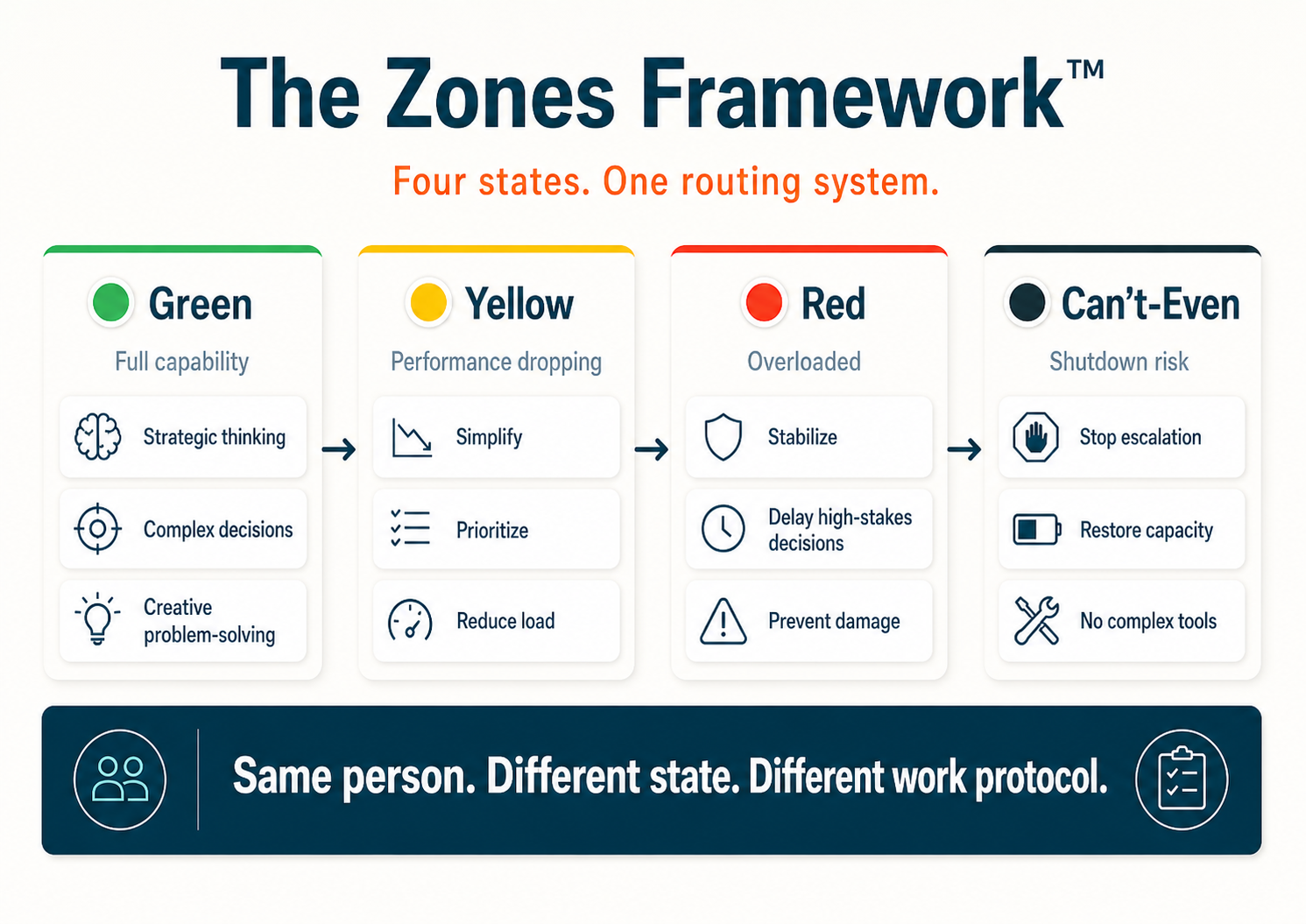
The Zones Framework™ gives individuals a private way to identify the state already present, choose an appropriate intervention, and route the next work to what that state can support.
- Green · strong access
- Yellow · stretched
- Red · overloaded
- Can't-Even · operating depletion
This distinction is part of Capacity Intelligence™. Individuals learn to identify their own state and choose the appropriate intervention. Managers do not assign Zones or receive private app activity, individual Zone history, or live individual-state monitoring. They work from capacity an employee chooses to declare, observable workload and calendar conditions, and the complexity, reversibility, and consequence of the task.
What Trait Labels Can Hide
The middle column lists operating explanations plausible enough to check before anyone makes a character judgment.
| Trait label | What else could be happening | What to check before deciding |
|---|---|---|
| Lazy | Maybe. Or the task never had a clear next step. It may be blocked, undefined, or bigger than the capacity currently available for it. | Does the person have a sustained baseline on comparable work that was clear and supported? |
| Unmotivated | Something in the job may have changed. The demand went up, the control went down, or the work stopped fitting the person doing it. | What changed, in the work itself, in autonomy, or in recovery? |
| Procrastinator | The person may not be putting it off at all. The next move may be unclear, consequential, or dependent on someone else. | Can the task be reduced to one clear next step? Is a dependency or consequential decision being avoided? |
| Scattered | Too much work may be open at once, priorities may be colliding, or interruptions may be forcing constant context reconstruction. | How many active priorities, queues, and interruption sources are competing for attention? |
| Forgetful | Working memory may be overloaded, open loops may be multiplying, or the operating system may rely too heavily on memory. | What was added recently? Which commitments should be externalized into a reliable system? |
| Indecisive | Maybe nobody made clear who gets to decide, or what a good decision looks like. Stack enough decisions together and anyone slows down. | Who owns this decision, and what does it actually require? |
| Short-tempered | Recent workload, unresolved conflict, interruption, or inadequate recovery may be reducing the person's margin. | What load and conflict have accumulated? Is the conduct isolated, conditional, or repeated across conditions? |
| Reactive | The work system may be rewarding the loudest demand, leaving no protected time for planning or consequence-based routing. | Is intake controlled? Are priorities explicit? Does urgent work routinely displace important work? |
| Disorganized | Intake, handoffs, ownership, and tracking may not match the volume or variability of the work. | Where does work enter? Who owns it? How much stays open? What repeatedly falls outside the system? |
| Unreliable | Inputs, priorities, staffing, task clarity, or capacity may be inconsistent. A capability or accountability issue may also be present. | Does the pattern cluster under identifiable conditions, or does it persist across clear, supported, comparable work? |
| Checked out | Something changed before the person checked out. The useful question is what. Look at the work, the role, and the conditions around the change before deciding it is attitude. | When did the pattern begin? What changed before it? What does the employee report, and what does the work evidence show? |
| Difficult | Worth testing directly. The behavior may track one manager, one process, or one kind of demand, not the person generally. | Where does it show up, and where does it not? |
| Burned out | Sustained demand and inadequate recovery may be contributing, but the label alone does not establish cause or severity. | Examine workload and recovery over time, regretted attrition risk, role conditions, and any need for appropriate professional support. |
| Slow to execute | Slow execution may belong to the path, not the person. A two-hour piece of work can still take two weeks if most of its life is spent waiting or coming back for another pass. | Trace the actual path. Where does the work wait, restart, return, or require context to be rebuilt? |
| Resistant to change | Maybe. Or maybe they are the only one saying out loud what the change actually requires. | What new work does the change add, and what does it remove? |
| Disengaged | Describes the appearance. It does not say why the person pulled back. Role fit, leadership, incentives, control, and demand could all explain it. | Separate what the person says, what the work shows, and the specific behavior in question. |
| Defensive | Defensive describes the response. Before making it a trait, look at the feedback, the stakes, and whether the same response appears under clearer conditions. | Is the feedback specific and fair? Does the response change when the conditions do? |
The table is a diagnostic pause, not a substitute diagnosis. Several causes can coexist. A work-path problem does not rule out a capability or accountability problem, and a capacity effect does not excuse harmful conduct.
Why This Matters Operationally
A trait label can lock in a conclusion. An operating question creates something you can test.
Once a manager decides that someone is unreliable, disengaged, or resistant, every later event can be interpreted through that label. A poorly chosen intervention can also add load, obscure a structural problem, and make the original pattern harder to interpret.
Start with the work. Where did it stop moving? Where did it come back for another pass? Who was everyone waiting on? Structural drag in the path can be established directly without making a claim about anyone's state.
Then test the capacity effect. Emergent Skills makes the additional claim that work demand is materially reducing access to existing skill only when the evidence supports baseline shift, a load signature, shared conditions, and reversibility. The Pilot tests reversibility by changing the relevant condition and measuring whether an agreed operating metric improves without replacing the people.
Managers do not diagnose private states. They manage demand and consequence, deciding from what the employee tells them and what the work itself shows.
Capacity does not erase accountability
Ethics issues, repeated conduct violations, and capability gaps require the appropriate management response. So do role-fit problems and failures that persist across clear and supported conditions. A failed capacity test withholds the capacity claim. It does not erase structural evidence already in the work path.
Before you label the person, trace one stalled priority.
The Stalled Priority Snapshot reconstructs one live work path, identifies the strongest observable drag pattern, estimates directly traceable extra labor, and designs one 14-day routing experiment. It produces a local routing hypothesis, not a completed capacity diagnosis.
