Enterprise Services · Organizational Capacity Intelligence License
Performance infrastructure. Not another program.
The License follows the Pilot when the results, 30-day durability check, and continuing need justify it. It starts by testing whether the change works in the next connected work group. Named owners, manager practice, private individual support, and regular operating reviews help sustain the changes that hold.
You keep tracing where important work falls short, testing the explanations, changing supported conditions, and measuring the result. Work-path friction and reduced access to existing skill remain separate findings. If a simpler internal handoff can sustain the result, an ongoing License may be unnecessary.
Executive Summary Sustain the changes that improved execution. +
The License carries forward the Snapshot's local findings, the Diagnostic's pattern assessment, the Audit's cost and intervention case, and the Pilot's measured results. The 30-day check supplies early durability evidence. The next connected work group gets its own baseline and a defined test of reproduction. Wider expansion depends on those results. Each stage has its own scope and buying decision within the same ES system.
What it can include:
- The Emergent Skills app and ten Professional Skills Pillars across the licensed population
- The Zones Framework for private self-assessment, with shared work constraints guiding work decisions
- Manager cohorts focused on voluntarily shared work constraints, observable demand, and task consequence
- Privacy-protected aggregate operating-demand patterns and operating-outcome reporting
- Intervention playbooks, ongoing support, and quarterly executive reviews
The private side stays private. Managers do not see individual app use or Zone history. They act on voluntarily shared work constraints, observable demand, and how complex, reversible, or consequential the work is. Employees do not have to disclose a Zone or personal circumstances to discuss a work adjustment.
Renewal depends on continuing operating value. Did approval wait fall or a useful gain hold? Did rework come down? Did the result reproduce in a connected group without shifting the cost elsewhere? Implementation records and voluntary group feedback help interpret the result. Private app use stays private and does not establish operating value.
Current commercial structure: Foundation begins at $480 per licensed employee per year, with a 200-person and $96,000 annual minimum. Scale begins at $600 per licensed employee per year, with a 500-person and $300,000 annual minimum. Enterprise scope and pricing are customized. Final scope, inclusions, implementation timing, and commercial terms are confirmed during scoping.
Up to three Design Partner slots are planned for 2026, with availability confirmed during scoping. These deployments test sustained use and operating results across connected groups; projected outcomes remain hypotheses until supported by evidence.
What The License Sustains
Fix the path. Protect the capacity. Improve execution.
ES investigates two routes that can contribute to execution drag: friction in the work path and demand conditions that reduce access to existing skill. Either can occur alone, they can reinforce each other, or another cause may explain the result better. A queue can slow a capable team without reducing its capacity; demanding conditions may also affect judgment, focus, communication, or creativity without a visible queue.
Initial Investigation Checks establish what needs investigating: outcome validity, priority choice, delivery prerequisites, and external dependency. Is the result still worth pursuing? Is it genuinely a chosen priority? Are capability, information, authority, and funding available? Is something outside the organization controlling progress? We also consider other explanations, including whether a known, workable operating standard simply needs to be restored.
The Four Tests assess whether the evidence supports a capacity effect: baseline shift, load signature, shared conditions, and reversibility. The first three may justify a hypothesis; a measured intervention tests its reversibility prediction. Better flow alone does not establish restored access to skill. The Zones Framework guides private individual choices and is separate from these evidence tests.
The Economics Are Earned From Your Operating Results
We do not take an industry percentage, multiply it by your payroll, and call the result ROI. Your business case comes from what actually changed in your operation.
The commercial case carries forward the Audit assumptions, Pilot results, and durability findings. Each connected group adds its own comparable baseline, measured outcome, and implementation record. Renewal asks whether the gains hold or reproduce, what continuing support contributes, and whether that value justifies the ongoing cost.
The Five Capacity Taxes are overlapping cost lenses. We control overlap across Taxes and groups, keep person-hours separate from calendar delay, and distinguish released capacity from cash savings. Delay is valued only with a supported financial basis. Recovery Debt needs longitudinal and turnover evidence. Forfeited Upside remains separate and uses client-supplied opportunities and valuations.
The business case records which condition changed, which metric moved, whether the gain held, and what financial value the evidence supports. It includes implementation and ongoing costs, other changes that may have affected the result, assumptions, and uncertainty. Licensing a population does not justify multiplying one team's improvement across that population.
What the License Includes
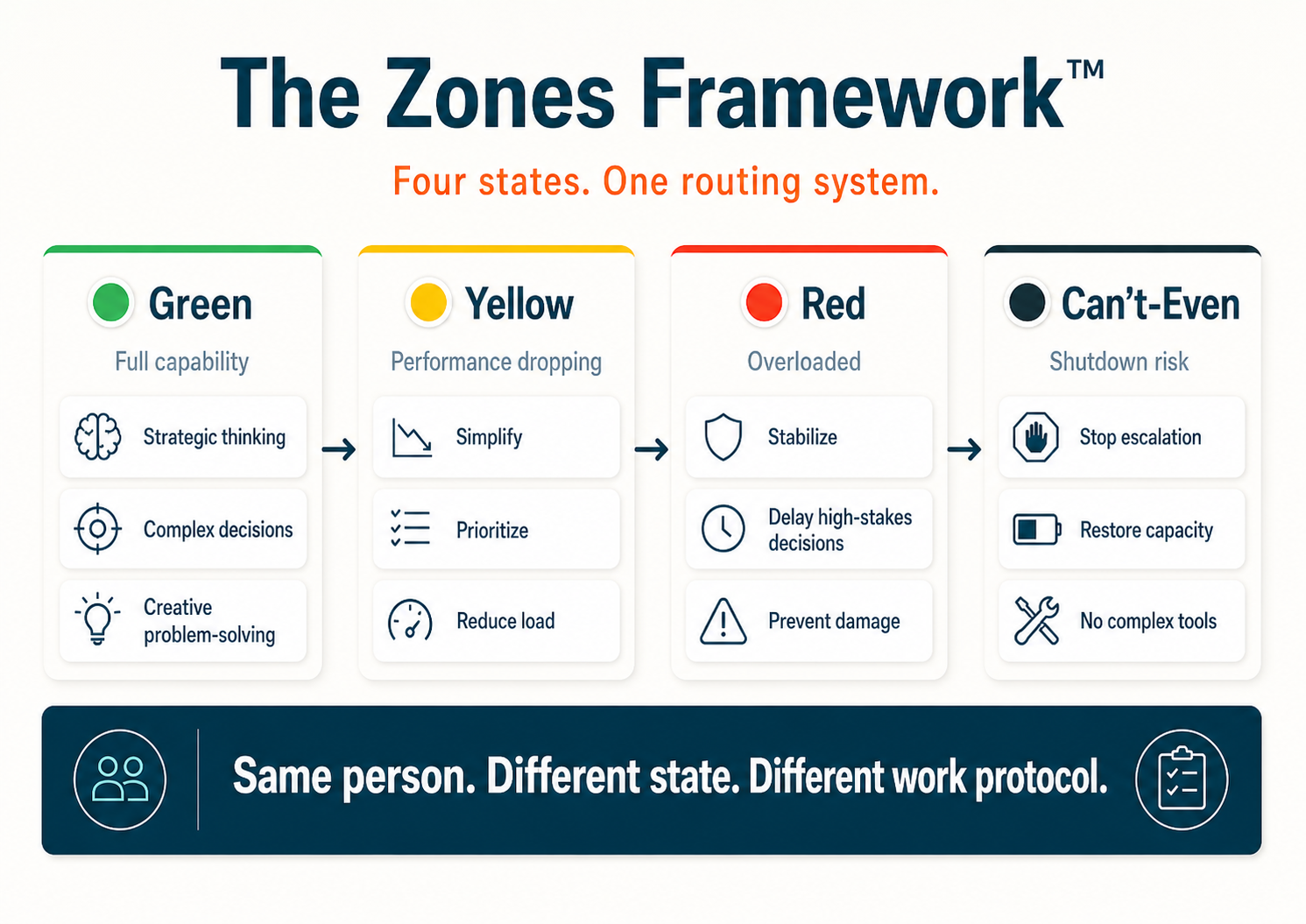
Five connected components, one recurring operating discipline.
Private app and professional development
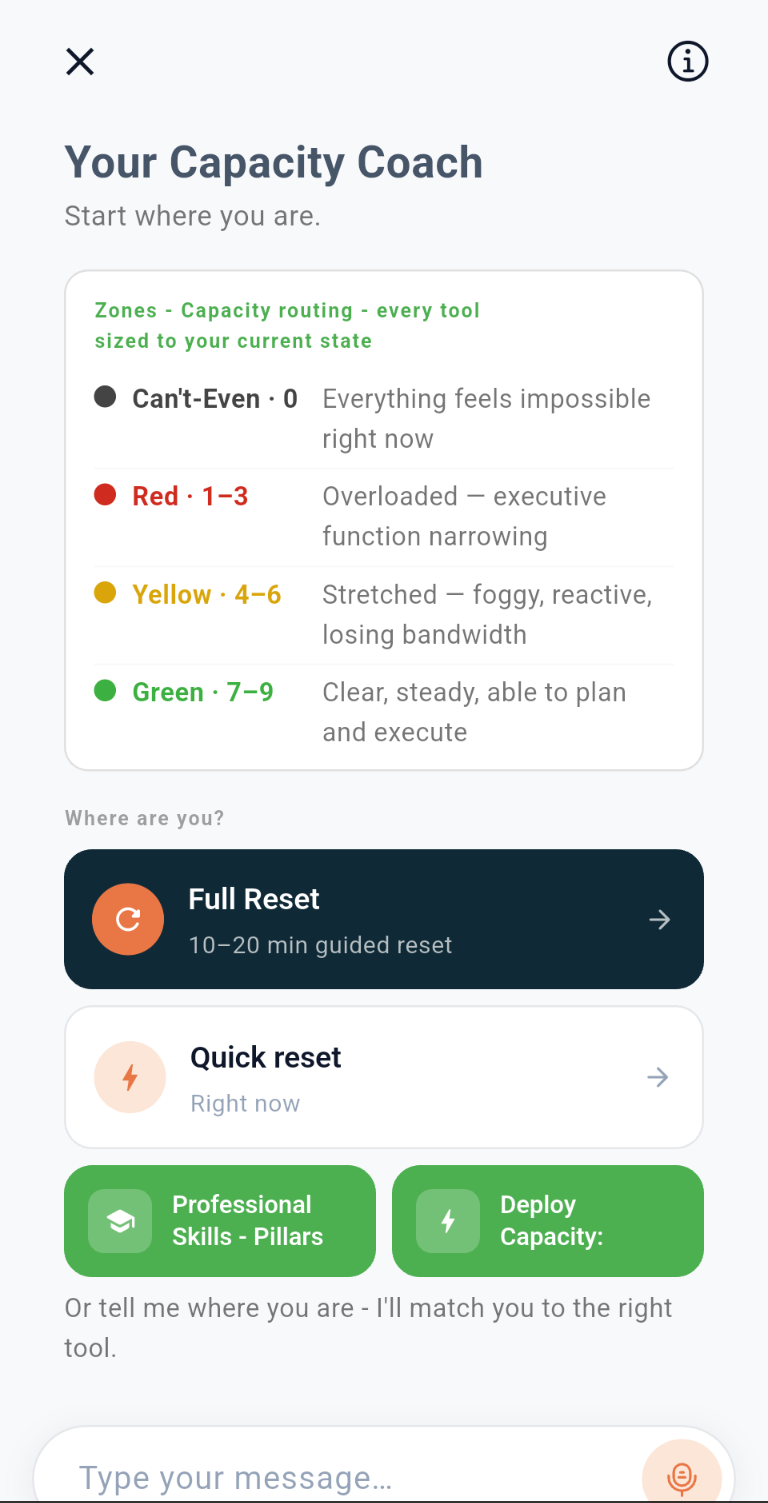 Employees get private access to the app, the Reset → Build → Thrive development arc, and ten Professional Skills Pillars. The app starts with a simple question: what capacity do I actually have right now, and what kind of work does that support?
Tools are built for the floor and scaled to the ceiling. Green uses the full version, Yellow a smaller version, Red a tiny version, and Can't-Even a five-second floor.
When capacity is low, the app supports a reset or helps route around the state. The goal is not to force Green. When usable access does not return, consequential work waits, pairs, simplifies, or moves.
When capacity is available, the app shifts to five Green deployment paths: Think Better, Communicate Better, Fix the Pattern, Create Better, and Prepare Better.
Individual app activity and Zone history remain private. No manager or employer receives a record of which intervention a person used or when it was used.
Zones as private language and shared routing logic
Green, Yellow, Red, and Can't-Even help individuals assess their own state privately and choose support and a next action. Work conversations focus on the constraint and the adjustment needed. Zones are not employee ratings or validated performance scores, and a successful Pilot does not establish them as a measurement instrument.
Managers do not assign a Zone or infer one from behavior. They use voluntarily shared work constraints, observable demand, and task consequence to decide whether work should proceed, wait, pair, simplify, or move. Any transfer of work must account for the receiving person's commitments.
Manager demand-and-consequence cohorts
The Manager Capacity Cohort develops practices for sustaining the changes under ordinary operating pressure: clearer decision rights, fewer unnecessary escalations, protected preparation for consequential work, and routing the next task by its consequence and reversibility. Cohort depth and frequency follow the contracted tier.
Managers manage demand and consequence. They do not monitor private state.
Aggregate operating-demand and outcome reporting
Reporting focuses on privacy-protected aggregate operating-demand patterns and agreed operating outcomes. Demand patterns can include queue age, work in progress, and meeting load. Operating outcomes can include approval wait, decision cycle time, reversals, rework, manager after-hours load, milestone completion, and strategic work completed.
There is no employee surveillance layer hiding behind the aggregate reporting. No individual drill-down. No individual inference. No live Zone dashboard. No use in performance evaluation. Cohort thresholds, sponsor access, source systems, and reporting rules are agreed before deployment.
Current capabilities and any planned integrations are reviewed explicitly during scoping. A feature is not represented as live until it is available in the contracted deployment.
Quarterly executive reviews and intervention support
Quarterly reviews examine each group's agreed outcome, adoption, continuing support needs, and any return to the old route. They check whether demand or cost shifted elsewhere and whether the evidence supports sustaining, adapting, expanding, or stopping the intervention. The review records an owner, operating standard, metric, target, and review date for the next action. The Five Capacity Taxes organize cost exposure; they do not establish the cause.
Intervention playbooks preserve the changes that were tested, the conditions under which they worked, and the limits found. Adaptations are recorded and assessed against the local baseline. Support connects work redesign, manager practice, private individual tools, and operating review within the same system.
How Deployment Works
The License normally follows a Pilot that improved an agreed operating result and a 30-day check showing that the gain begins to hold. The entry decision also considers adoption, privacy, support still required, and whether the customer needs ongoing ES infrastructure. Reversibility evidence matters where a capacity-effect hypothesis was tested. One successful Pilot does not establish wider repeatability.
The handoff includes the Pilot route, baseline, intervention record, playbook, measured results, durability findings, uncertainties, and continuing support needs. We select the next group because it shares a decision, approval, handoff, manager, or dependency with that route. Its owner and the people controlling the relevant work agree what will be repeated, what needs adaptation, and why.
Before changing that group's work, we agree its own baseline, metric, target, owner, review window, quality or service limits, and rules for adapting or stopping. We confirm the required authority and participation, privacy review, app access, manager cohorts, data sources, and reporting thresholds. Implementation timing depends on the contracted scope and readiness.
The first reporting cycle compares the connected group's outcome with its own baseline. It records adoption, adaptations, bypasses, reversion, support needs, and changes in work volume or mix. The Pilot supplies a reference, not a substitute baseline or an assumed effect size. We report each group's result and any capacity-effect evidence within its limits. Wider expansion requires supported reproduction and a result that begins to hold; a weak or unclear finding calls for adjustment, more evidence, or stopping.
We have not yet proved the License works at production scale: sustained use, measured operating improvement, renewal, and trusted privacy over time. That is what the Design Partner deployments are for. We will measure what happens and report the result whichever way it lands.
Who The License Is For
Organizations ready to test and sustain changes across demanding knowledge work.
The broad market is any mid-to-large organization with departments whose output depends on judgment and decisions under pressure, not routine execution.
The starting scope is usually a department, function, or business unit with a meaningful Pilot result, early durability evidence, an accountable sponsor, and a continuing need for the system. Work changes begin with the next connected group and expand as the evidence supports them. The work matters more than the industry label: judgment, coordination, and consequential decisions shape the result in settings such as pharma, financial services, private equity, professional services, law, technology, engineering, healthcare, and clinical operations.
License Tiers
The licensed population defines access and pricing. Changes to work are introduced in connected groups as evidence supports expansion. Tiers differ in manager-cohort depth, reporting scope, and support. Final inclusions and implementation timing are confirmed during scoping and contracting.
Foundation
$480 per employee per year
Minimum population: 200 employees
Minimum annual contract: $96,000
App and ten-pillar curriculum, internal use of the Zones routing language, one manager cohort per year for up to 30 managers, standard privacy-protected aggregate reporting, quarterly executive reviews, and standard support.
Best fit: a defined knowledge-worker population expanding from a successful Pilot.
Scale
$600 per employee per year
Minimum population: 500 employees
Minimum annual contract: $300,000
Everything in Foundation, plus two manager cohorts per year for up to 60 managers, expanded reporting and intervention support, priority service, and an annual measurement refresh. A full Capacity Audit, if needed, is scoped separately.
Best fit: multiple teams or functions sustaining a shared operating discipline.
Enterprise
Custom pricing
Scope and minimum are determined during scoping
Customized population, manager cohorts, reporting architecture, intervention support, executive review cadence, implementation services, and account support, all subject to privacy and evidence guardrails.
Best fit: large organizations expanding a proven model across multiple functions or business units.
Commercial credits, multi-year pricing, implementation services, and Design Partner terms are confirmed in the written proposal. No public pricing statement overrides the executed agreement.
Who Delivers the License
A senior practitioner leads ES deployment, manager-cohort delivery, quarterly reviews, intervention support, and any contracted measurement refresh. The client's executive sponsor owns the business outcome, resources, and cross-function decisions. Each work group has a named owner for its operating standard and agreed measures, with responsibility for data access and review assigned before deployment. The written scope defines which work ES delivers and which work the client owns.
During the Design Partner phase, the founder is directly involved in kickoff, methodology review, findings interpretation, and executive readouts. As the License matures, those responsibilities move into the standard delivery model.
Background. Jim Wilde brings more than four decades of enterprise systems experience, including nine years as a consultant and lead developer on mta.info, the public-facing platform for the Metropolitan Transportation Authority. The methodology is documented in CAPACITY: The Variable No One Measures.
2026 Design Partner Cohort · Up to Three Planned Slots
Help test the production-scale model.
The License has not yet earned production-scale outcome claims. Design Partners help test sustained use, manager adoption, privacy trust, operating results, and renewal logic in real demanding work.
- Founder involvement at named moments such as kickoff, methodology review, and executive readouts.
- Methodology adaptation within clear guardrails while the production operating model is refined.
- Case-study consideration only when measured results, client permission, and confidentiality requirements support publication.
Current Design Partner terms include 15% off the first engagement. Final commercial terms are stated in the written proposal.
Questions We Get
Do we need a successful Pilot before licensing?
Normally, yes. The Pilot supplies the measured result and intervention record; the 30-day check adds early durability evidence. Scoping also examines adoption, privacy, support needs, authority to act, and the value of continuing. The License tests reproduction in the next connected group against that group's own baseline. Wider expansion must be earned. If an internal handoff can sustain the result, a License may be unnecessary.
What is the privacy architecture?
Individual app activity and Zone history are private. Managers and sponsors do not receive live individual-state monitoring, individual intervention history, or individual drill-down. Reporting covers agreed operating-demand patterns and outcomes, implementation records, and voluntary group feedback under confidentiality thresholds and access rules agreed before deployment. Where those thresholds cannot be met, sensitive group results are withheld or combined at a level that protects privacy.
Can managers see or assign employee Zones?
No. Individuals use Zones for private self-assessment and choosing support. Managers use voluntarily shared work constraints, observable demand, and task consequence. They do not require Zone disclosure, infer a Zone from behavior, or use Zones as employee ratings. The Four Tests assess evidence for a capacity effect; they do not assign people to Zones.
Can we license only part of the organization?
Yes. The licensed population can be a department, function, or business unit where the Pilot has produced credible evidence and an executive owns the result. The tier's population and annual contract minimums still apply. The licensed scope can be larger than the first connected group in which work changes are tested.
Is this primarily a software subscription?
No. The app is one component. The License connects five things: work-path redesign, manager practice, private individual support, aggregate reporting, and quarterly executive review.
What outcomes justify renewal?
Renewal depends on maintaining or improving agreed operating outcomes, evidence of reproduction where expansion was attempted, and value that justifies the ongoing cost and effort. Reviews consider adoption, support still needed, other changes, and whether costs shifted elsewhere. Private app use and sentiment do not establish that value. The decision may be to renew, narrow or adapt the scope, or stop under the agreement.
What happens if we do not renew?
Licensed app access and ongoing services end according to the agreement. The client retains its own operating data and the deliverables specified in the contract. Managers and employees retain what they learned. Continued use of branded materials, reporting components, and licensed content is governed by the executed agreement.
Sustain the gains. Test the next group.
Bring the Pilot readout and 30-day findings. We will assess what still needs support, whether the License adds continuing value, and which connected group should test reproduction next. Together we define its baseline and owner, the licensed scope, and the evidence required before expanding further.
