Process bottlenecks · Workflow bottlenecks · Approval bottlenecks
Bottleneck Analysis: Find the Constraint Slowing the Work
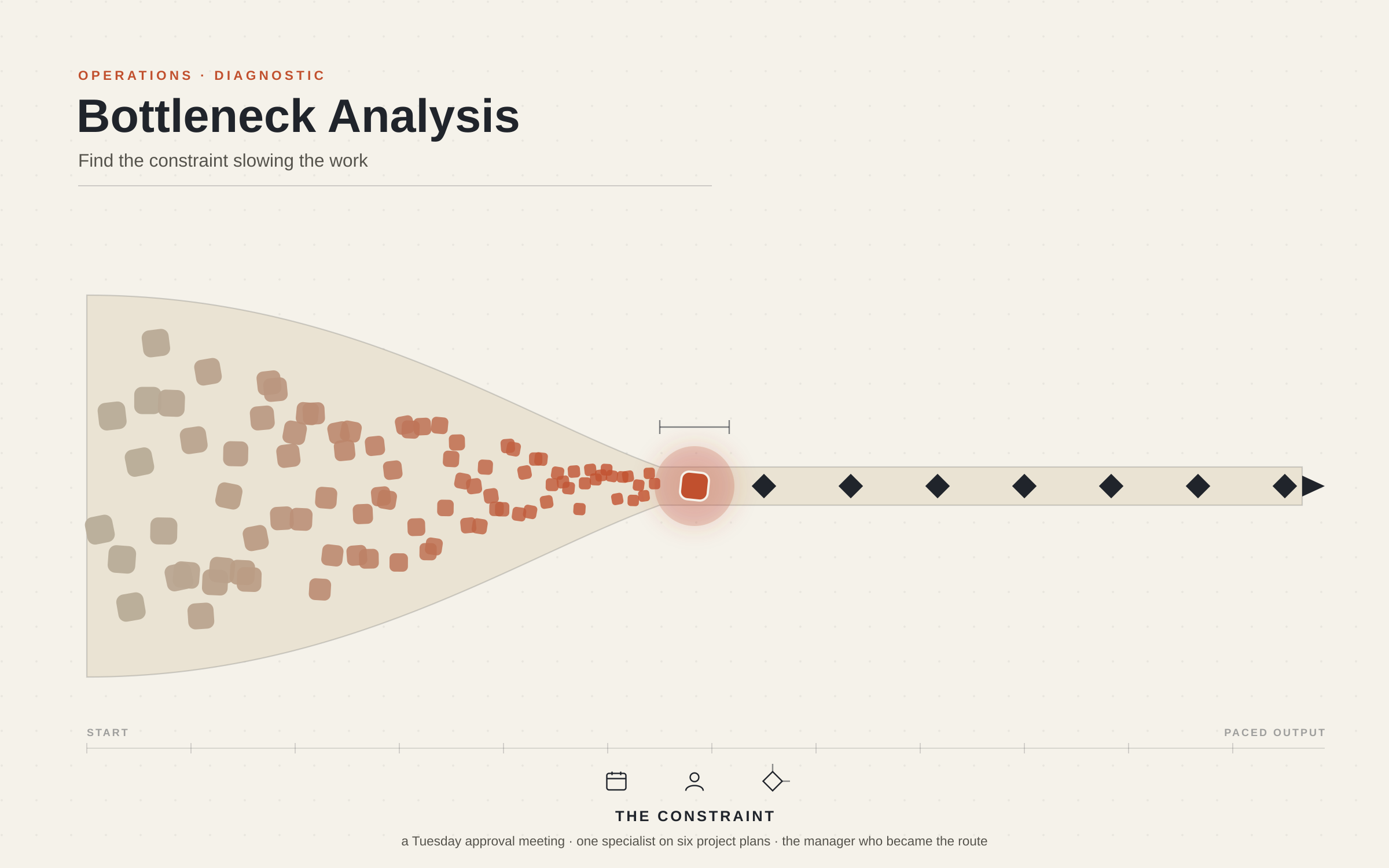
A bottleneck is the point that sets the pace for everything behind it. In knowledge work, that point is rarely a machine. It might be Tuesday's approval meeting. Or the one specialist whose name turns up on six project plans. Sometimes it is a manager who has become the route for every consequential decision, and no one decided that on purpose.
Bottleneck analysis follows one piece of important work through the route it took. The aim is to find the condition controlling the flow, change it, and see whether the work moves.
Executive SummaryThe short version for operating leaders.+
Bottleneck analysis identifies the constraint limiting throughput on a defined route. The useful evidence is ordinary: work accumulating before one point, decisions aging in the same queue, repeat trips through review, and downstream teams receiving work in bursts.
Those clues give you a place to investigate. They do not settle it. Change one operating condition and watch the measure closest to the suspected constraint. For an approval queue, that may be the age of the oldest request and the number that cleared, not a broad project score. If the result stays flat, go back to the route.
Some stalled work never reaches this analysis. Maybe the outcome is still unclear. A project can also be short of funding or missing a capability it plainly needs. If the vendor controls the date, write that down and stop.
The usual first step is a $1,500, 90-minute Stalled Priority Snapshot. We reconstruct one important priority, identify the strongest observable constraint, and design one 14-day routing experiment with the rejection condition written down in advance.
icture a team preparing customer proposals. Writing one takes four hours. Approval takes anywhere from two days to two weeks.
The proposals all go to the same executive because pricing, scope, routine exceptions, and genuinely unusual risks have been bundled into one decision. Some requests arrive incomplete. Several come back with questions. The team responds by sending reminders and adding proposal updates to the weekly meeting.
You could call the executive the bottleneck and stop there. That label would be true enough to sound useful and too shallow to fix much. The more useful finding is the route: every commercial judgment, large or small, has been pushed into one queue with no entry standard and no decision threshold.
Now there is something to test. By the fourth week of Q1, the team gives routine pricing a defined band and asks the executive to see only the exceptions. The old Jira status still says "Awaiting approval," which is not very helpful, so someone keeps a plain spreadsheet with the date each request entered the queue. It is slightly clumsy. It is also enough to tell whether approvals are clearing faster.
What bottleneck analysis means
Slow work has several suspects. Only one sets the pace.
The term comes from operations. The American Society for Quality describes identifying the constraint as the first step in the Theory of Constraints. The Lean Enterprise Institute maps the current flow of material and information from request to delivery.
Knowledge work still has flow. A product launch passes through decisions, drafts, specialist reviews, handoffs, approvals, and release windows. Some steps are quick. Some drag. A few happen in parallel and barely touch the finish date. The bottleneck is the condition that limits how quickly the whole outcome can move.
That distinction matters. Improving every slow-looking step is expensive. Worse, it can produce a beautiful local metric while the customer waits just as long.
Suppose legal review takes three days and executive approval takes five. Legal may look slow. Yet legal starts on day one while the proposal is still being finalized, so its review finishes before the executive sees the package. Cutting legal review in half changes nothing about the delivery date. The executive approval queue is still setting the pace.
I keep the expected finish date beside the trace for this reason. It is an unremarkable column, and it stops the room from spending twenty minutes improving a step that was never holding up the customer.
Four clues worth taking seriously
One late item proves very little. A recurring pattern across similar work is harder to dismiss. These are the traces I would look for first.
The pile keeps growing
Requests enter a stage faster than they leave it. People remain busy, the list gets longer, and older items become harder to restart because the context has gone cold. Check the size and age of the queue over time. Today's snapshot can mislead. The trend is much more revealing.
Different projects wait for the same thing
A legal opinion, architecture review, executive decision, customer answer, or compliance sign-off appears on several critical routes. Shared specialists are common in enterprise work. Trouble starts when demand is released without a rule for sequencing it.
Finished work keeps coming back
Rework can hide a bottleneck. One reviewer changes the standard set by another. "Final" approval turns out to be provisional. The definition of done moves late. Version history and reopen counts often tell this story more honestly than the status meeting.
Downstream teams live through feast and famine
They wait, then a batch arrives all at once. Release windows get missed. Urgent work gets created downstream to compensate for waiting upstream. The rush at the end is often blamed on execution, even when the real problem sits several steps earlier.
None of these clues stands alone particularly well. A queue can reflect a seasonal surge. Rework may come from genuine discovery. And the twelve-day compliance review in February might have been exactly right for that one contract.
Where workflow bottlenecks hide
Usually in ordinary operating choices
Manufacturing language can make bottleneck analysis sound mechanical. Office bottlenecks are messier. They live in policy, authority, meeting cadence, intake, and the informal promises people make to get work through.
- Approval cadence: completed work waits for a weekly or monthly meeting.
- Concentrated decisions: too many choices route to one leader, including choices the team once made itself.
- Shared specialists: several priorities depend on the same expert with no agreed sequence.
- Weak handoffs: the next person receives the deliverable without the context or acceptance standard needed to act.
- Uncontrolled intake: new work enters continuously while unfinished work remains open.
- Review loops: reviewers apply different standards, so completed work keeps reopening.
The manager bottleneck deserves special care. Sometimes one manager really is taking too long. Accountability still matters. But the next question is operational: why does all this work require that manager's attention in the first place?
The answer may be concentrated authority. It may be a messy intake process that makes the manager reconstruct every request. In other cases, the team has simply forgotten which decisions it is still allowed to make. "The manager is slow" does not get you far enough into any of those.
How to conduct a bottleneck analysis
Put one stalled priority on the table
Broad process workshops tend to produce broad answers. "Communication." "Capacity." "Silos." Everyone can agree with those words because they are too large to test. One actual priority forces the conversation into dates, decisions, handoffs, and consequences.
Name the finish
What was supposed to be delivered, to whom, and by when? Ask whether the outcome still matters and whether the people involved shared the same definition of done.
Check the obvious alternatives early
Capability, funding, authority, information, priority protection, and external dependencies belong here. If a vendor controls the date, say so. If the project was never funded to succeed, the workflow is a distraction.
Rebuild the route from records
Pull timestamps from tickets, calendar entries, message threads, approval records, and version history. Memory fills gaps too smoothly. Records preserve the awkward pauses and repeat trips that matter.
Mark touch time and waiting time
How long was someone working on the outcome? How long was it waiting for a decision, answer, meeting, handoff, or restart? Then identify which waits sat on the route controlling the finish date.
Write a specific explanation
"Approval bottleneck" is still broad. "Routine and exceptional requests share one executive queue, and incomplete submissions require repeat review" is specific enough to change.
Give the explanation a chance to fail
Change one condition for 14 days. Decide in advance which measure should move and what result would weaken the diagnosis. That last part keeps a reasonable hypothesis from turning into a permanent story.
What would convince you that you found it?
This is the question most bottleneck discussions skip. Teams find a crowded queue, clean it up, and declare victory. For a few days everything feels better. Then the old delay returns or appears somewhere else.
Choose a measure close to the suspected constraint. Approval age is better than a company-wide engagement score. Reopenings are better than a general feeling that communication improved. Completed offers are better than the number of proposal tasks closed.
The diagnosis is getting stronger
- The queue clears faster and stays smaller.
- More work finishes without an increase in starts.
- Repeat reviews decline.
- Downstream work arrives more steadily.
- Total elapsed time moves in the predicted direction.
Time to reopen the analysis
- The local step speeds up while the finish date stays put.
- The same delay continues after the condition changes.
- Only one unusual item improves.
- The queue simply relocates without better completion.
- An external dependency turns out to control the date.
The bottleneck may move after the first change. That is common. What worries me more is a queue that relocates while completion doesn't improve. The dashboard can still look encouraging for a week or two.
Related diagnostic methods
Same stalled priority, four different questions
These methods overlap, which is why their names get used interchangeably. Keeping their questions separate produces a cleaner diagnosis.
| Method | The question it answers | What you leave with |
|---|---|---|
| Bottleneck analysis | What is currently limiting the flow? | A supported constraint and a test of the routing. |
| Root cause analysis | What created or sustains the problem? | A causal explanation and corrective action. |
| Gap analysis | How far is the actual result from the intended one? | A defined gap and a set of priorities. |
| Workload analysis | How is demand distributed against available resources? | An allocation, workload, or staffing adjustment. |
Take the proposal example. The gap is the difference between the expected approval time and the actual one. The executive queue is the candidate bottleneck. The approval design may be the root cause. Workload analysis comes in if the executive still receives more genuine exceptions than one person can reasonably clear. That possibility cannot be ruled out from the workflow map.
Your software probably holds part of the answer
Workfront, ServiceNow, Jira, and other work-management platforms can show assignments, dependencies, status changes, open work, capacity, and reported blockers. Use that evidence. Time in status can expose an aging approval queue. A rising work-in-progress trend can show that a stage is taking in more than it releases.
The formal workflow is still only one version of events. In Jira, a ticket may sit in "In Review" from Monday morning until Friday afternoon even though the actual decision happened in a Thursday 8:30 pricing call. Nobody changes the status until the next day. Another draft may have circled through email while the platform showed "in progress." So the trace usually needs the calendar and message history too.
Sometimes the timestamp is wrong by a day. That does not make it useless. Mark it as an estimate in the readout and keep going.
A few questions that come up
Before you start tracing
How do I identify a process bottleneck?+
Choose one outcome and rebuild its actual route. Look for growing queues, old decisions, repeated reviews, and work released in batches. Then change one condition near the strongest candidate and watch whether completion improves. The test is what turns a plausible explanation into a supported one.
Can one project have several bottlenecks?+
It can have several delays and constraints. Usually one condition is setting the current pace on the route you defined. Ease it and another constraint may become visible. That sequence is expected.
What if the manager really is causing the delay?+
Say what the record supports. If decisions sit untouched in one manager's queue, that is an operating fact. Then look at a few of them. Were the requests complete? Did they really require the manager? Poor follow-through is still possible, as is a role that has accumulated far more authority than anyone noticed.
How much data do we need?+
Enough to reconstruct one meaningful route with defensible dates. A perfect dataset is unusual. Ticket history, calendars, messages, versions, and approval records can usually establish the major waits. Where the record is weak, the finding should say so.
Bring the priority people are tired of explaining.
In a $1,500, 90-minute Stalled Priority Snapshot, we reconstruct its route, separate the work from the waiting, and identify the strongest constraint the record supports.
The readout includes one 14-day routing experiment and the result that would send us back to the diagnosis. If the same pattern reaches across several priorities, that is execution drag, and the Work Demand Diagnostic examines the wider system.