Business Process Bottlenecks
Business Process Bottlenecks: Task vs. Resource Bottlenecks
Business process bottlenecks can come from the design of the workflow or from resources that cannot be used when the work needs them. Telling the two apart helps you choose the right fix.
Sometimes that works. Often it does not, and nobody understands why the same intervention that unstuck the last project does nothing for this one.
The reason is simple: not every stalled workflow has the same cause.
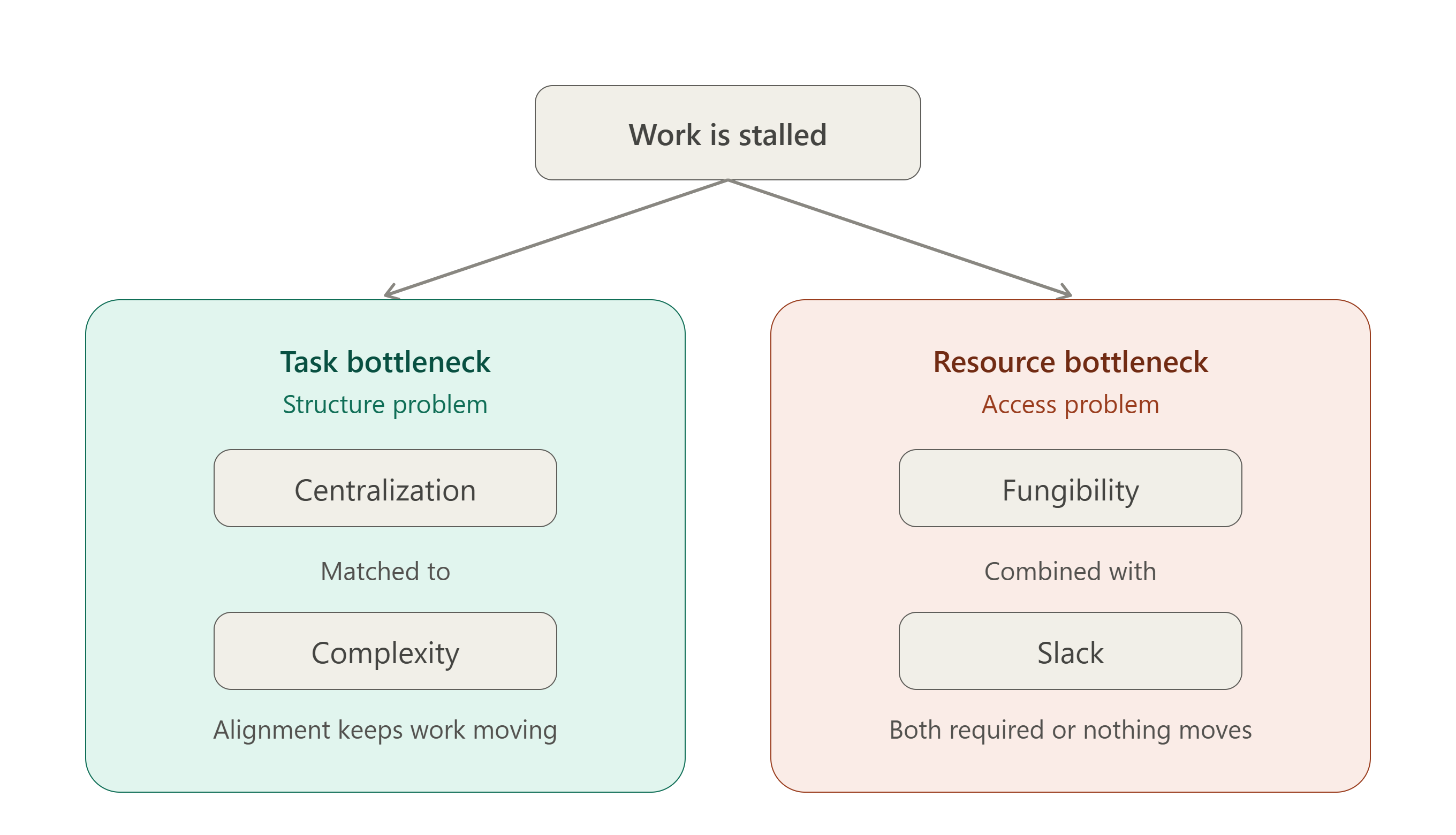
Research from Samina Karim, Chi-Hyon Lee, and Manuela N. Hoehn-Weiss, published in MIT Sloan Management Review and grounded in a two-decade study of 28 of the largest U.S. carriers, separates business process bottlenecks into two categories: task bottlenecks and resource bottlenecks. Confuse them and the fix can make the workflow worse.
A workflow design problem
Task Bottlenecks Come From Workflow Structure
A task bottleneck appears when one step is waiting for another step. The required resources may be present, but the work is queued behind a dependency, approval, or sequence that has not finished.
Two variables matter: how centralized the workflow is and how complex the task sequence is. Centralized systems route many activities through one point. That can help coordination, but it becomes dangerous when volume spikes. Complex sequences create long chains of dependent steps, giving the work more places to stop or loop back.
The researchers' finding cuts against the instinct to always decentralize: short, simple task cycles perform better centralized. Long, complex ones need to run in parallel. Match the wrong structure to the wrong complexity and the bottleneck is already built into the design.
That makes it a work-design problem, not a capability problem. Check whether the workflow itself created the delay before you look at the people running it.
A resource access problem
Resource Bottlenecks Limit What the Workflow Can Use
The second kind is different: the task isn't waiting on another task, it's waiting on something to become usable. Usable breaks into two conditions, and both have to hold.
Fungibility asks whether a resource can be applied to this task. Slack asks whether it is available when the task needs it.
A specialist who can only do one kind of work is not fungible outside that lane. A generalist who is fully booked has fungibility with no slack. Neither converts to output.
A resource bottleneck rarely announces itself as a resource problem. It tends to show up disguised as a scheduling conflict, a hiring request, or a training gap, and the workflow absorbs the delay long before anyone names the real cause.
This is also the logic behind Capacity Intelligence™: a skill can exist without being accessible to the work. A person may have the exact capability a task requires and still be unavailable because other demands have consumed the capacity needed to use it.
From the outside, that can look like a skills gap. The work record may show something else: the skill is present, but the operating conditions keep it out of reach.
Case in point
How Task and Resource Bottlenecks Compound
Most diagnostic work goes wrong at the same point: it stops at "things are stalled" and jumps straight to a remedy, usually more headcount or more training, before confirming which kind of stall is actually in front of it.
The airline data makes the cost of that mistake concrete. Every major U.S. carrier faced the December 2022 storm, and most recovered within a day or two. Southwest did not. According to the U.S. Department of Transportation, the operational failure led to 16,900 canceled flights, a $140 million civil penalty, and more than $600 million in passenger refunds and reimbursements.
The planes and crews were not missing. Southwest ran a point-to-point network instead of the hub-and-spoke model its rivals used, so aircraft and crews ended up scattered across the system with no slack to reposition them and no parallel route around the gap. That combination, long dependency chains, thin slack, and no way around a broken link, is a resource bottleneck compounding a task bottleneck: exactly the interaction the study was built to explain.
One stalled point can cascade through the system until a short disruption becomes a prolonged operational failure.
Check the workflow structure and resource access before choosing the fix. Fixing the wrong problem buys nothing.
This is why Emergent Skills tests the explanation before naming a cause. Skip that step and you may respond to a task bottleneck by adding resources, or redesign a workflow when the actual constraint is that capable people have no slack left. The work record should establish the pattern, and a small operating change should test whether the diagnosis holds.
A short work-path trace usually shows which type you're dealing with:
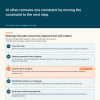
- Task sequence: Is the work waiting on a dependency, approval, or required step?
- Resource fit: Is the available resource capable of doing this particular work?
- Resource availability: Can that resource be used when the task needs it?
- Interaction: Is the workflow tying up the same resource needed downstream?
Bottleneck analysis
How to Analyze a Business Process Bottleneck
Task bottlenecks and resource bottlenecks interact. A misaligned workflow keeps resources locked up in unfinished work, which starves other tasks downstream. A resource shortage stalls a task even in a perfectly designed workflow. You cannot fully fix one without checking the other.
A useful bottleneck analysis starts with one delayed outcome, not a general complaint about the team. Map where the work waits, loops, reopens, or changes hands. Then ask whether the constraint comes from the task sequence, access to a usable resource, or both.
- Name the outcome that should have moved by now.
- Trace the actual workflow, including waits, approvals, handoffs, and rework.
- Classify the constraint as task-based, resource-based, or interacting.
- Test one small operating change and measure whether the delay improves.
If the test does not change the result, revise the explanation. The work path may not be the cause of the stall.
If a stalled priority is sitting on your desk right now and you are not sure which kind it is, that is a 90-minute conversation, not a project.
Find the Bottleneck Before Choosing the Fix
The Stalled Priority Snapshot traces one important delay, estimates its labor cost, and designs a 14-day routing experiment. You leave with a testable explanation, not a long consulting project.
Sources: S. Karim, C.-H. Lee, and M.N. Hoehn-Weiss, "Improve Workflows by Managing Bottlenecks," MIT Sloan Management Review, Dec. 10, 2024; and the U.S. Department of Transportation, "DOT Penalizes Southwest Airlines $140 Million for 2022 Holiday Meltdown," Dec. 18, 2023.