For stalled priorities, project delays, and execution gaps
Operational Gap Analysis for Stalled Priorities
An operational gap analysis looks past the distance between your strategy and your results. It traces how the work actually moved, so you can see where a priority waited, reopened, or hit a workflow bottleneck.
Why a Standard Gap Analysis Can Fall Short
Standard gap analysis asks where you are, where you want to be, and what must change to close the distance. Harvard Business School and Forbes Advisor both explain that familiar current-state and desired-state approach.
Project and work-management systems add useful evidence: status, owners, milestones, workload, blockers, and dependencies. Those records can confirm that a project delay exists. They do not always explain why approvals stalled, work reopened, or the same person kept becoming the bottleneck.
Sometimes the gap really is strategy, funding, or capability. Other times the strategy is fine and the skill already exists, but the priority is stuck behind a decision backlog or an overloaded manager. An operational gap analysis checks both before settling on a cause.
Three Gaps Behind a Stalled Priority
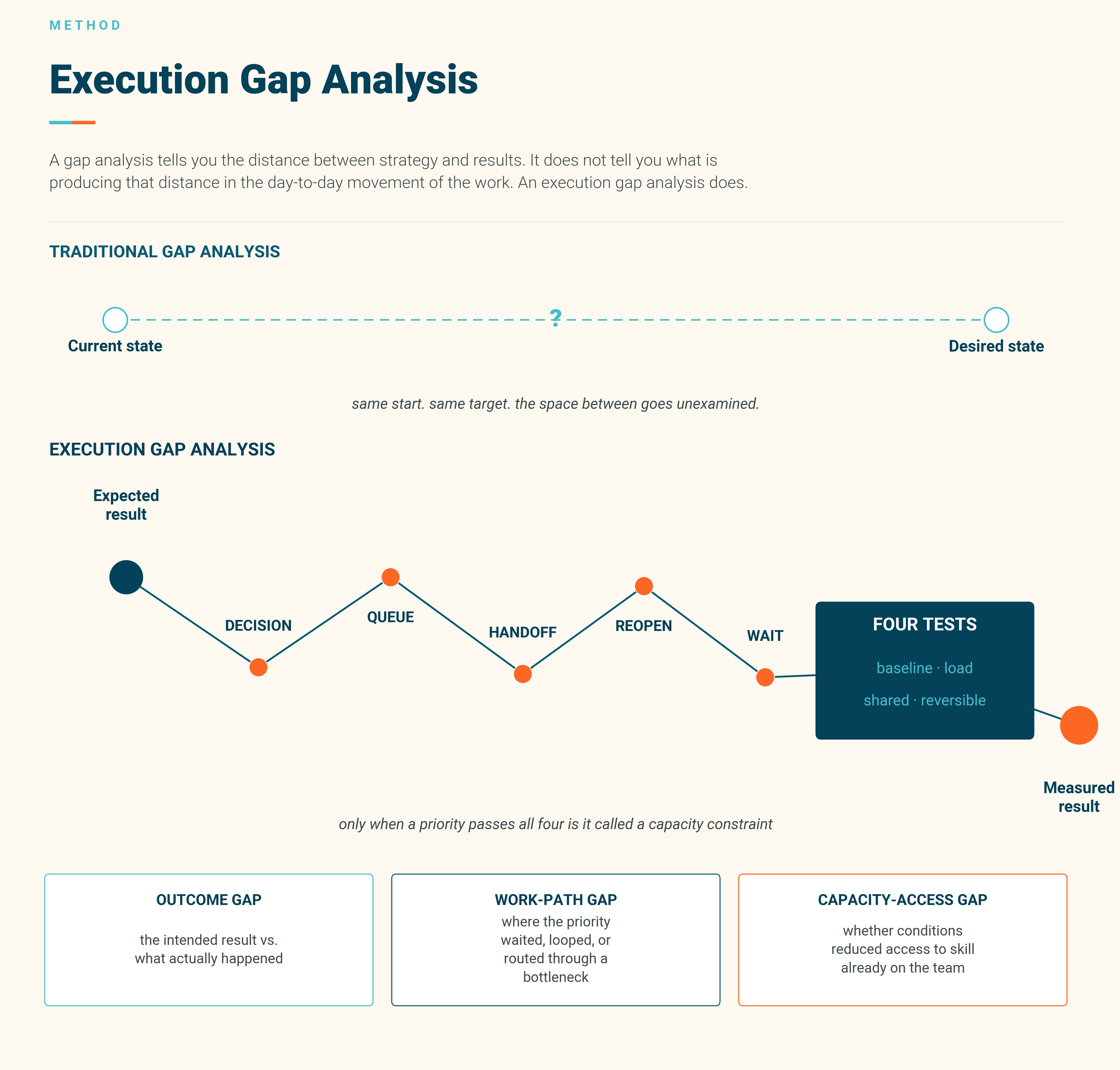
The outcome gap tells you the priority is late. The other two help explain why. If you are still establishing the problem, start with the common causes of project delays. If you already have a specific stalled priority, the route can be traced directly.
How an Operational Gap Analysis Works
Define the intended result
What was supposed to happen, by when, and how success would be measured.
Establish the current reality
What actually happened. How far behind, over budget, or below expectation the priority is right now.
Reconstruct the actual route
We trace the work through the decisions, approvals, handoffs, and restarts it actually went through. The Decision Trace maps where slow decision-making, unclear authority, or a reopened decision added delay.
Separate work from waiting
Productive touch time gets separated from elapsed time spent waiting, reworking, or chasing a decision. The Flow Read pairs the work record with what the people who carried the priority actually experienced, not just the workflow chart.
Test the explanation
We check whether the execution gap is better explained by:
- An unclear or changing objective
- Insufficient resources or skill
- External dependencies outside the team's control
- Friction in the work path itself
- Demand conditions reducing access to skill that already exists
When demand conditions look like the strongest explanation, we check it against four tests before calling it a capacity constraint: a measurable baseline shift, a load pattern that matches, conditions shared across the team rather than one person, and reversibility when conditions change. If it doesn't pass, we go back to the list.
Design a small intervention
The first response is a focused, 14-day change aimed at the best-supported constraint, with an owner, a metric, and a condition that would reject the explanation.
Measure whether execution improves
The intervention tests the diagnosis. If the target measure improves while quality holds, the explanation gets more credible. If it doesn't, we test another one.
Traditional Gap Analysis vs. Operational Gap Analysis
Traditional gap analysis
Current state → desired state → root cause → action plan.
Operational gap analysis
Expected result → actual work route → observable constraint → testable change → measured result.
This method is narrower than a full enterprise gap analysis. Emergent Skills calls its application to stalled work an execution gap analysis. It works best when the intended outcome is already clear and an important priority should have moved by now.
Start With One Priority That Should Have Moved
The Stalled Priority Snapshot applies this operational gap analysis to one priority in a 90-minute facilitated session. It traces the route, estimates the directly visible labor-cost floor, reports elapsed delay separately, and produces a one-page readout within 24 hours.
The readout includes one 14-day routing experiment with an owner, a metric, and a rejection condition. It is a credible local hypothesis, not a claim that every project delay comes from the work path.
If the pattern appears across a team or function, the Work Demand Diagnostic uses a wider evidence base. For a different way to investigate one late outcome, see how root cause analysis applies to a stalled priority.
Not ready to book? The Execution Drag Checklist walks through the warning signs, and The Hidden P&L Exposure of Work Friction and Reduced Access to Skill makes the cost case in P&L terms.
Book a Stalled Priority Snapshot
Bring one stalled priority. In 90 minutes, we trace where it waited, looped, reopened, or routed through overloaded people, then design one 14-day change to test the best-supported explanation.