Method
Gap Analysis
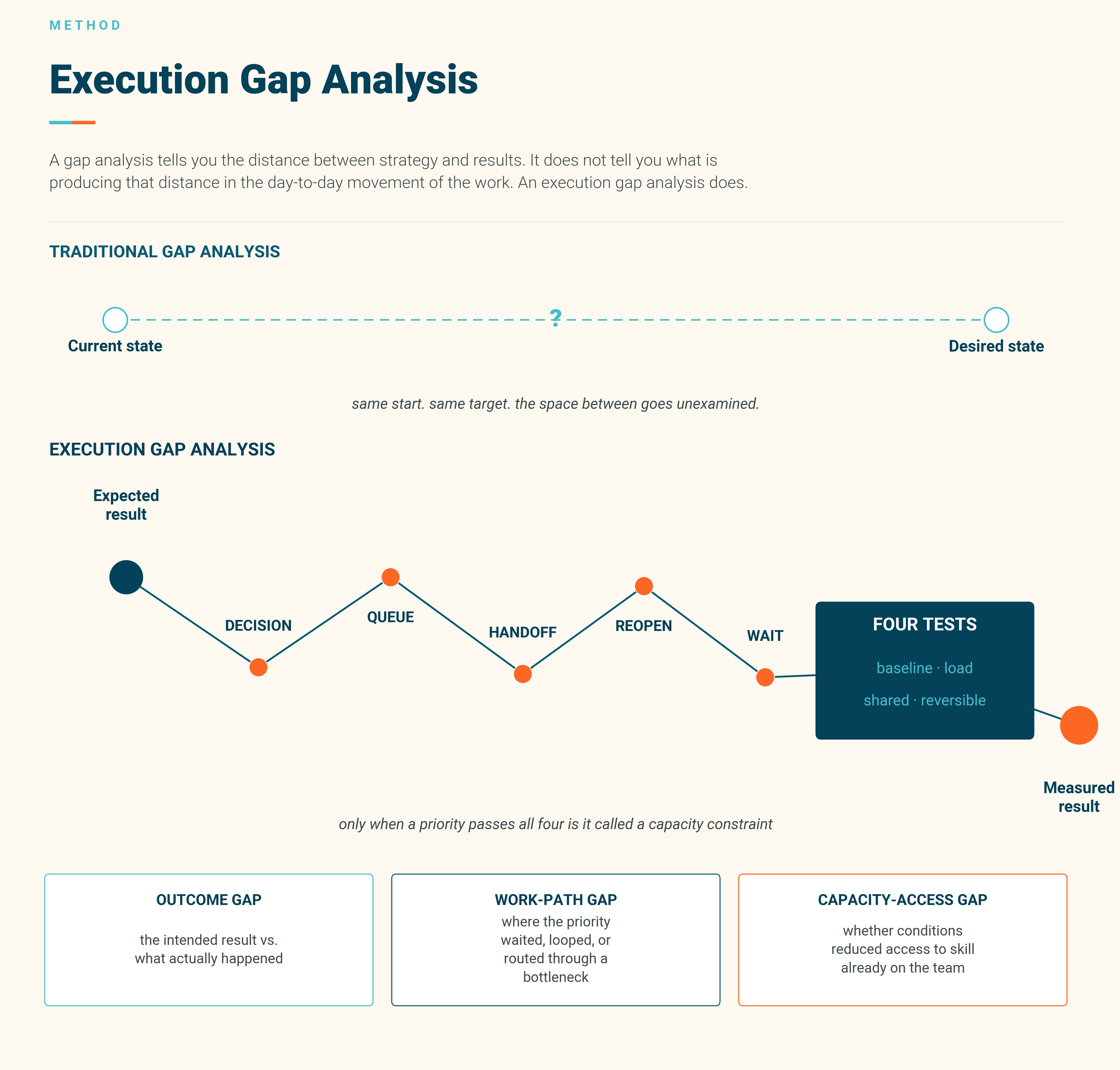
A gap analysis tells you the distance between your strategy and your results. It does not tell you what is producing that distance in the day-to-day movement of the work. An execution gap analysis does.
What Traditional Gap Analysis Misses
Standard gap analysis asks where you are, where you want to be, and treats the space between as a strategy problem or a skill problem. Harvard Business School and Forbes Advisor both walk through that standard version.
That model assumes the gap lives in strategy, structure, or competence. Often it doesn't. The strategy is sound. The skill already exists on the team. What's missing is access to it. The priority is buried in meeting load, decision backlog, manager load, or recovery debt, and no amount of strategic realignment fixes that.
An execution gap analysis is built to find that difference.
The Three Gaps We Examine
Most diagnostics stop at the outcome gap. That tells you a priority is late. It doesn't tell you why, and it doesn't tell you what to change next Monday.
How the Process Works
Define the intended result
What was supposed to happen, by when, and how success would be measured.
Establish the current reality
What actually happened. How far behind, over budget, or below expectation the priority is right now.
Reconstruct the actual route
We trace the work through every decision, approval, handoff, queue, restart, and dependency it passed through. This is where our Decision Trace instrument runs. It maps where a decision was made, delayed, or bounced back.
Separate work from waiting
Productive touch time gets isolated from elapsed time lost to waiting, rework, coordination, and unresolved decisions. Our Flow Read instrument captures this split directly from the people doing the work, not from a workflow chart.
Test the explanation
We do not start by blaming the process, the manager, or the employee's ability. We test whether the gap is better explained by:
- An unclear or changing objective
- Insufficient resources or skill
- External dependencies outside the team's control
- Friction in the work path itself
- Demand conditions reducing access to skill that already exists
If the fifth explanation is the strongest fit, we don't stop there. We run it against the Four Tests: baseline shift (did something measurably change), load signature (does the load pattern match), shared conditions (is it shared across the team, not one person), and reversibility (does it resolve when conditions change). Only when a priority passes all four do we call it a capacity constraint to a client. If the evidence doesn't hold, we revise the explanation.
Design a small intervention
Not a transformation program. A focused, 14-day change aimed directly at the constraint we found.
Measure whether execution improves
The intervention is the test of the diagnosis. If the work moves, the explanation holds. If it doesn't, we go back to step 5.
The Difference, Stated Plainly
Traditional gap analysis
Current state → desired state → root cause → action plan.
Execution gap analysis
Expected result → actual work route → observable constraint → testable change → measured result.
It's narrower than a full enterprise gap analysis. It's built to be more operational. It works best when you already know what you want and a priority that matters isn't moving.
Where This Starts
The Stalled Priority Snapshot is a rapid execution gap analysis on one priority: 90 minutes, a traced route, a labor-cost number, and a 14-day routing experiment to test it.
For a broader diagnostic across a team or function, the Capacity Audit builds on the same method with a wider evidence base for a comprehensive root-cause assessment.
Not ready to book? The Execution Drag Checklist walks through the warning signs, and The Hidden P&L Exposure of Work Friction and Reduced Access to Skill makes the cost case in P&L terms.
Book a Stalled Priority Snapshot
90 minutes, one priority, a traced route, a labor-cost number, and a 14-day routing experiment to test it.