Stalled Priority Snapshot · 90-minute investigation of one stalled business result
Stalled Priority Snapshot: find what is holding back one critical result.
A priority is late, keeps coming back for another review, or launched on time without the expected uptake. You have heard the explanations. You need a clear account of what happened and a next step the manager or leader responsible for the result can act on.
The Snapshot combines structured written input from 6-8 people who worked on the project with a 90-minute working session for up to three participants. We reconstruct the work behind the result and test two routes into execution drag: where the work path itself creates waits, loops, queues, handoff failures, or rework, and whether the way work is loaded and routed is contributing to errors, repeated work, missed handoffs, or decision problems. You receive a written assessment with the route map, the evidence behind the finding, and a recommended next step with the role responsible for acting on it. Supported extra-labor estimates and a proposed test are included where the records justify them.
$1,500 USD, fixed scope. Structured written input from 6-8 project contributors, plus up to three participants in the 90-minute working session. Written report within 24 hours of the session, a 15-minute walkthrough with the result owner, and a follow-up after an agreed test. No follow-on commitment. Remote or in person, with location and any travel arrangements agreed before booking.
Led by Jim Wilde: decades in enterprise systems, nine of them as a lead consultant at the MTA on mta.info and the NYC subway countdown clocks.
Request a quote or tell us your PO status and preferred date. We reply within one business day. Scope, purchasing terms, and the session date are confirmed separately.
Two routes into execution drag
One stalled result. Two routes to check.
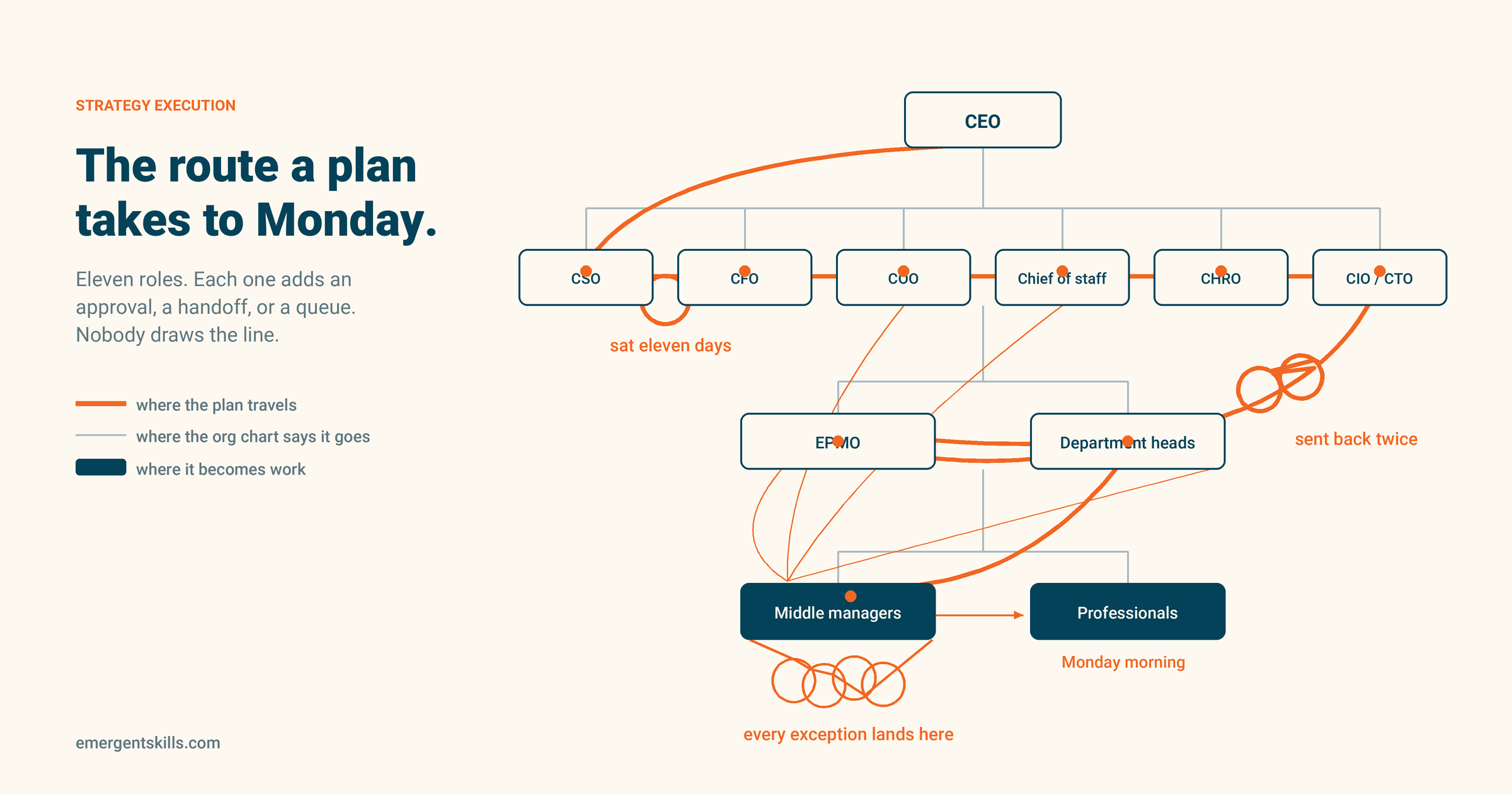
A late result is rarely one person's fault and rarely one cause. The Snapshot tests the two routes the evidence can actually show.

Route 1. The work path
Waits at approvals, loops back for rework, queues at a gate, gaps at a handoff. What the work record itself explains.
Route 2. How work is loaded and routed
Where a step is routed through someone already loaded with other work, that step waits longer, returns for rework, or produces a weaker decision.
The Snapshot tests both routes against the record and names which one the evidence supports, what remains unproven, and the next step.
The sample read
See a sample stalled-project analysis before you buy it.
Northline Group is a fictional company with about $2B in revenue and roughly 9,000 employees. All figures are invented to demonstrate the report, not customer results. Use the sample to see how a finding connects to the work record and a proposed action. Your report follows the evidence available for your result.
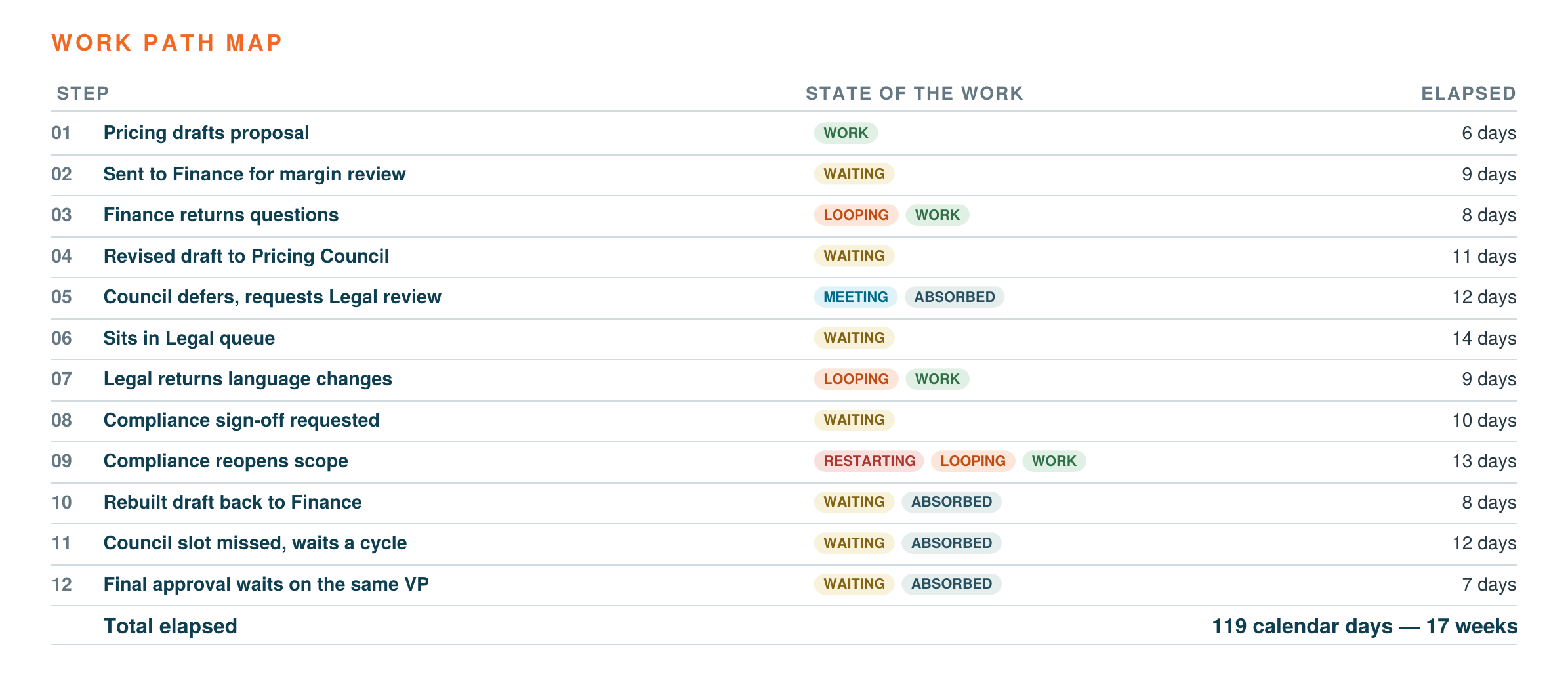
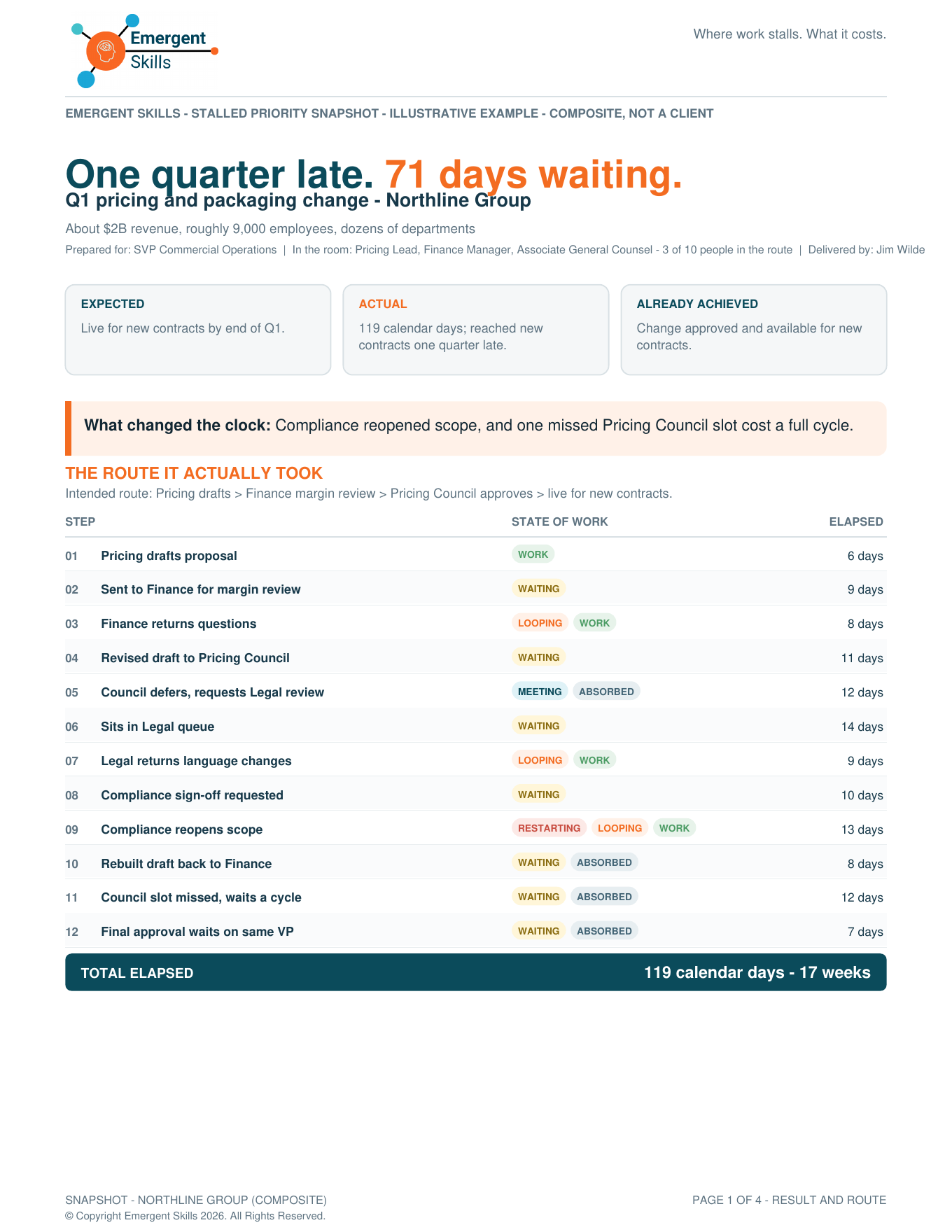
The invented case is a pricing and packaging change intended for the end of Q1. Pricing drafts, Finance reviews margin, and the Pricing Council approves. The reconstructed route involves ten people; three participate in the session.
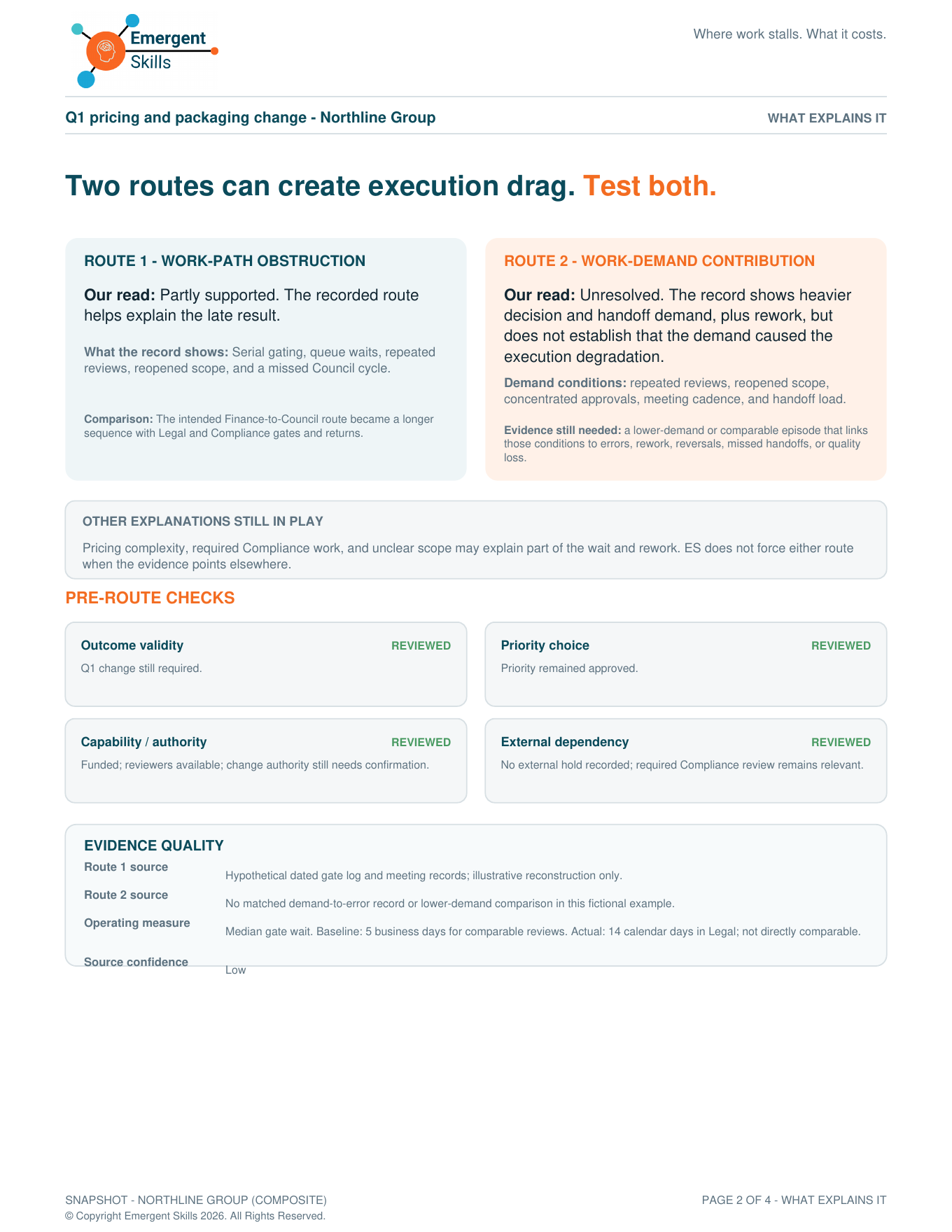
As you read, check four things: can you follow the work, see what the work path explains, see whether the way work is loaded and routed contributed to errors or rework, and understand the next decision? Page two also identifies alternative explanations and what the session has not established.
See a mixed-results Snapshot: launched on time, adoption below target.
Sample findings
The two-route finding, the cost calculation, and the proposed test.
The path: 12 steps, 119 calendar days
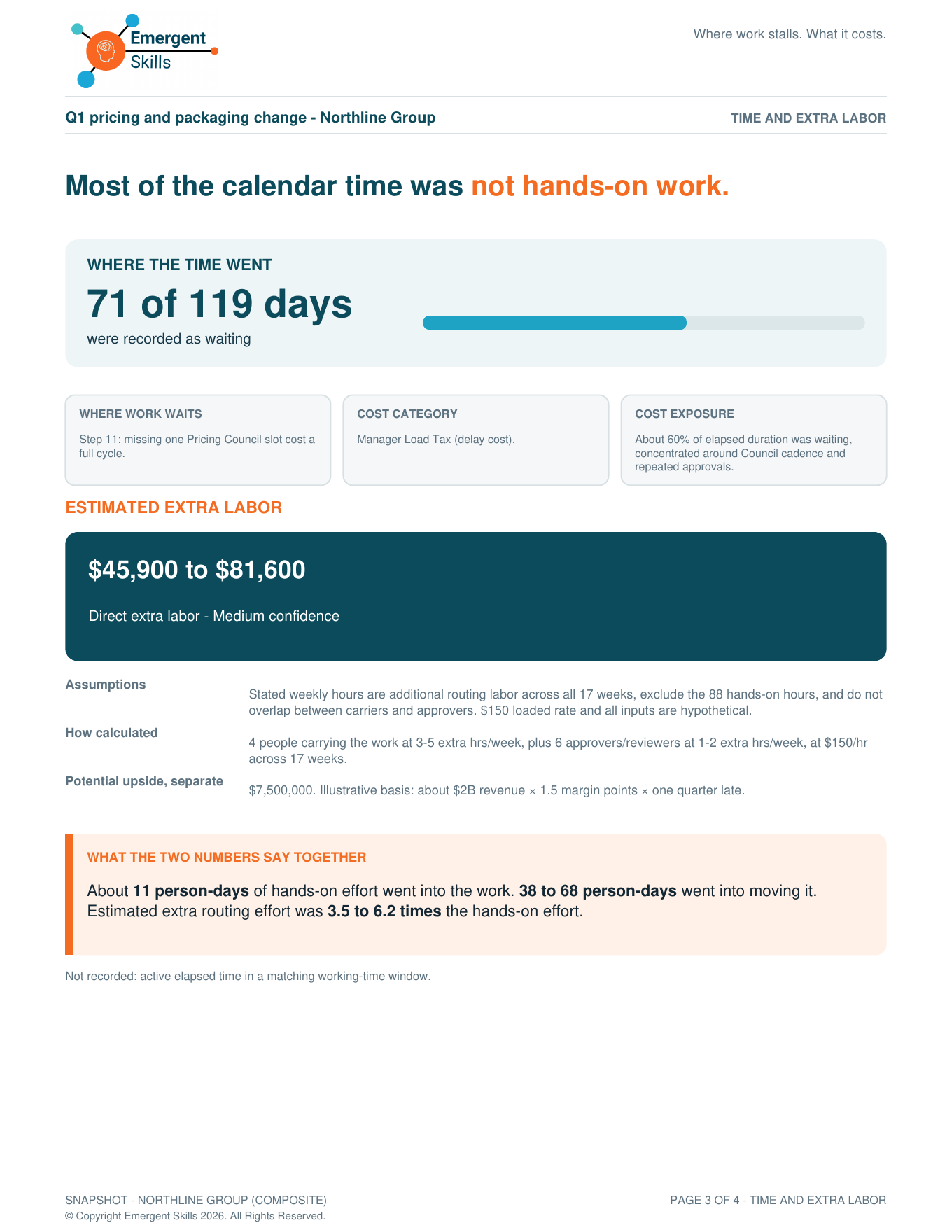
The example spans 119 calendar days, including 71 days marked as waiting. It assumes 88 person-hours of hands-on effort.
The proposed pattern: sequential reviews and repeated gating
In the invented route, Finance, Legal, and Compliance review in sequence, and reopened items restart the sequence. Missing a Pricing Council slot adds another meeting cycle. That suggests a review pattern worth investigating; required controls still need to be understood.
The illustrative estimate: $45,900 to $81,600
Illustrative extra labor: four people at three to five additional hours a week, plus six reviewers at one to two, over 17 weeks at an assumed loaded rate of $150 an hour. The calculation produces 306–544 extra person-hours, or $45,900–$81,600.
What the effort comparison says
Against the assumed 88 person-hours of hands-on effort, the extra coordination effort is about 3.5–6.2 times as large. That is a labor-to-labor comparison. It says nothing about how many calendar days a change would recover.
What is reported separately
The 119 days are total elapsed duration, not necessarily 119 days late. The separate $7.5M missed-value illustration assumes a 1.5 percentage-point margin improvement across $2B of annual revenue, delayed for one quarter. It is an assumed exposure, not an observed loss or a saving promised by the Snapshot, and is not added to the labor estimate.
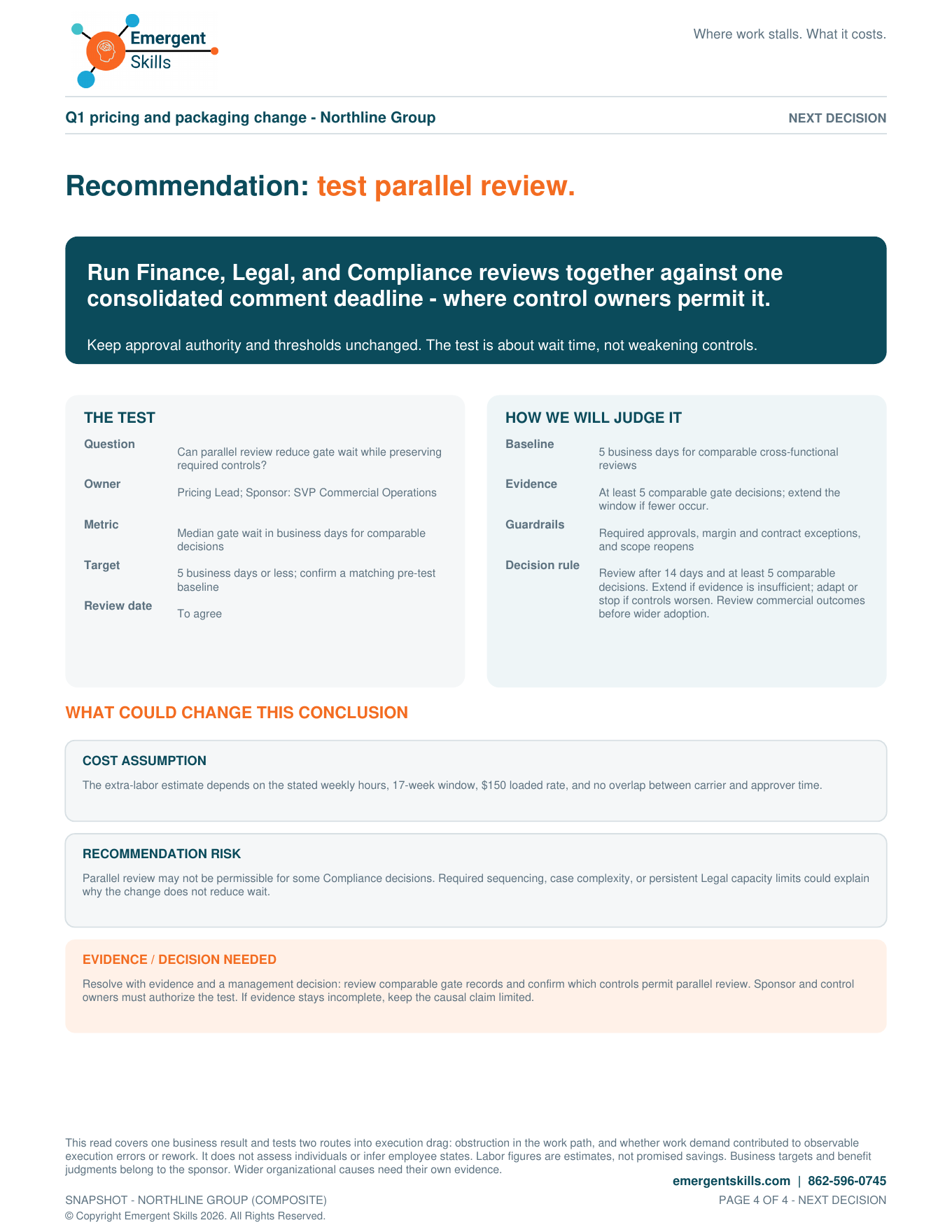
The candidate test: concurrent review
A candidate test is concurrent Finance, Legal, and Compliance review with a shared comment deadline and authorized boundaries for routine decisions. Track sequential gates, gate waiting time, reopens, and any control or quality failures. Agree the owner, baseline, targets, and approval before starting a 14-day observation window. At the review, adopt, adapt, extend, or stop based on sufficient observations; the calendar alone does not establish success.
The full written read Open all four pages of the sample report+
Page one shows what stalled and the twelve-step route it took. Page two tests both routes into execution drag: what the work path explains, whether the way work was loaded and routed contributed to errors or rework, the four preliminary checks, and what else could explain the delay. Page three shows time, Capacity Tax exposure, and the extra-labor calculation. Page four sets out the proposed test and the decision it is meant to inform.
Report length follows the evidence. A mixed-results case can include the result owner's target, reported result, and remaining shortfall. The time-and-cost page is omitted when there are no supported quantities to report; longer routes or supporting records can add pages.
Why bring in ES?
What does Jim add to your internal review?
Your team may already know the project in detail. An internal review can work well when someone has the time and access to bring the accounts together and challenge the explanation. AI can help organize records and flag inconsistencies; the people who know the work still need to check the source material and resolve disputed accounts.
The reason to bring Jim in is to give one unresolved result a focused review across the contributors, participants, and records involved. He leads the reconstruction, checks competing explanations, and turns the session into a written assessment the manager or leader responsible for the result can use:
Convene the room
Bring the right perspectives into one conversation and keep attention on the result and its path.
Check both routes
Check where the work path was obstructed and whether the way work was loaded and routed contributed to errors, repeated work, missed handoffs, or decision problems. Compare other explanations, identify the supporting evidence, and state what could change the finding.
Resolve the record
Reconcile conflicting accounts where possible and mark unresolved steps or dates as uncertain.
Agree the next step
Help the responsible people agree on a practical next step, the authority it needs, and the evidence that would justify continuing.
The useful difference is a reviewed account across functions that tests both routes into execution drag: what happened, which explanation the evidence supports, what remains unproven, and what the responsible people can do next. You can assess that work in the sample before deciding whether you need outside help.
If your team can do this confidently itself, use the sample and the cost-of-stalled-work calculator to build and check an estimate.
A clear account of the shortfall and a practical next step.
- Structured written input from 6-8 people who worked on the project, followed by a 90-minute facilitated session for up to three participants, focused on one result and the gap between what was expected and what happened.
- A work-path map showing work, handoffs, approvals, waiting, and rework, with uncertain steps marked.
- A two-route evidence assessment: what the work path explains, whether the way work was loaded and routed contributed to errors or rework, what other explanations remain plausible, and what evidence could change the conclusion. The report also names the next decision or investigation and the role responsible for acting on it.
- An extra-labor estimate where supportable, with assumptions, arithmetic, and limitations. Elapsed time and any client-supplied missed-value exposure stay separate.
- The assumption the estimate depends on, the one unknown that would most change the recommendation, and whether more evidence can resolve it or a decision is needed.
- A proposed local experiment when warranted: the question, change, required approval, owner, metric, target, evidence threshold, guardrail, and decision rule. If a test is premature, the report names the next question to investigate.
- A brief written report within 24 hours and a 15-minute walkthrough with the result owner.
- A brief follow-up after an agreed test to review the evidence and decide what comes next.
$1,500 USD, fixed scope. Remote or in person, with location and any travel arrangements agreed before booking. No follow-on commitment. The full $1,500 is credited toward the Work Demand Diagnostic if booked within 30 days.
Best fit: one important result depends on work across functions or decision points and is late, stuck in review, or under-adopted. There is a manager or leader responsible for the result and a realistic route to authorizing a small change within 30 days.
A fair question
What if the chokepoint turns out to be me?
Then we look at what that approval does, why it exists, and whether the work could move differently without losing the control it provides. Any test needs the relevant authority and must preserve required controls. The subject of the review is how the work moves and what can change; the Snapshot does not rate individual performance.
No HR records, system credentials, or data exports are required. We use the work description, dates, estimates, and purchasing information needed for the engagement. Participants should share only information they are authorized to share, and you decide how to circulate the report within your organization.
Two situations worth tracing
A missing approval. A launch people have not adopted.
What stopped moving the last time a key person took a week off?
An approval waited. A handoff stopped. Someone checked email from vacation to keep the work moving. Bring one example to the Snapshot. We trace what waited and what others needed to move it forward.
In a 2026 survey of 1,000 U.S. knowledge workers conducted by Morning Consult for Zoom, 75% said work dependent on a key teammate pauses for at least a day when that person is away. Read Zoom's Out of Office Index.
Launched on time. Still short of the result.
Illustrative example: a rollout launched on schedule. The target was 80 of 100 eligible users adopting it by the review date; 45 did. We trace the work needed for those users to make the switch: getting access, obtaining approval, and completing the move from the old process. Where did that work wait, return, or stop?
You name the shortfall and stay responsible for judging the business benefit. We test both routes: whether the work path obstructed adoption and whether the way work was loaded and routed contributed to errors, rework, reversals, missed handoffs, or decision problems. Sometimes neither route explains the gap; low adoption on its own is not an execution-drag finding.
How the session runs
90 minutes to test what is holding back one result.
Before the session, 6-8 people who worked on the project provide structured written input about what they handled, what they waited for, what came back, and what changed. Up to three people then join the 90-minute working session to reconcile the route, check the evidence, and agree what should happen next. Include someone who handles the work directly and, where possible, someone who can authorize a change. For an adoption shortfall, include someone who knows how users get access and make the switch. We confirm the scope, contributor group, and participant mix before booking.
Light preparation. Bring the expected result, the actual result as of a stated date, and the main steps or waits you know. Note where the figures or dates came from. For mixed results, identify who owns the target and how progress is measured. Approximate dates are useful. Where authorized, have the calendar invitations, ticket or approval history, and revision dates for the route at hand. Bring an approved blended loaded hourly rate if available. No presentation, system credentials, or data export is required; the preparation sheet explains what will help. If your organization permits an AI assistant, the sheet includes a prompt you run inside your own tools to assemble the timeline from calendar and approval history. Nothing leaves your environment except what you choose to bring.
In the session, we check the priority’s conditions, reconstruct the sequence, and separate hands-on work from waits and repeated effort. Then we test both routes into execution drag: what the work path itself explains and whether the way work is loaded and routed is contributing to errors, rework, missed handoffs, or decision problems. Participants may consult calendars or records they are authorized to use. Recollections stay identified as recollections, and disputed dates stay uncertain. We finish by agreeing a proposed test or the next evidence needed.
Allow for internal time. Three people attending for 90 minutes contribute 4.5 person-hours, plus the time 6-8 contributors spend on written input, light preparation, the result-owner walkthrough, and any agreed test. Those internal costs are additional to the fee.
Who runs the session
Jim Wilde, founder, Emergent Skills.
At the MTA, Jim worked as a senior consultant and lead developer on mta.info, the agency’s public-facing platform, and on the subway system’s countdown clocks.
Jim leads your Snapshot session and prepares the written readout. He brings that delivery experience to the questions about dependencies, approvals, handoffs, and the information needed to move work forward.
Where this sits
Use the Snapshot for one result that is falling short.
One Snapshot examines one result and tests two routes into execution drag: obstruction in the work path, and execution problems associated with the way work is loaded and routed. It may support a local estimate and a testable explanation. It does not establish how often the same pattern occurs elsewhere; that is a separate question for the Diagnostic.
The Snapshot, the Diagnostic, and the Pilot apply the underlying execution gap analysis at different scopes: examine the conditions, reconstruct the work, test both routes into execution drag, and test the explanation. See how an execution gap analysis works.
Executive summary What it is, when to use it, what it produces, and where it stops.+
What it is. A facilitated analysis of one result: a milestone, decision, deliverable, dependency, or step needed for adoption. Structured written input from 6-8 people who worked on the project broadens the record. Up to three people then reconstruct and reconcile the route in the working session and test two routes into execution drag: obstruction in the work path, and execution problems associated with the way work is loaded and routed.
Why use it. Different functions may hold different parts of the story. Written input and the working session bring those accounts together so the result owner can decide what to investigate or change next.
When to use it. A result is late, has restarted, is partly delivered, or has fallen short on adoption after launch.
What it produces. A map with uncertain steps marked, a two-route evidence assessment, the strongest explanation supported by the available evidence, and a recommended next step. Cost estimates and a local experiment are included when the evidence supports them. When the evidence points beyond both routes, the report explains why and identifies the next decision or question to investigate.
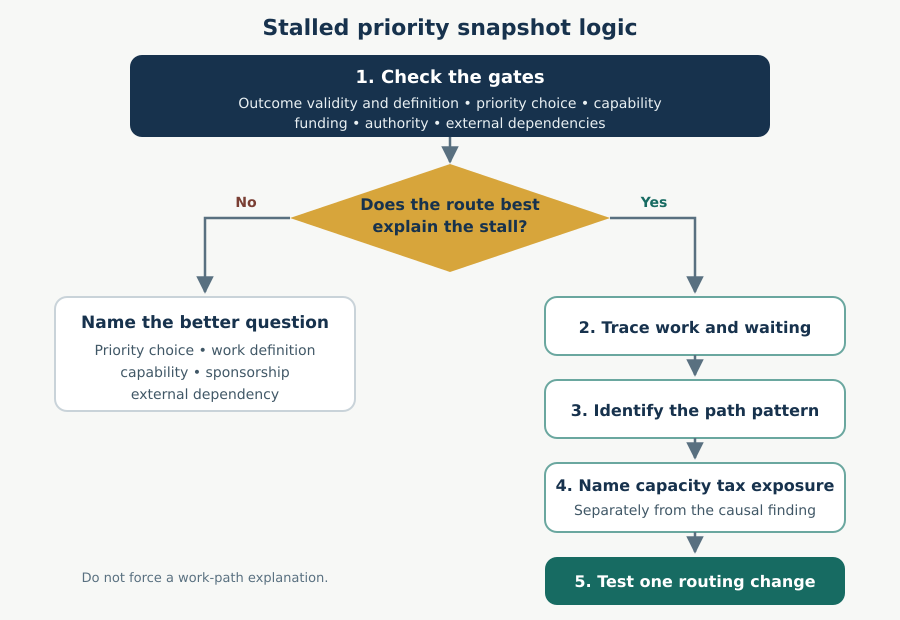
What it checks first. Whether the outcome is still valid and clear, the priority is genuinely chosen, the necessary resources and authority are available, and an external dependency controls progress. Those checks come before either route into execution drag is treated as the explanation.
Where it stops. One session examines one result. It does not establish an enterprise-wide pattern, prove a root cause, or assess individual performance.
Method notes What is checked before the two routes, how the Five Capacity Taxes are handled, and where the Snapshot stops.+
Before testing either route. We check whether the outcome is still valid and sufficiently defined; whether leadership has chosen it over competing demands; whether capability, information, tools, staffing, authority, and funding are available; and whether an external dependency controls progress. Previous success is useful evidence, but does not rule out a new capability or resource problem. New work does not automatically imply a capability gap. Only then do we test the work-path route and the work-demand route into execution drag.
The Taxes follow the evidence. The Five Capacity Taxes are the Emergent Skills framework for describing overlapping cost exposures. They are not independent root causes and are not added together.
Work-path evidence may inform estimates of coordination effort, rework, and queue-related effort, described in the framework as Meeting Tax, Decision Density Tax, and Manager Load Tax. Waiting time is not automatically paid labor lost. Work-demand evidence supports a contribution finding only when the records or participant accounts connect the observed demand pattern to errors, repeated work, reversals, missed handoffs, or decision problems; a busy team by itself is not proof.
Recovery Debt describes possible downstream exposure that a single session cannot establish. Forfeited Upside requires a client-supplied business basis and explicit assumptions. Neither is converted into an established loss by labeling it.
Cost estimates. We count supportable extra labor, distinguish levels of involvement, and show the rate, time period, range, and uncertainty. An estimate is not automatically a conservative floor or a recoverable saving. Total elapsed duration, delay against a baseline, and missed-value exposure remain separate. Each report names the assumption its figure rests on and what evidence would overturn it.
What a test can establish. Readiness to authorize a change within 30 days is a fit question. The 14-day observation window starts after an agreed change is approved and introduced. It must contain enough relevant observations and preserve required controls and quality. Improvement supports the change’s contribution, not an exclusive cause. No improvement can also be inconclusive. If the evidence is too weak for a test, the report identifies what to check next.
Want to explore the fit first?
Run the first fifteen minutes yourself.
The Execution Drag Checklist walks through the opening questions used to frame a result that has not moved. Use it to decide whether you have a specific case worth tracing. Download the checklist.
Request and schedule
Start with the priority. We will confirm the fit and arrangements.
1. Send the request
Describe one result: what was expected, what happened, and by what date. For a rollout with low uptake, include the target and observed adoption. Suggest the participating roles and give your preferred date and session format. A few sentences are enough.
2. Tell us your purchasing status
Have a PO ready? Include its number and any purchasing instructions. Need a quote to obtain a PO, or expect the PO to follow? Select that option. We will coordinate any PO documentation, supplier registration, invoicing requirements, and payment terms with you.
3. Confirm the session
We reply within one business day to review the request. We then confirm fit, scope, the 6-8 written contributors, session participants, purchasing arrangements, and an available date. We decline the booking when the answer is already clear, the contributor and participant group cannot cover the relevant route, or no manager or leader can authorize a change within 30 days. Once agreed, we send the preparation sheet and session details.
Submitting the form does not charge you, accept PO terms, reserve a date, or confirm a booking. Your date is a preference until we agree the session with you.
Start with one result
Find what is holding back one result.
$1,500 USD for the fixed scope described above.