
Why "Pushing Through" Is a Resource Error
When discipline becomes debt: The capacity cost of overriding your nervous system
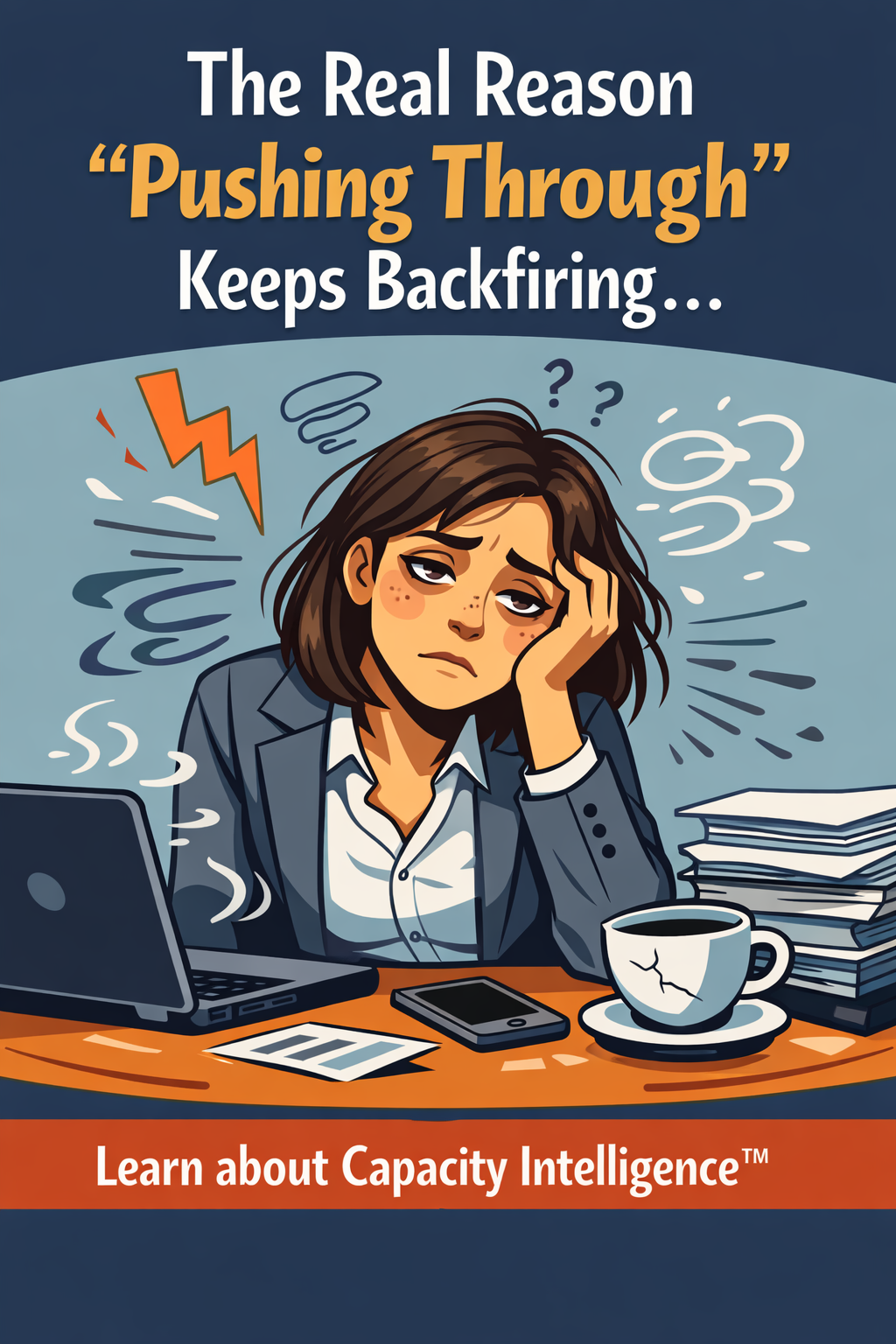
"I just need to push through." You've said it a hundred times. Maybe you said it this morning. We call it discipline. Grit. Mental toughness. But your nervous system isn't calling for discipline. It's calling for recovery.
That resistance you feel? The heaviness in your chest, the fog behind your eyes, the way simple decisions feel like calculus?
That's not a character flaw. That's data. Your brain is telling you that the resources required exceed the resources available.
And when you override that signal—when you "push through"—you're not being tough. You're borrowing against your future. You're taking a loan from Thursday-you to pay Tuesday's bills. The invoice is silent. Until it isn't.
Sources: Gallup 2024, Deloitte, WHO
The Math Problem Nobody Teaches You
Here's the thing about "pushing through": it only works when you actually have something to push with.
Imagine your cognitive capacity like a bank account. Every task, every decision, every interaction—withdrawal. Rest, recovery, genuine restoration—deposits.
The Overdraft Problem
"Pushing through" when you're depleted is like writing checks when your account is empty. The checks clear—for now. But you're not actually producing resources. You're accumulating overdraft fees in cortisol and adrenaline.
That's not the cost of "not working hard enough." That's the cost of asking depleted systems to perform like full ones. If you're feeling this daily drain, building emotional resilience becomes essential—not optional.
Why This Matters: Capacity Intelligence™
Most productivity advice assumes you show up at peak capacity. Morning routines that take 90 minutes of uninterrupted focus. Time management systems that require executive function to implement. Meditation apps that assume sustained attention.
All designed for Green Zone brains. The ones that are rested, resourced, ready.
But you need help at 3 PM on Tuesday when you've:
- Reread the same email four times
- Said "I'm fine" through clenched teeth
- Forgotten why you opened that browser tab
- Spent 20 minutes deciding what's for lunch
That's capacity depletion. Not laziness. Not weakness. A resource state.
Capacity Intelligence™ is the ability to:
This isn't just self-awareness. It's operationalized self-awareness—observation + strategic action + validation. "Pushing through" skips all three steps. It assumes the answer is always "more effort." But effort without capacity is just friction.
The Green Zone Trap (Why "Push Through" Keeps Failing)
Here's the thing nobody tells you: Every piece of "push through" advice was designed for Green Zone.
- "Just get started!" assumes you can sequence tasks
- "Break it into smaller pieces!" assumes you can identify pieces
- "Use a timer!" assumes timers don't trigger more anxiety
- "Discipline equals freedom!" assumes discipline doesn't require resources
But most of us live in Yellow Zone—high effort, diminishing returns. Functional but stretched. The spreadsheet works, but so does the tension headache. And we regularly hit Red Zone—survival mode. Just trying not to make mistakes.
76% of workers say stress negatively affects their mental or physical health. That's not a discipline shortage. That's the Green Zone Trap—using Green Zone tools on Yellow/Red Zone problems. If you're struggling with productivity, the problem might not be motivation—it might be zone mismatch.
What "Push Through" Actually Looks Like by Zone
Same situation—deadline pressure, mounting tasks, that familiar feeling of "I should just keep going." Different zones. Different math.
Green Zone (7-9): Push Away
The State
Rested. Resourced. Can access creativity, empathy, complex reasoning. The "push through" signal here: "This is hard but engaging."
The Verdict
Actually fine. This is challenge, not depletion. You have the cognitive reserves to meet the demand. Lean in.
Capacity-Aware Response
Tackle the complex stuff. Take on the meeting. Write the difficult email. This is when "discipline" works because you have resources to deploy.
Yellow Zone (4-6): Pause and Assess
The State
Functional but stretched. High effort, diminishing returns. The spreadsheet works, but you're forgetting things. Signal: "I can do this but it's taking everything."
The Verdict
This is where the damage starts. You CAN push through. The question is whether you should. Every hour here costs more than it produces.
Capacity-Aware Response
Use a 2-minute reset. Smaller tools only. Lower complexity tasks. Delay the important decision. Ask: "What's the actual deadline?" Often there's more time than urgency suggests.
Red Zone (1-3): Stop. Body First.
The State
Survival mode. Executive function offline. Just trying not to make mistakes. The signal: "I have to. There's no choice."
The Verdict
This is active damage. Pushing through Red Zone doesn't complete tasks—it creates mistakes that take longer to fix. You're manufacturing cleanup work.
Capacity-Aware Response
30 seconds body-first. Cold water on wrists. Three breaths. Walk to window. No thinking required. Get to Yellow, THEN decide if you can work.
Can't-Even Zone (0🪫): The Answer Is Rest
The State
System offline. Can't access skills. Existing is the task. The signal: "I should be able to do this."
The Verdict
There is nothing to push with. "Should" is a Green Zone word. You're in Can't-Even. The only intervention is rest. That's it. That's the tool.
Capacity-Aware Response
Permission to stop. Not "permission to feel bad about stopping"—actual permission. Rest is the intervention. Everything else can wait because everything else WILL wait whether you push or not. Rest and recovery isn't weakness—it's the only path forward.
The Invoice Nobody Sees
"Pushing through" has a cost structure. Most people never see it because it's delayed.
Immediate Costs
Lowered work quality. Mistakes you'll fix later. Shorter temper with people you care about. Decisions made from reactivity instead of clarity.
24-Hour Costs
Poor sleep. Residual tension. Wake up already in Yellow Zone. The "why am I tired when I just slept" phenomenon.
Accumulated Costs
Chronic capacity depletion. Baseline shifts from Green to Yellow. Things that used to be easy now require effort. The slow erosion where you don't notice until you can't remember what "normal" felt like.
Companies lose $8.8 trillion globally to disengagement each year. That's not lazy people. That's depleted people showing up to jobs that keep asking for Green Zone performance from Yellow/Red Zone humans. The invoice is always paid. The only question is when and how.
The Bias That Keeps You Stuck
Optimism Bias tells you "next week will be calmer." It won't.
Next week has its own deadlines, its own surprises, its own capacity demands. The calm window you're waiting for isn't coming because you keep borrowing from it to pay this week.
Optimism Bias is why you schedule 8 hours of focused work into a day with 4 meetings. It's why you assume "I'll catch up on the weekend" when you've said that for 11 weekends straight.
Capacity Intelligence™ counters this with radical honesty about current resources. Not pessimism—accuracy. Working with what you actually have instead of what you wish you had. This is why work-life balance isn't about perfect scheduling—it's about honest capacity assessment.
What's In It For You
Immediate benefit: Stop wasting energy on the wrong intervention. "Push through" burns resources. Recognizing zone state first means you use tools that actually work at your current capacity.
Tactical benefit: Know which version of yourself you're working with. Tuesday-afternoon-you is not Saturday-morning-you. They need different approaches. Capacity Intelligence™ gives you the language to match.
Strategic benefit: Capacity Intelligence™ is the meta-skill that makes every other skill accessible. Can't use emotional regulation techniques? That's not failure—that's Red Zone. Recognize it, use a body-first tool, get back to Yellow, then use regulation.
The ROI of Recovery
Every $1 invested in mental health intervention returns $4 in productivity, according to WHO. But the real return isn't dollars. It's access to skills you already have.
You already know how to focus, communicate clearly, make decisions, set boundaries. Capacity depletion doesn't delete those skills—it blocks access to them. Capacity Intelligence™ removes the block.
The Actual Point
I could wrap this up with something inspirational. "You deserve rest" or "your worth isn't your productivity." Both true. Also not super helpful when you're staring at a deadline.
So here's the practical version:
"Pushing through" is a resource error. It assumes infinite capacity in a finite system. Sometimes the math works. Often it doesn't. The cost is always paid.
Capacity Intelligence™ is the alternative. Check your zone. Match your tool. Measure if it worked. Adjust. Not revolutionary. Just honest about how humans actually work.
Start Here
This may not be you, but it is certainly someone you know. Save this for the next time you feel like you "should" be doing more.
Get the app - just type "Full Restore" when you need it.