Focus & Self-Management
(Or: When Your Brain Has 47 Tabs Open and None of Them Are Loading)
Attention tools that work when attention doesn't. No willpower required.
Part of the full Emergent Skills platform. All 10 pillars, one subscription.
Your path: Reset → Build → Thrive (with frequent detours)
You're Not Bad at Focusing. Focus Is Bad at You.
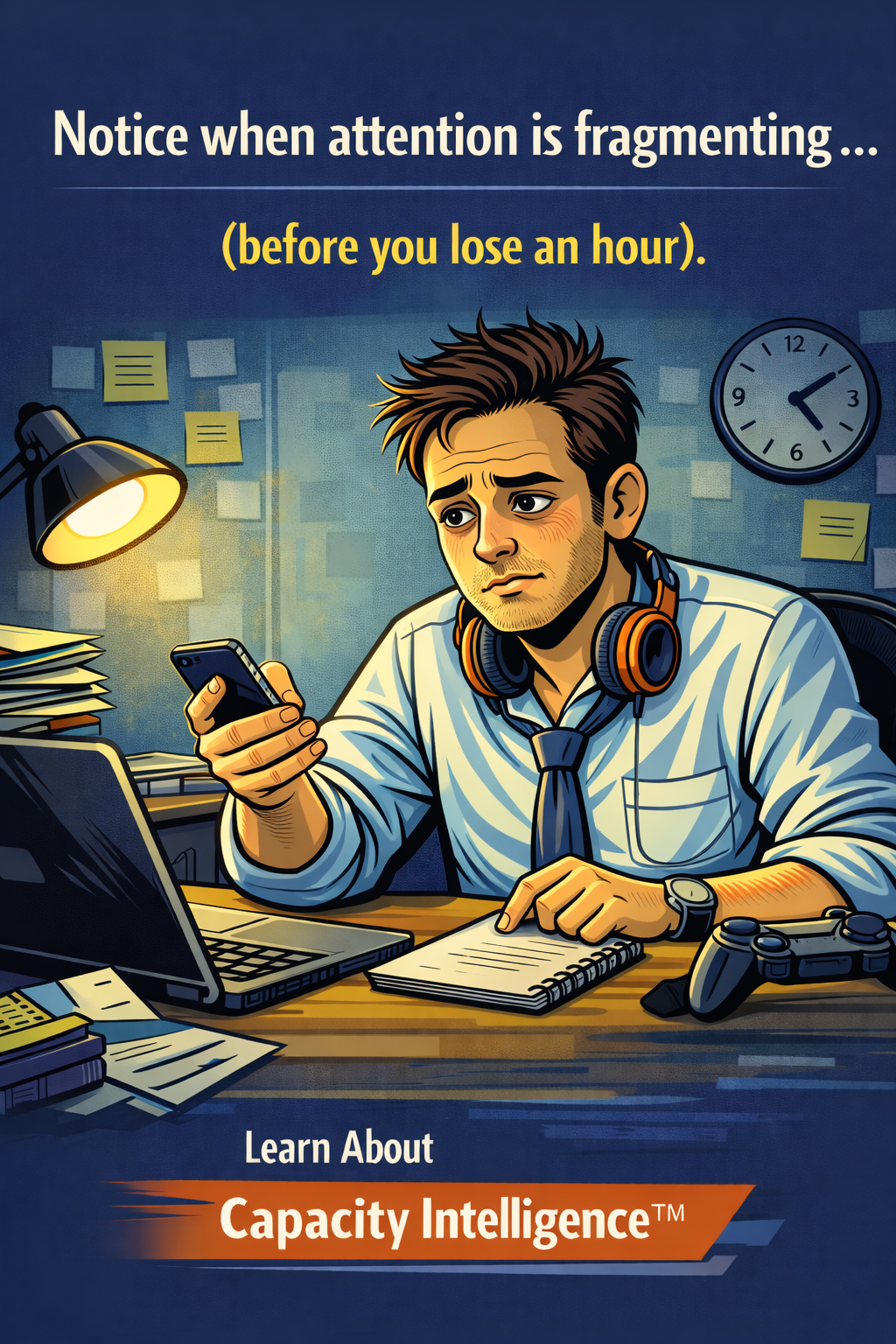
It's 10:23 AM. You sat down to write one email at 9:15. Since then you've: researched a question that arose mid-sentence, opened three browser tabs you don't remember opening, started organizing your desk, remembered a different task, and now you're reading this instead of any of them.
Sound familiar? Here's a number that should validate your entire existence: Adults check their phones 96 times per day on average. That's every 10 minutes. And each interruption takes 23 minutes to recover from. The math doesn't math. We're all drowning.
Everyone keeps telling you to "eliminate distractions." Amazing advice. Except the main distraction is your own brain, and you can't exactly put that in a drawer.
This is where traditional focus advice breaks: it assumes your attention is a resource you control. The Zones Framework™ understands something different - focus is a capacity that fluctuates, depletes, and needs different tools at different levels.
Writing this from 🟡Yellow Zone. Already forgot my train of thought twice. Kept going anyway.
Why This Matters: Capacity Intelligence™
Most focus training assumes you're starting from a calm, resourced state. Deep work protocols, distraction-blocking apps, focus music playlists - all designed for brains already capable of sustained attention.
But you need help when you're:
- Staring at a blank document while your brain plays three songs simultaneously
- Reading the same paragraph for the fourth time without absorbing it
- Unable to start the thing you actually want to do
- Hyperfocused on the wrong thing for six hours straight
That's executive dysfunction meeting capacity depletion. And it's why "just focus" is about as useful as telling someone with a broken leg to "just walk."
Capacity Intelligence™ is different. It's the meta-skill, foundation, that makes attention management possible - the ability to:
Recognize → Notice when attention is fragmenting (before you lose an hour)
Match → Select focus strategies appropriate to your current zone, not your ideal state
Act → Use the capacity-matched intervention
Reflect → Notice what actually worked (not what "should" work)
Adjust → Build personalized focus protocols based on real data
This is Operationalized Self-Awareness™ - not just noticing you're distracted, but having zone-appropriate tools ready when you notice.
The Thing Nobody's Admitting
Knowledge workers lose 2.1 hours daily to interruptions and the recovery time that follows. That's not a focus problem. That's a design problem. We built work environments that make sustained attention structurally impossible, then blame individuals for not focusing.
But here's the capacity angle: when you're in 🟢Green Zone, you can recover from an interruption in 10 minutes. In 🟡Yellow Zone? 25 minutes. In 🔴Red Zone? You might never get back to the original task that day.
Same interruption. Different capacity. Completely different outcomes.
ADHD affects approximately 4.4% of US adults. But executive function challenges under stress? That's everybody. The difference is ADHD folks live there full-time. Chronic stress just gives everyone a visitor's pass.
(The ADHD community developed these survival strategies because we had to. Turns out they work for everyone whose brain is under siege. Welcome to our world. We have snacks and fidget toys.)
The Green Zone Trap (Why Focus Hacks Fail)
Here's the pattern nobody mentions:
Every focus technique is designed for 🟢Green Zone - when executive function is online, working memory works, and you can actually implement complex strategies.
- Pomodoro Technique - requires the ability to estimate 25-minute chunks
- Deep Work blocks - assumes 4-hour sustained attention is possible
- Digital minimalism - needs executive function to resist impulses
- "Eat the frog" - presumes you can identify and tackle the hardest thing first
But most of us operate in 🟡Yellow Zone - attention works but requires constant effort, working memory is unreliable, transitions are hard.
And we regularly hit 🔴Red Zone - where sustained attention is genuinely impossible, not a character flaw.
Sometimes we crash into ⚫Can't-Even Zone. When choosing what to focus on IS the focus problem.
The focus industry has a fundamental design flaw: it assumes consistent executive function.
Result? Techniques fail exactly when you need them, creating shame spirals: Can't focus → use willpower → depletes capacity → even less focus → more shame → repeat.
This is why focus apps have abysmal retention rates. Why productivity systems become another source of guilt. Why that timer app you downloaded sits unused while you feel bad about not using it.
They're all Green Zone solutions for Yellow/Red Zone problems. Capacity Intelligence™ breaks the cycle by matching tools to actual executive function capacity.
Same Skill, Different Zones (The Actual Secret)
The secret isn't better focus techniques. It's matching techniques to actual capacity.
Here's what "sustaining attention on a task" looks like at different capacity levels:
🟢Green Zone (7-9): Full Protocol
Set intention. Create focus environment. Use 90-minute deep work block. Single-task with purpose. Review and transition mindfully. Plan next session.
When it works: Well-rested, no urgent crises, low ambient stress.
🟡Yellow Zone (4-6): Simplified Version
Body doubles or co-working. Shorter bursts (15-25 min). External accountability. Phone in another room. One browser tab only. Forgive the wandering - gently return.
When it works: Functional but effortful. Attention drifts but can be recaptured.
🔴Red Zone (1-3): Survival Mode
5-minute sprints maximum. Physical movement between tasks. Voice memos instead of writing. Body-first (cold water, movement, pressure). Lower the bar dramatically - showing up counts.
When it works: Executive function is basically offline but something must get done.
⚫Can't-Even Zone (0🪫): Rest Is The Tool
No focus work. Period. Passive rest only. The task will exist tomorrow. Trying to force focus at this level creates debt you'll pay for days.
When it works: When attempting focus causes physical distress signals.
The focus hack wasn't wrong - the capacity matching was. That's what Capacity Intelligence™ fixes.
What's In It For You (The Honest Part)
Immediate benefit: Stop the shame spiral. A wandering mind at Yellow 4 isn't failure - it's a capacity signal that needs different tools, not more willpower.
Tactical benefit: Operationalized Self-Awareness™ turns "I can't focus" into "I'm at Yellow 5, which means body-double mode, not deep-work mode." Action instead of spiral.
Strategic benefit: Capacity Intelligence™ is the meta-skill that makes focus techniques actually accessible. Can't use Pomodoro? That's not failure - that's Red Zone. Recognize it, use a 5-minute sprint, see if you shift.
Task-switching and interruptions cost the economy hundreds of billions annually. But what you really get back is access to your own attention under variable conditions.
You already know how to focus. You've done it before. Stress and depletion just block access. Capacity Intelligence™ removes the block.
That's the difference between fighting your brain and working with it. Between "why can't I just focus" and "what does my brain need right now to focus."
What You Actually Get Here
Executive Function Mapping
Learn which executive functions deplete first for you. Working memory? Task initiation? Sustained attention? Different patterns need different interventions.
Zone-Scaled Focus Protocols
🟢🟡🔴⚫ versions of every attention technique. Deep work for Green. Body doubles for Yellow. 5-minute sprints for Red. Rest for Can't-Even.
External Structure Building
Stop relying on internal willpower. Create environments that make focus the path of least resistance. Because ADHD folks figured out decades ago that external scaffolding beats internal discipline.
Attention Recovery Protocols
What to do after the interruption. After the rabbit hole. After the three-hour hyperfocus on the wrong thing. Getting back faster without the shame detour.
Hyperfocus Management
Yes, hyperfocus is real. Yes, it's a double-edged sword. Learn to channel it instead of being hijacked by it. Exit strategies that actually work.
AI Coach Access
24/7 support that understands executive dysfunction. For when you're stuck in a scroll hole at midnight or need help breaking down an overwhelming task.
Real Timeline (Because Honesty)
First use: Complete one focus block without the shame spiral when attention wanders. Notice without judgment.
Week 2: Start recognizing your zone before you've lost an hour. "Oh, I'm at Yellow 5. Time for a body double, not solo deep work."
Month 1: Recover from interruptions faster. The 23-minute recovery becomes 10 minutes because you have protocols.
Month 3: Actually use hyperfocus intentionally sometimes. It's still wild. But slightly more tamed.
Month 6: Your relationship with attention shifts from adversarial to collaborative. Still challenging. Less combative.
Results vary wildly. Some people feel relief immediately when they stop pathologizing their natural attention patterns. Others need weeks to unlearn the shame. Currently testing my own hyperfocus exit strategies. Got stuck researching focus research for four hours while writing this. Irony noted.
This Is For You If:
- You have three half-finished tasks and no idea which one to complete
- "Just focus" makes you want to throw things because you've been TRYING
- You can hyperfocus for 8 hours on the wrong thing but not 20 minutes on the right thing
- Your browser history looks like a map of ADHD
- You've bought focus apps, timers, and productivity tools that now collect digital dust
- You're secretly convinced everyone else has some attention superpower you missed
- You're neurodivergent and tired of neurotypical focus advice (solidarity)
- You're neurotypical but chronic stress has given you executive dysfunction anyway
The Connection Thing (Because Focus Doesn't Exist Alone)
Focus connects to everything. It's actually hard to find a pillar it doesn't touch:
Productivity & Achievement - These are Power Pairs. Focus without productivity is spinning wheels. Productivity without focus is scattered effort. They need each other.
Motivation & Emotional Resilience - Can't focus when you're emotionally depleted. Can't stay motivated when you can't sustain attention long enough to see progress.
Stress Mastery & Work-Life Balance - Stress murders executive function. Chronic stress creates chronic focus problems. Address one, help the other.
Rest & Recovery - Sleep deprivation and focus problems are basically the same thing wearing different hats. The brain can't attend without rest.
These connect. Or they don't, and you get the modern attention economy: everyone scrolling, nobody present, wondering why they feel so fragmented.
About Neurodivergent-First Design
This pillar was built ND-first. Not as an accommodation. As a foundation.
Here's the insight: ADHD and other neurodivergent conditions create daily executive function challenges. We've been developing coping strategies our whole lives. Not because we're broken - because standard environments weren't designed for how our brains work.
But here's what's wild: those same executive function challenges hit everyone under chronic stress. Working memory issues. Attention regulation problems. Task initiation struggles. Emotional dysregulation affecting focus.
Brains are wired differently - but they all struggle under stress. Neurodivergent folks just have more practice at it.
ND-first design principle: Build tools that work when executive function is unreliable. They'll work even better when executive function is online.
Design for ⚫Can't-Even Zone and scale up → tools work for everyone.
Design for 🟢Green Zone and scale down → tools fail under stress.
Neurodivergent employees score 24 points lower on holistic health measures. Not because of the neurodivergence - because of environments that don't accommodate different operating systems. This pillar accounts for that.
Money Talk (The Business Case)
The personal cost: If fragmented attention eats 2-3 hours daily - and the research suggests it does - that's 10-15 hours weekly. Two full workdays lost to attention fragmentation, context-switching costs, and recovery time.
The hidden cost: The cognitive load of managing attention problems while pretending you don't have them. The extra energy spent masking. The creative ideas that never surface because you can't sustain attention long enough to develop them.
For the enterprise folks: Employees with better focus management show higher engagement, lower burnout, fewer errors. Accommodating neurodivergent employees - which really means creating focus-friendly environments - benefits everyone. ROI isn't just productivity. It's retention, innovation, and people who can actually think.
About Your Brain Being a Beautiful Disaster
Some neuroscience, lightly held:
Your prefrontal cortex handles executive function - the collection of cognitive processes that include attention regulation, working memory, impulse control, and task switching. It's the CEO of your brain.
But here's the thing: the prefrontal cortex is expensive to run. It consumes massive resources. And it's the first thing to go offline when resources are scarce.
Stress? Prefrontal cortex goes offline. Sleep deprivation? Prefrontal cortex struggles. Emotional flooding? Prefrontal cortex takes a break. Hunger? You get the idea.
This is why focus problems get worse when you're depleted. It's not weakness. It's biology. The systems responsible for sustained attention literally require resources you don't have.
Capacity Intelligence™ accounts for this. Green Zone strategies require prefrontal cortex resources. Red Zone strategies work with the brainstem and body - systems that stay online even when higher functions check out.
You're not fighting your brain. You're working with a system that has different capabilities at different resource levels. That's not failure. That's accurate self-knowledge.
Where This Fits (The Journey Architecture)
Focus & Self-Management spans all three phases:
RESET: Stop the shame spiral. Learn zone recognition. Complete one focus block without self-criticism.
BUILD: Create external structures that support attention. Develop zone-matched protocols. Build sustainable focus habits.
THRIVE: Attention becomes a tool you use, not a problem you fight. Hyperfocus on command (sometimes). Focus as a superpower instead of a struggle.
Translation: Capacity Intelligence™ at the Reset level buys you back 1-2 hours daily of actual focused work. Not by adding hours - by making existing attention usable instead of fragmented.
Start Your Reset (Attention Optional)
30 minutes. Actually free. Your attention can wander during it - that's part of the data.
Focus on one thing today. Even for 10 minutes. Without the shame when your brain wanders.
One More Thing (The Self-Aware Ending)
I'll be honest: I got distracted seven times while writing this page. Researched the neuroscience section for way too long. Opened Twitter twice. Made coffee I forgot to drink.
That's... exactly the point?
Each time, I noticed [RECOGNIZE]. Checked my zone - hovering around Yellow 5 [ZONE AWARENESS]. Used a body double for accountability [MATCH + ACT]. Did it work? Mostly [REFLECT]. Tomorrow, phone goes in another room during writing [ADJUST].
That's Operationalized Self-Awareness™ in real-time. Not perfect focus. Functional focus. The ability to notice, match, act, and adjust instead of spiraling into shame about how you "should" be able to concentrate.
Most focus advice would tell me to eliminate all distractions. Capacity Intelligence™ says: "You got distracted. That's data about your current capacity. What do you do with data?"
Anyway. The point. Right.
Start here:
- 30-Minute Crisis Reset → (Free, works when attention doesn't)
- Learn The Zones Framework™ → (The foundation for everything)
- Full Subscription → (All 10 Life Skills Pillars + AI coaching)
Or just type "focus" when you're stuck.