Communication and Connection Skills
How to talk to humans without losing what's left of yourself
One of 10 pillars included with your Emergent Skills subscription
The Meeting That Broke Something
It's 2:47 PM. You just got out of a "quick sync" that lasted 47 minutes and required you to perform being a functional professional while your brain screamed about seventeen other things. Someone asked a question. You answered. Or you think you answered? The words came out but you're genuinely not sure what you said.
Now you're at your desk - staring at Slack, jaw tight, replaying whether "sounds good" sounded passive-aggressive or just... sounds good.
44% of professionals report experiencing this level of stress daily. That's the Gallup number. The other 56% are either lying or in management.
Here's the thing nobody tells you: You already know how to communicate. The skills aren't missing - they're just offline. Stress blocks access. That's called capacity depletion, and it's why every communication tip designed for your best self fails spectacularly on your worst Tuesday.
Currently writing at: 🟡Yellow Zone, probably a 5. Words are working but each paragraph takes longer than it should. Classic capacity drag. Going to keep going anyway because that's... kind of the demonstration.
The Surgeon General literally issued an advisory about loneliness - half of American adults feel isolated. And we're supposed to fix that with communication skills designed for people who aren't already running translation software 24/7?
Yeah. That's the problem we're solving. Or trying to. Ask me again after the next Slack notification.
What's Actually Happening (The Capacity Lens)
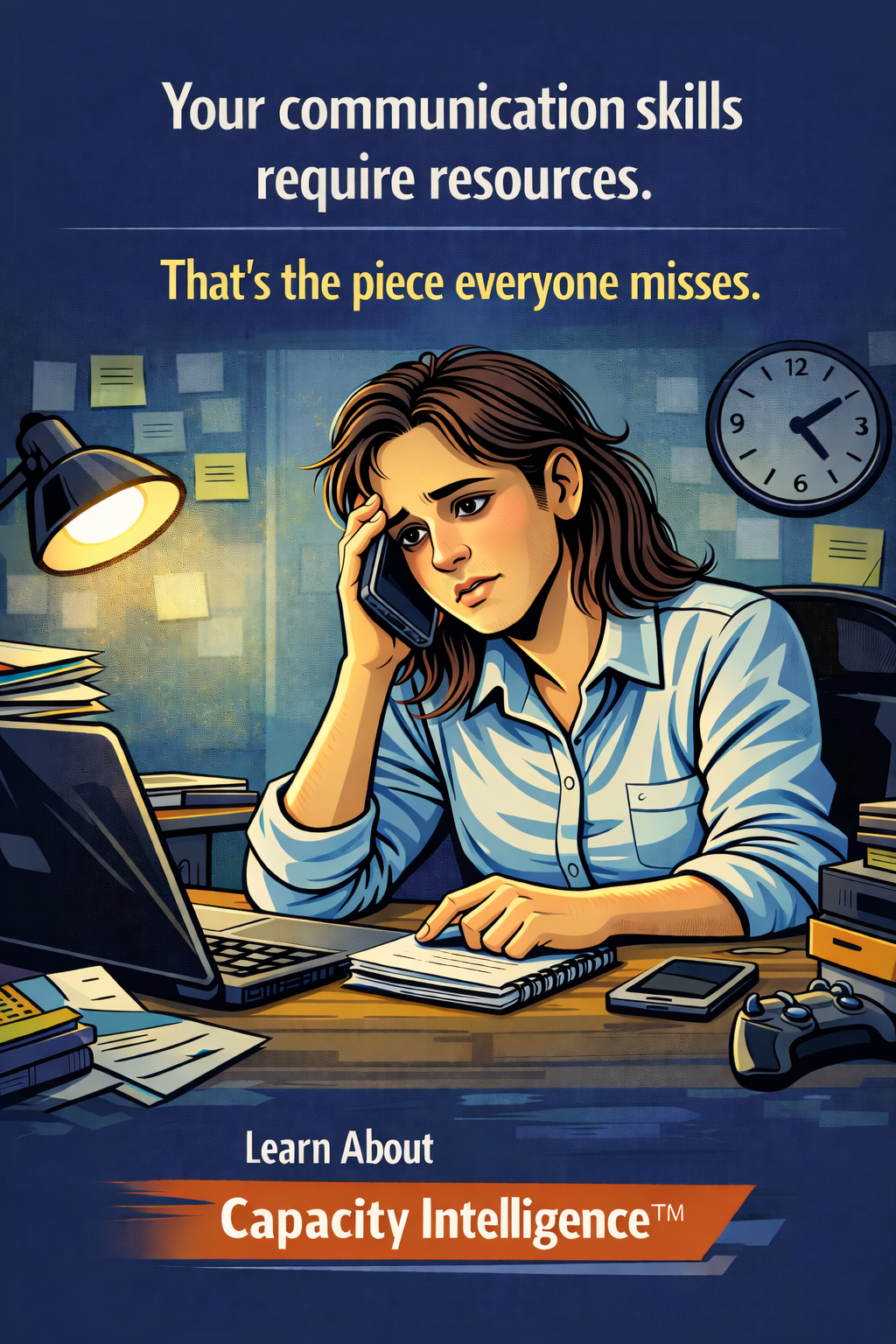
Your communication skills require resources. That's the piece everyone misses.
Every workplace conversation runs multiple processes simultaneously: word selection, tone calibration, social hierarchy calculation, threat detection, past-interaction reference, facial expression management, voice modulation. All while pretending you're not doing any of it.
The Green Zone Trap: All communication training assumes you have full cognitive capacity - 🟢Green Zone. But 77% of workers report burnout symptoms. That's not 🟢Green Zone. That's 🟡Yellow at best, sliding toward 🔴Red by 3 PM.
When you're depleted, executive function goes offline first. That's the thing that helps you pause before speaking, consider other perspectives, regulate emotional reactions. The exact skills you need for communication? They require the resources that stress takes away.
It's like telling someone with a broken leg to walk it off. The advice isn't wrong, exactly. It's just useless for the actual situation.
Lost my train of thought there. Something about - right. The translation thing.
If you're neurodivergent, you're already doing triple the processing: your thought → neurotypical-acceptable version → professional packaging → delivery → monitoring for "weird" reactions → adjusting in real-time. Every conversation is a performance. And performances drain capacity.
But here's the convergence nobody talks about: under chronic stress, everyone's brain does the neurodivergent thing. NT professionals start experiencing the same working memory issues, the same emotional dysregulation, the same "wait what were we talking about" that ND folks navigate constantly.
Which means tools built for variable capacity - ND-first design - work for everyone running hot. That's not accommodation. That's just good engineering.
Why This Matters: Capacity Intelligence™
Most communication training assumes you show up at peak capacity. Active listening workshops designed for brains that are rested, resourced, and ready to learn.
But you need help at 3 PM on Tuesday when you've:
- Said "that's a great question" three times without answering any of them
- Typed and deleted the same Slack message four times
- Forgotten someone's name mid-conversation (someone you've worked with for two years)
- Agreed to something you definitely don't have capacity for
That's capacity depletion. And it's why traditional advice fails exactly when you need it.
Capacity Intelligence™ is different. It's the meta-skill, foundation that makes every other skill accessible - including communication. Here's how it works:
That's Operationalized Self-Awareness™ in action. Not just noticing you're struggling - doing something about it with the resources you actually have.
Self-awareness without action is just watching yourself drown while taking detailed mental notes about the water temperature.
The Same Conversation at Different Capacity Levels
Here's what actually makes this different. Same scenario - difficult conversation with a colleague - scaled by zone:
🟢Green Zone Version (Full Protocol)
Use the FORD method - Family, Occupation, Recreation, Dreams - for natural conversation flow. Practice active listening with reflection ("So what I'm hearing is..."). Prepare talking points, anticipate responses, leave space for dialogue. Schedule 15-minute buffer afterward for processing.
Time: 20-30 minutes plus prep
🟡Yellow Zone Version (Simplified)
One talking point only. Write it down beforehand. Use "I" statements. If you freeze, say "Let me think about that" instead of word-vomiting. Skip the nuance - direct is fine when depleted. Text buffer: "Can we talk at 3?" gives you time to prepare.
Time: 10 minutes, scripted
🔴Red Zone Version (Survival)
Don't have the conversation right now. Send a text: "I want to talk about [thing]. Can we find time tomorrow?" That's it. That's the whole communication skill. Recognizing you don't have capacity IS the skill.
Time: 30 seconds
⚫Can't-Even Zone Version
Nothing. Rest is the intervention. The conversation will exist tomorrow. So will you, if you let yourself recover. No email, no text, no "just one quick message." Shut down.
Time: Zero. That's the point.
The protocol wasn't wrong - the capacity matching was. That's what Capacity Intelligence™ fixes.
What You Actually Get
Okay, actual tools. Let me just list these because I'm losing steam and structure helps when 🟡Yellow Zone hits -
The Pause-and-Translate Method
Permission to say "give me a second" instead of improvising something you'll regret. Works in meetings, Slack, everywhere. Stupidly simple. Stupidly effective.
Energy-Matching Assessment
Figure out how much performance you can afford before the conversation starts. Tuesday you might have Full Professional energy. Thursday you're at Barely Verbal. Most days are somewhere in the weird middle.
Scripts That Don't Sound Like Scripts
For when your brain freezes and you need words that work. Ways to say no without the guilt paragraph. Ways to ask for clarification without sounding dumb. Ways to end conversations without being weird about it.
FORD Method (Adapted for Low Capacity)
Family, Occupation, Recreation, Dreams - but scaled. 🟢Green Zone: full conversational flow. 🟡Yellow Zone: pick ONE letter and stick with it. 🔴Red Zone: "How was your weekend?" and that's plenty.
Recovery Protocols
What to do AFTER the difficult conversation. Most people skip this and wonder why they're wrecked by 5 PM. Five-minute resets. Drop-Shoulder before meetings. Floor Facts when your brain loops on what you should have said.
24/7 AI Coach
Practice on robots before humans. Rehearse difficult conversations. Get feedback without stakes. It's weird but it works.
What's In It For You (The Real Part)
Immediate: Stop wasting energy on conversations you're not resourced for. Recognize "not right now" as a valid response instead of forcing communication that makes everything worse.
Tactical: Know which tools match your Tuesday-afternoon brain versus your Saturday-morning brain. Different scripts for different states. Stop using 🟢Green Zone techniques in 🔴Red Zone situations.
Strategic: Capacity Intelligence™ is the meta-skill, foundation that makes every communication skill accessible. Can't do active listening right now? That's not failure - that's 🔴Red Zone. Recognize it, use a body-first tool, get back to 🟡Yellow, then try the listening thing.
Teams with good communication show +23% profitability - Gallup says so. And every $1 invested in mental health returns $4 in productivity. But what you really get back is access. Access to skills you already have. Stress just blocks them.
You already know how to communicate clearly, set boundaries, read a room. You learned this stuff. Capacity depletion doesn't erase it - it just takes the keys. Capacity Intelligence™ gets the keys back.
That's the difference between a thermometer (tells you you're stressed) and a thermostat (tells you you're stressed AND does something about it).
The Brain Lies (Cognitive Bias Section)
Mind-Reading Bias
"They definitely think I'm incompetent after that meeting"
They're thinking about their own meeting. Or lunch. Probably lunch.
Capacity connection: Mind-reading gets worse as capacity drops. 🔴Red Zone brain fills in every ambiguous signal with threat.
Spotlight Effect
"Everyone noticed I stumbled on that word"
They were looking at their phones. Or Slack. Or the ceiling tiles.
Capacity connection: Self-monitoring spikes in 🟡Yellow Zone. More depleted = more convinced everyone's watching.
Negativity Bias
"That one awkward pause ruined the whole conversation"
The other 12 minutes were fine. The pause was 3 seconds.
Capacity connection: Low capacity = brain only remembers the bad parts. That's survival wiring, not accuracy.
Your brain thinks it's protecting you. It's mostly just making communication harder and then blaming you for struggling.
Routes: Different Brains, Different Entry Points
ND Route (Neurodivergent)
Communication for neurodivergent brains is Olympic-level performance art. The constant translation. The masking that causes actual physical exhaustion. Rejection sensitivity making feedback feel like existential threat. Processing delays making real-time conversation feel like combat.
We built this for brains that need explicit rules because subtext is fake and "reading the room" assumes the room makes sense. If you've ever wanted subtitles for conversations, this is the thing.
NT Route (Neurotypical)
For NT brains, communication struggles usually come from overthinking. The post-meeting spirals. Mind-reading what people "really" meant. Cognitive reframes work beautifully here - separating story from fact, challenging assumptions, reality-testing the catastrophe scenarios.
Until you're stressed. Then your brain does the ND thing anyway and suddenly you need the explicit scripts too.
The convergence: Under chronic stress, everyone needs the ND approach. Executive function drops and suddenly the scaffolding that neurodivergent folks build consciously becomes necessary for everyone. That's why ND-first design works for all brains under pressure.
What About Toxic Workplaces?
Sometimes the problem isn't your communication - it's that your environment is genuinely broken. Tools for navigating dysfunction, power dynamics, and political minefields aren't about personal capacity. They're about survival in broken systems. That content lives throughout this pillar and connects to Stress Mastery & Work-Life Balance.
You can't individual-skill your way out of systemic problems. But you can protect what capacity you have while navigating them.
Connections (How This Fits)
Communication needs Confidence & Calm Under Pressure. Can't advocate if you don't believe you deserve things. Needs Confidence & Self-Worth too - hard to ask for what you need when you're not sure you're worth it.
And Emotional Mastery & Self-Forgiveness so you don't lose it mid-conversation. Plus Stress Mastery because depleted capacity makes every interaction harder.
Everything connects. Pull one thread and -
You know what, I keep writing that sentence. You get it.
Path Phase: This lives in Build - the stage where you're past crisis and constructing actual sustainable practices. If you're in free-fall, start with Reset first. Communication assumes you have some baseline capacity to work with.
The Numbers (Because ROI Matters)
Low engagement costs $8.8 trillion globally. Trillion. That's mostly communication breakdown at scale - teams that can't coordinate, feedback that doesn't land, conflict that festers instead of resolving.
High-development cultures see 2× retention. Know what drives development? People actually talking to each other. Not emoji reactions. Not "per my last email." Real words exchanged between humans who have capacity for connection.
The Surgeon General's loneliness advisory found that workplace connectedness predicts job satisfaction, creativity, performance, everything. Quality social support prevents burnout. But when authentic connection requires energy you don't have...
If you're losing 500 hours a year to communication recovery - the spiral after meetings, the anxiety before difficult conversations, the rehearsal and replay - that's your actual life dissolving into whether you used the right emoji.
Mental health ROI is 4:1. Engagement drives 23% profit increase. But honestly I'm tired of framing human suffering in productivity terms. Can we just admit that sending an email shouldn't require the same preparation as a TED talk?
The bar is in hell. We're trying to raise it slightly.
Start Your Reset
30-Minute Reset for Communication Under Pressure
Free. No card needed. Works at 3 AM when you're spiraling about tomorrow's meeting.
You don't need another active listening workshop. You need survival tools for when your brain's at 30% and someone asks "got a minute?" and you want to scream NO I HAVE NEVER HAD A MINUTE IN MY LIFE but instead you say "sure!"
Have one real conversation today. Just one. A small one. Or don't. I'm not your manager.
Closing (Demonstrating the Thing)
I could wrap this up with something inspirational. Had a whole closing planned about connection and belonging and the human need for -
But I just got a notification and lost where I was going with that. Which is... actually the point?
Real-time demonstration: That interruption was a 🟡Yellow Zone signal. Option A: beat myself up for losing focus. Option B: use Drop-Shoulder (3 seconds), re-read last paragraph, continue. Went with B. Helpfulness rating: 7/10. Good enough.
That's Operationalized Self-Awareness™ in action. Not watching yourself struggle - doing something about it with whatever capacity you actually have.
Most people would spiral into "why can't I focus" for another fifteen minutes. That takes you from 🟡Yellow to 🔴Red. Capacity Intelligence™ says: "Okay, that's a 5 on the stress scale. I need a Smaller tool, not a Full one. Quick reset, back to the paragraph."
Progress not perfection. Or whatever that saying is.
Start here:
- 30-Minute Crisis Reset (Free, unlimited, works when you can't sleep)
- Learn The Zones Framework™ (Foundation for everything)
- Full Subscription (All 10 pillars + AI coaching)
Written while actively avoiding a conversation with someone on my team. The irony isn't lost on me. I know the FORD method - Family, Occupation, Recreation, Dreams - but right now I can't remember what the D stands for and I'm not going to look it up because that would break the demonstration of what 🟡Yellow Zone actually feels like. The conversation keeps getting more awkward the longer I wait. Tomorrow I'll probably do the thing. Or the next day. Point is: I built these tools and I still struggle to use them consistently. That's not failure. That's variable capacity being variable. The tools work when I remember they exist. Which I will. Eventually. Probably after one more round of avoidance that makes everything worse.
If you need me I'll be practicing what to say in the shower. The conversation will go completely differently in real life. It always does.