
The Big Burnout Problem

burnout - stress

Research Analysis | January 2026

The Burnout Problem Everyone Agrees On (And Why Nothing's Working)

SHRM's 2026 State of the Workplace report surveyed over 3,800 respondents - workers, HR professionals, and executives. One finding should stop every leadership team cold.

Stress and burnout is the only organizational need that landed in the top five across all three groups.

Workers said it. HR said it. Executives said it. Everyone agrees this is the problem.

And yet.

The Numbers Keep Getting Worse

DHR Global's 2026 Workforce Trends Report surveyed 1,500 professionals across North America, Europe, and Asia. The findings paint a stark picture:

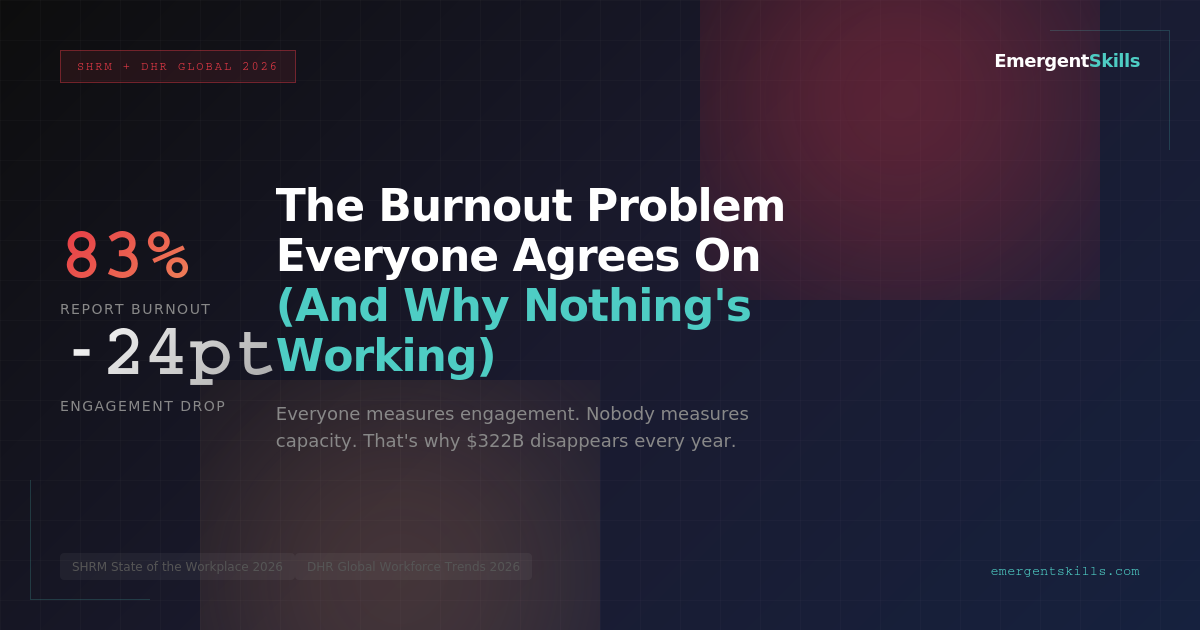
  • 83% of workers report feeling at least some degree of burnout
  • 52% say burnout is dragging down their engagement - up from 34% last year
  • Employee engagement dropped from 88% to 64% in a single year

That's a 24-point collapse. In one year.

Meanwhile, SHRM found that 72% of workers say their organization could do more to address their needs. And 25% rated their organization as "not effective at all" or only "slightly effective" at meeting those needs.

So everyone agrees burnout is the problem. Everyone agrees organizations aren't solving it. And the numbers keep climbing. Why?

The Measurement Blind Spot

Here's what most organizations measure:

  • Engagement scores (lagging, often gamed)
  • Turnover (too late - they already left)
  • Wellness program participation (measures attendance, not outcomes)

Here's what actually predicts performance collapse:

  • Real-time capacity state
  • How quickly someone recovers from stress
  • Whether they're using tools matched to their actual bandwidth

Nobody measures this. Which is why "we have a wellness program" and "our people are burning out" keep showing up in the same sentence at the same company.

The SHRM report found that 31% of HR professionals say employee experience is eroding or contracting at their organizations. Only 26% say it's improving. They're prioritizing something they're actively losing ground on.

That's not a commitment problem. It's a tools problem.

The Capacity Gap

Here's what I've learned building systems for depleted professionals:

Most workplace tools - training programs, leadership frameworks, productivity systems - assume you have capacity you don't have. They're designed for 🟢Green Zone thinking. Clear head, full access to executive function, ready to learn and implement.

But 83% of your workforce isn't in Green Zone. They're in 🟡Yellow Zone (stretched, compensating), 🔴Red Zone (reactive, making errors), or worse.

When you hand a 🔴Red Zone brain a 🟢Green Zone tool, it doesn't help. It adds one more thing they can't do to the list of things they're already failing at.

That's why the wellness apps don't work. That's why the resilience training doesn't stick. That's why engagement keeps collapsing even as investment in "employee experience" increases.

You're not addressing capacity. You're assuming it.

This is why understanding the Green Zone Trap matters - it explains the fundamental mismatch between how we design workplace interventions and the actual cognitive state of the people using them.

What Changes

The SHRM data validates the problem. DHR quantifies the damage. Neither tells you what to do when your workforce is already depleted.

That requires a different approach:

Measure capacity, not just engagement

Know whether someone is in 🟢Green Zone, 🟡Yellow Zone, 🔴Red Zone, or ⚫Can't-Even Zone before you ask them to perform. The Zones Framework™ provides a shared language for this conversation.

Match tools to actual state

A 90-day development program doesn't help someone who can't get through today. Start with what works in 30 minutes when executive function is compromised. This is the foundation of building motivation and emotional resilience - meeting people where they actually are.

Build recovery into the system

Not as a perk. As infrastructure. The research on single-session interventions shows you can shift someone's capacity state in one focused session - if the intervention is designed for depleted brains.

This is what Capacity Intelligence™ means: knowing what you can do with what you actually have right now, and having tools that meet you there.

The Window

SHRM just told every HR leader in America that burnout is the consensus crisis. DHR just showed that engagement is in freefall and burnout's impact is accelerating.

For a brief moment, the conversation is open. People are looking for answers.

The organizations that figure out capacity - not wellness theater, actual capacity management - will have an edge the others won't understand until it's too late.

The ones that don't will keep measuring engagement while their best people quietly collapse.

Go Deeper

The Burnout Crisis Nobody's Measuring Right - the full research, the economics, and what Capacity Intelligence™ actually looks like in practice.

For a comprehensive approach to rebuilding when you're already depleted, explore Stress Mastery & Work-Life Balance.

Ready to Build Real Capacity?

Get notified when Emergent Skills launches. Tools designed for how your brain actually works - especially when it's not working at its best.
Free 30-minute reset

Start Free 30-Minute Reset 

Capacity Intelligence™ - The Foundation for everything you learn.

The Emergent Skills Program (Yeah, There's Actually a Method to This)

Look, I get it. Another program. Another system. But here's the thing — these 10 pillars? They're literally everything that's been kicking my ass for years, organized into something that actually makes sense. Especially when you're stuck in 🟡 Yellow Zone at 2 PM wondering why basic tasks feel like calculus.

Here's what nobody tells you: tools require resources you don't always have. That's not a character flaw. That's capacity depletion. And it's why we built everything around Capacity Intelligence™ — the ability to recognize what you actually have to work with and match tools accordingly.

Thirty minutes to stop the spiral. Thirty days to start the fix. Stick around longer if you want to actually master it. Works even when you're 🔴 Red Zone. Maybe especially then.

So I discovered something at 3 AM last Tuesday. Every single panic spiral, every frozen presentation moment, every "why can't I just DO THE THING" — it all fits into one of these 10 categories. And apparently LinkedIn says these are the exact skills that get people promoted? Wild.

The kicker: We use AI coaches exclusively. No awkward video calls with Brad the life coach at 7 AM. Just you, your brain, and an AI that remembers your specific flavor of panic. Plus it scales to whatever Zone you're in — full version when you're 🟢 Green, tiny version when you're Red and just trying not to cry in the bathroom.

That's Capacity Intelligence™ in action: recognizing your actual resources in real-time and using capacity-matched tools instead of forcing Green Zone solutions on a Red Zone brain.

OK So Here's What Nobody Tells You

Every single one of these skills? Connected. Fix your sleep, suddenly you can focus. Manage stress, confidence goes up. It's like your brain has been playing life on hard mode and someone finally showed you the settings menu.

The real secret? All these skills are about moving up through the Zones. Spending more time in 🟢 Green, less time in 🔴 Red, knowing what to do when you're stuck in 🟡 Yellow.

That's Capacity Intelligence™: operationalized self-awareness. Not just watching yourself struggle — doing something about it.

The Zones Framework™ — Your Capacity Intelligence™ Operating Manual

Here's what most productivity advice gets wrong: it assumes you're always at peak capacity. Morning routines, meditation apps, time management systems — all designed for Green Zone brains with cognitive resources to spare.

But 44% of professionals report daily stress at work. That means nearly half the workforce is regularly operating in Yellow or Red Zone. Tools designed for Green Zone fail exactly when you need them.

  • 🟢 Green Zone (7-9): Capacity mode — focus, empathy, creativity all online. Full tools work here.
  • 🟡 Yellow Zone (4-6): Strain mode — high effort, diminishing returns. Need simpler, right-sized tools.
  • 🔴 Red Zone (1-3): Survival mode — executive function offline, body-first tools only.
  • Can't-Even Zone (0🪫): Shutdown — system offline. Rest is the only intervention.

Every tool in Emergent Skills scales to your Zone. Because "just do better" doesn't work when your nervous system's in survival mode. That's not motivation failure — that's asking Yellow/Red Zone people to use Green Zone solutions. Capacity Intelligence™ breaks the cycle.

What Is Capacity Intelligence™?

It's the meta-skill that makes every other skill accessible. The ability to:

  1. Recognize your actual resources in real-time (Zone awareness)
  2. Match tools to your current state, not where you "should" be
  3. Measure if it worked (the feedback loop everyone skips)

This isn't self-awareness. It's operationalized self-awareness — observation + strategic action + validation. Not a thermometer (tells you the temperature). A thermostat (tells you the temperature AND does something about it).

The Emotional Intelligence Part

  • Finally understanding WTF you're feeling. Red? Yellow? Green? Changes everything. That's Zone awareness.
  • Not letting emotions hijack your whole day. Recognizing Red Zone spirals before they eat your afternoon.
  • Reading rooms without being creepy. Sensing other people's Zones equals social intelligence.
  • Navigating office politics like an adult. Requires Yellow/Green minimum.

The Career ROI Part

  • Showing up consistently. Bare minimum, still counts. Yellow Zone reliability beats Red Zone heroics.
  • Speaking without your voice shaking. Yellow/Green vocal control equals executive presence.
  • Being the calm one when shit hits fan. Staying Green while everyone else goes Red. That's Capacity Intelligence™.
  • Actually collaborating, not just cc'ing.

The Science-y Part

  • Your patterns aren't your personality. They're just Red Zone survival habits that stuck.
  • Interrupting spirals before they start. Catching Yellow before it crashes into Red. Operationalized self-awareness.
  • Techniques based on actual research. Polyvagal theory equals Zones Framework™ in fancy language.
  • Building new neural pathways. Teaching your nervous system Green exists.

McKinsey says improving workplace health could unlock $3.7–11.7 trillion in global value. For you? More energy, better focus, being the one who gets tapped for opportunities while everyone else is burning out.

You're in Green/Yellow while the competition's stuck in Red. That's not talent. That's Capacity Intelligence™.

The AI coach doesn't judge when you practice the same anxiety technique 47 times at 3 AM. No awkward "how does that make you feel" conversations. Just you, figuring out how to stop self-sabotaging, one 30-minute session at a time.

And it scales to your Zone. Full coaching in Green, bite-sized basics in Yellow, survival mode scripts in Red. Because you can't "think positive" your way out of a nervous system state, but you can give it capacity-matched tools.

Pick Your Biggest Problem & Start Fixing It

Thirty minutes to stop the spiral. Thirty days to start the fix. Stick around longer to master it. 
(Works in any Zone. Especially the bad ones.)

Learn the Zones Framework™ →  |  Explore Capacity Intelligence™ →  |  See the Research →

Start Free 30-Minute Reset