
The Risk Nobody Warned You About
You're Not Just Stressed. You're Losing Access.
Forty-four percent of professionals report daily workplace stress. But stress isn't the real problem. Capacity loss is - and in the kind of work you do, it has consequences.
If you're reading this, chances are you're not falling apart.
You're still showing up. Still meeting deadlines. Still being relied on.
And yet - something feels off.
Thinking takes longer. Decisions feel heavier than they should. You avoid things you used to handle easily. Your confidence flickers, not because you don't know what to do - but because you can't reliably access it when you need it.
Here's the thing nobody tells you: This isn't ordinary stress. This is capacity loss - and in the kind of work you do, it has consequences.
Stress Is Common. Capacity Loss Is Costly.
A lot of professionals are stressed. Obviously. We have the dashboards and the Slack notifications and the "quick syncs" that are never quick to prove it.
But only some are in roles where stress breaks the job itself.
If your work depends on judgment, decision-making, prioritization under ambiguity, emotional regulation, thinking clearly when stakes are high - then stress doesn't just make work uncomfortable. It quietly degrades performance.
Not dramatically. Not all at once. Just enough to matter.
$8.8 trillion. That's what low engagement costs the global economy each year. Translate it to capacity terms: that's the cost of asking 🟡Yellow Zone people to do 🟢Green Zone work. That's what happens when seventy-seven percent of workers worldwide are operating disengaged - which really means depleted - and we're still expecting peak cognitive function.
What Lost Capacity Actually Looks Like at Work
Capacity loss rarely shows up as burnout at first. It shows up as subtle but dangerous shifts:
- You delay decisions you'd normally make quickly
- You default to "safe" choices instead of good ones
- You reread the same document three times - honestly four times, if you're being accurate
- You avoid complex conversations
- You feel reactive in meetings instead of grounded
- You say "I'll circle back" more than you used to
From the outside, you still look competent. From the inside, you feel like you're operating at seventy percent. On a good day.
And because you're capable, people assume you've got this. So the load continues.
Seventy-seven percent of workers have experienced burnout at their current job. Not "ever." At their current job. Which means most of us are regularly hitting 🔴Red Zone - survival mode - and nobody's recalibrating expectations to match.
The Lie That Keeps This Invisible
Most advice assumes one thing that stopped being true a while ago: that skilled professionals can access their skills on demand.
So when access falters, the explanations sound like:
"You need to manage stress better." "You need more resilience." "You need a better system." "You just need to push through."
But none of those address the real issue. The skills aren't missing. They're offline.
That's The Green Zone Trap™. Every productivity system, every morning routine, every emotional regulation technique - designed for people who already have cognitive capacity to spare. Designed for 🟢Green Zone.
But you're not in Green Zone.
You're in 🟡Yellow Zone on a good day. High effort, diminishing returns. Functional but stretched. And sometimes you crash into 🔴Red Zone - survival mode - where the only tools that work are body-first, thirty seconds or less, no thinking required.
And the advice you've been given? Requires the green you don't have.
Why This Hits Some Professionals Harder Than Others
In procedural or low-ambiguity roles, stress slows output.
In capacity-critical roles - the ones that require judgment, strategy, tradeoffs, people - stress degrades judgment itself.
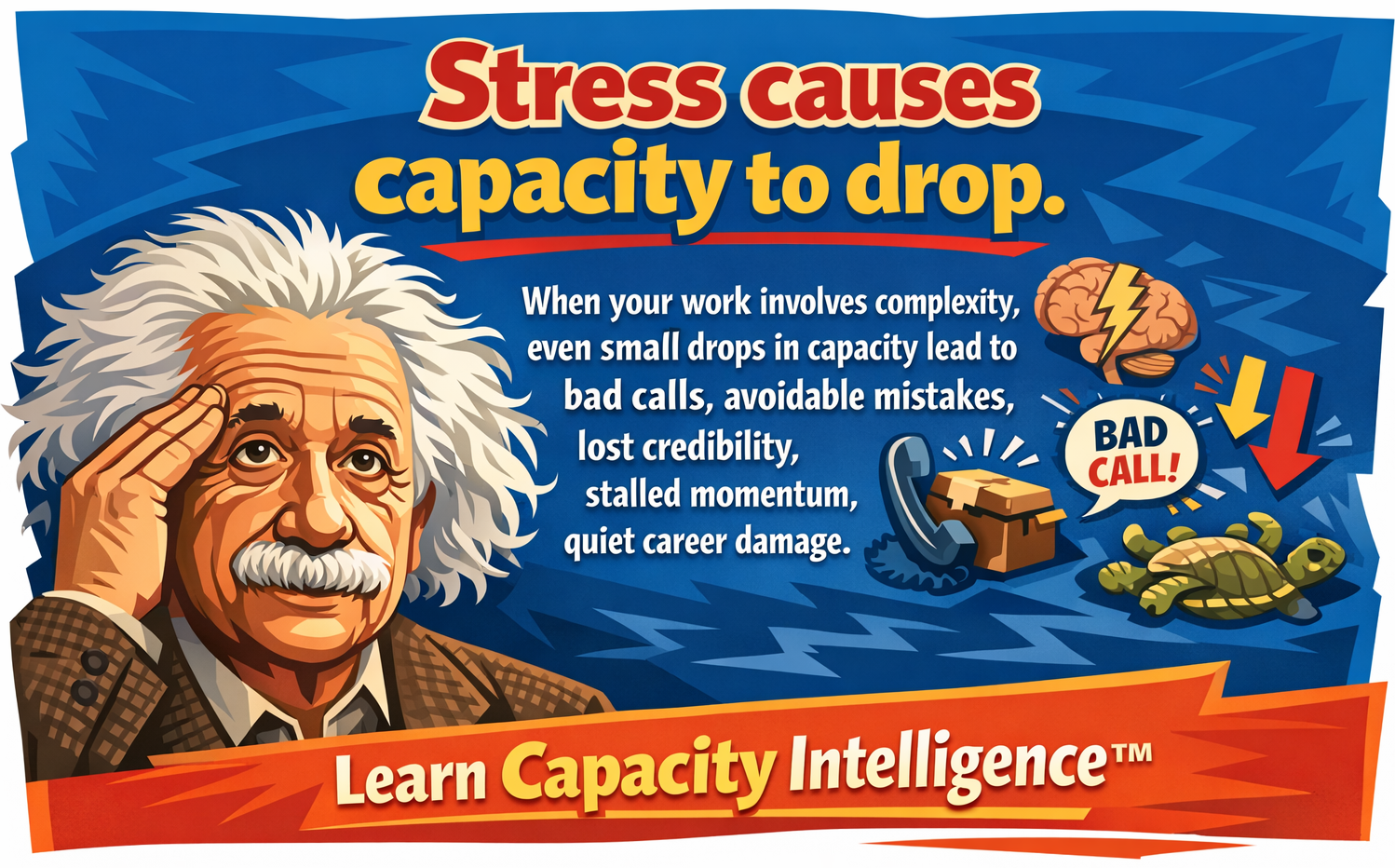
That's the difference. When your work involves complexity, even small drops in capacity lead to bad calls, avoidable mistakes, lost credibility, stalled momentum, quiet career damage.
This Isn't About Being Weak
It's about the biology of thinking under pressure. Executive function goes offline under chronic stress. That's not opinion, that's neuroscience. Working memory shrinks. Prefrontal cortex gets hijacked. Your skills are still there - you just can't reach them.
If you're struggling with confidence under pressure, this is why. The capacity isn't gone. The access is blocked.
The WHO says mental-health issues cost the global economy $1.1 trillion annually in lost productivity. But that's not really a mental health number. That's a capacity number. That's the cost of skilled professionals who can't access what they already know how to do.
What Actually Helps (And What Doesn't)
Here's the hard truth: Most tools only work when you already feel fine.
They assume stable attention, available energy, intact executive function.
But capacity loss is state-dependent. When you're depleted, the very tools you're told to use become inaccessible. The breathing technique requires presence you don't have. The journaling practice requires working memory that's offline. The strategic planning requires exactly the prefrontal function that stress shut down.
That's why trying harder backfires. That's why motivation talk feels insulting. That's why productivity systems collapse exactly when you need them most.
Capacity Collapse🪫
This is what happens when your capacity drops far enough that your skills stop working. Not because you never had them. Because access got blocked.
What's Different Here: Capacity Intelligence™
Emergent Skills is built around a different assumption:
Your ability to perform depends on your current capacity - not your potential.
Not where you "should" be. Not where you were last year. Not where your LinkedIn profile says you operate. Where you are right now.
This is Capacity Intelligence™ - the meta-skill of recognizing your actual resources in real-time and matching tools to that reality instead of fighting it.
It works through The Zones Framework™:
- 🟢Green Zone (7-9): Full capacity. Complex tools work. Strategic thinking possible.
- 🟡Yellow Zone (4-6): Functional but stretched. High effort, diminishing returns. Need simpler interventions.
- 🔴Red Zone (1-3): Survival mode. Body-first only. Thirty to ninety seconds. No thinking required.
- ⚫Can't-Even Zone (0🪫): System shutdown. Rest is the intervention. Permission to stop. That's it.
Instead of asking you to override depletion, Capacity Intelligence™ helps you recognize your actual zone, match tools to that reality, stabilize access, and restore function before burnout or failure.
Because knowing you're in 🔴Red Zone doesn't fix Red Zone. Having tools that work in Red Zone fixes Red Zone.
Operationalized Self-Awareness™: The Action Engine
Self-awareness without action is just anxious self-observation with better vocabulary. Like watching yourself drown while taking detailed mental notes about the water temperature.
Operationalized Self-Awareness™ is different. It's the five-step Awareness Loop:
RECOGNIZE
"I'm at Yellow 5."
MATCH
"Complex paragraphs aren't happening. I need a Smaller tool."
ACT
Actually use the capacity-matched intervention.
REFLECT
"Did it work? Helpfulness: 7/10."
ADJUST
"Next time, switch formats earlier instead of fighting it."
That's not self-awareness. That's observation plus strategic action plus validation. Not watching yourself struggle. Doing something about it.
The Real Benefit: Judgment Stays Intact
The goal isn't to feel calm all the time.
The goal is this: When pressure hits, you can still think.
Because in capacity-critical work - your kind of work - thinking is the job. Judgment is the output. Access is the difference between performing and quietly failing.
Every dollar invested in mental-health intervention returns four in productivity, says the WHO. But what you really get back is access to your existing skills under stress. You already know how to communicate clearly, manage time, set boundaries, think strategically. Stress just blocks access. Capacity Intelligence™ removes the block.
That's the difference between a thermometer (tells you the temperature) and a thermostat (tells you the temperature AND does something about it).
If This Feels Uncomfortably Accurate
If you're nodding while reading this - not because you're overwhelmed, but because you recognize the pattern - you're exactly who this is for.
You don't need fixing. You don't need motivation. You don't need to be told to "take better care of yourself."
You need your capacity back online.
That's a 🟡Yellow Zone signal. Recognition. Then: thirty-second reset - cold water on wrists - and back to the paragraph. Match. Act.
Still Yellow 5, probably. But functional. Progress, not perfection.
Where to Start
Real change starts when the problem is finally named. And yours just was.