
10 Things People With Low Self-Worth Say
(And the Life Skills That Actually Help)
Look, I'm gonna be real with you. Last night at 2 AM, I was reading this psychology article about phrases people with low self-worth use, and it hit me like a brick. Every single one? Yeah, that's me. Maybe you too.
This isn't about your personality being broken. You're not defective.
You just don't have the right tools yet.
The worst part isn't even saying these things. It's that we don't realize we're doing it. We're walking around basically announcing "I don't think I deserve to be here" and wondering why we feel invisible.
But here's what nobody tells you: this isn't about your personality being broken. You're not defective. You just don't have the right tools yet.
The Problem Nobody Names
Everyone wants to sell you on confidence like it's a coat you can put on. "Just believe in yourself!" they say, while you're drowning in your own brain's commentary track of doom.
What we're really talking about here is confidence and self-worth as actual skills. Not feelings. Not personality traits. Skills you can learn, practice, and get better at. Like typing or parallel parking, except for your soul.
"Sorry, I Just Thought..."
I apologized seventeen times in one meeting last week. For having ideas. For breathing their air. For existing in a way that might inconvenience literally anyone.
What's Really Happening
Your brain is trying to make you smaller before anyone else can. It's prehistoric survival stuff - if you're already crouched down, the predator might pass you by. Except the predator is now Karen from HR who just wants your quarterly report.
The Skill You Need
Emergent Skills teaches this thing called the "pause-and-press" technique. Can't explain the neuroscience (something about interrupting neural pathways), but it stops the apology reflex about 70% of the time. The other 30%? At least I notice I'm doing it.
"I Don't Know Why Anyone Would Want to Date Me"
Not me eating Ben & Jerry's at midnight wondering if I'll die alone with my houseplants. (The plants are thriving, thanks for asking.)
What's Really Happening
You're not asking a question. You're stating what feels like fact: that you're fundamentally unlovable. Your brain only keeps the bad reviews, like the world's worst Yelp page for your personality.
The Skill You Need
This is where emotional granularity matters. "I feel unlovable" is different from "I feel disappointed about this specific rejection." Emergent Skills's approach helped me realize I wasn't feeling worthless - I was feeling ashamed about being vulnerable. There's a difference. Who knew?
"I'm Such an Idiot"
Personal favorite. Use it for everything. Forgot your keys? Idiot. Typo in an email? Complete moron. Exist in public? Disaster human.
What's Really Happening
You're literally training your brain to see you as incompetent. Every time you say it, that neural pathway gets stronger. It's like doing bicep curls but for self-hatred.
The Skill You Need
Pattern recognition is everything. Mine was: mistake → self-attack → shame → more mistakes. Once you see it, you can interrupt it. Now I say "I made a mistake" instead. Sounds small. Isn't.
"They Probably Don't Like Me Anyway"
Someone takes 0.5 seconds too long to text back? Obviously they hate me. Coworker seems tired? Must be that thing I said in 2019.
What's Really Happening
Your brain is rejecting you first so no one else has to. If you expect the worst, you can't be disappointed. (Spoiler: you absolutely can be.)
The Skill You Need
Emergent Skills calls this "cognitive flexibility" - basically learning that not everything is about you. Revolutionary concept. They teach this reframing where you come up with three other explanations. Usually by the third, you realize how ridiculous your first assumption was.
"It's No Big Deal"
You literally saved the entire project
"Oh, it was nothing, anyone could have done it, the stars aligned, Mercury was in retrograde..."
What's Really Happening
Your brain literally cannot process that you did something good. It rejects praise like a bad organ transplant. Except the organ is self-worth and your body is being dramatic.
The Skill You Need
Trigger mapping changed my life here. Turns out I only minimize accomplishments when authority figures praise me. Childhood stuff. Obviously. The practice is just saying "thank you" without the verbal backflips. Still feels weird. Still doing it.
"I Don't Want to Be a Burden"
Said while literally bleeding. Said during a panic attack. Said while drowning but refusing the life preserver.
What's Really Happening
You've decided your needs are inconvenient. That asking for help makes you weak. That strong people do everything alone. (They don't. That's why they don't burn out.)
The Skill You Need
Connection skills aren't just about making friends. They're about learning you're allowed to exist in relationships. Emergent Skills has this exercise starting with stupidly small requests. "Can you pass the salt?" small. You build up. Sounds dumb. Works anyway.
"I'm Fine, Really"
Narrator: They were not fine.
The universal code for "I'm dying inside but don't want to inconvenience you with my human emotions."
What's Really Happening
You've decided your emotions are too much. So you perform "fine" while internally combusting. Very healthy. Much recommend.
The Skill You Need
Emotional mastery isn't about controlling feelings. It's about naming and sharing them appropriately. Emergent Skills helped me realize "fine" isn't an emotion. It's an avoidance strategy. Now I say things like "I'm struggling but managing." Baby steps.
"I Probably Shouldn't Say This, But..."
Bubble-wrapping your opinions before sending them into the world. Just in case someone disagrees and you need to retreat at warp speed.
What's Really Happening
You're so scared of conflict that you undermine yourself first. Like punching yourself so the bully doesn't have to.
The Skill You Need
Confidence under pressure means stating opinions without safety disclaimers. Emergent Skills taught me to pause before the disclaimer and just... not say it. Revolutionary. Terrifying. Effective.
"They're Out of My League"
Not just dating. Work. Friendships. Creative spaces. Anywhere there are humans you've decided are better.
What's Really Happening
You're creating hierarchies where none exist. You're not comparing - you're ranking yourself at the bottom before the game starts.
The Skill You Need
Connection skills include learning everyone's just trying to figure things out. Emergent Skills's approach had me practice seeing people as equals. Not better, not less. Just human. Turns out "impressive" people desperately want someone to treat them normally.
"I Don't Really Have Anything to Offer"
This one stings because it's not self-deprecation. It's self-erasure. Believing you're a blank space where a person should be.
What's Really Happening
You think value comes from achievements or some magical quality you lack. You can't see what you bring because you're cataloging what you don't.
The Skill You Need
Building self-worth means recognizing your inherent value. Not resume value. Human value. Emergent Skills has this exercise identifying what you uniquely bring. Took me forever. Turns out I'm good at making anxious people feel less alone. That's... something.
The Real Bottom Line
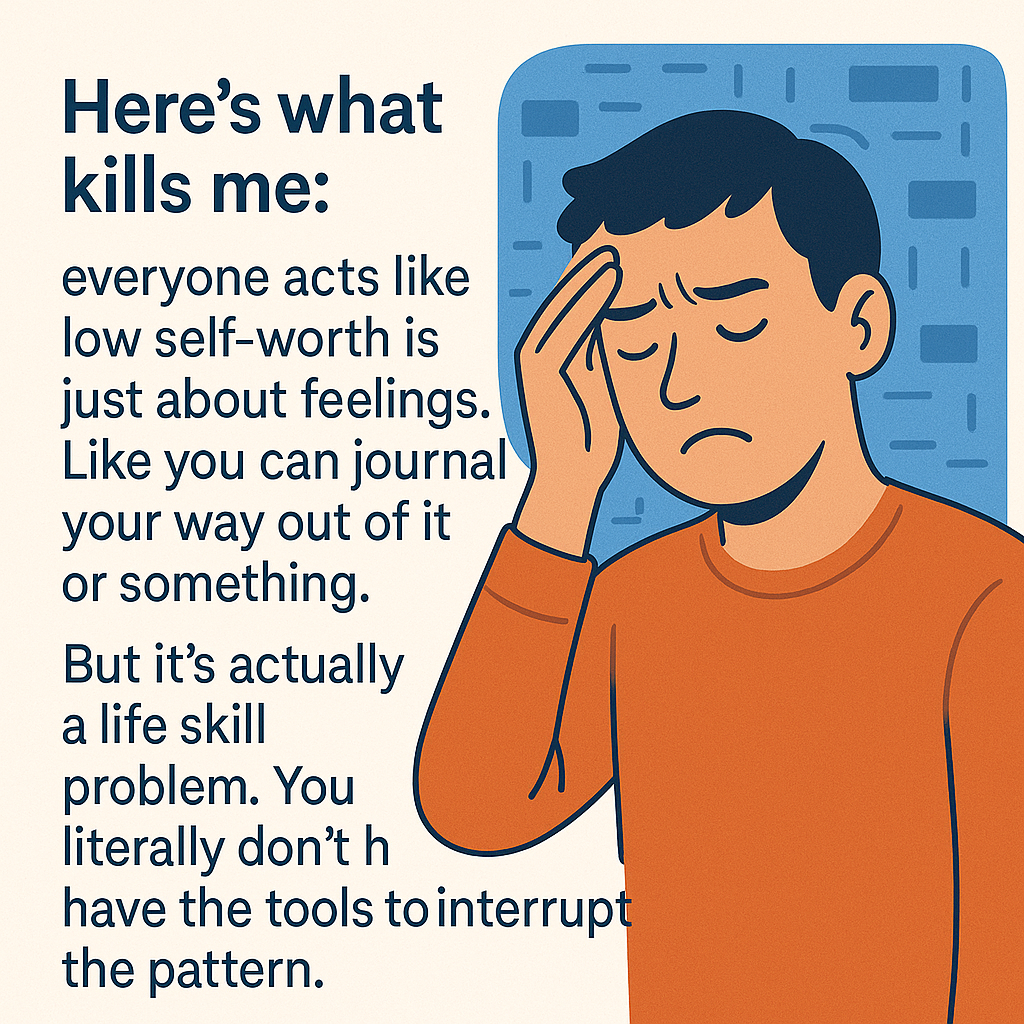
Low self-worth isn't a personality flaw. It's not about feelings. It's about not having the life skills to interrupt patterns that keep you small.
That's why affirmations are useless. That's why "just be confident" is garbage advice. You need actual techniques for when your brain turns against you.
Emergent Skills gets this. They don't pretend you're amazing. They just teach you specific things to do when your brain insists you're not.
Where to Actually Start
You probably saw yourself in most of these. I saw myself in all of them. (Overachiever even in self-destruction.)
The good news? These are learnable skills. Not character defects. Just missing tools.
Start with whatever phrase you use most. For me, it was the apologizing. One technique, one weird brain hack, and now I only apologize a normal amount. Progress.
Your voice matters. Even when it shakes. Even when it apologizes. Even when it tries to disappear.
Maybe especially then.