
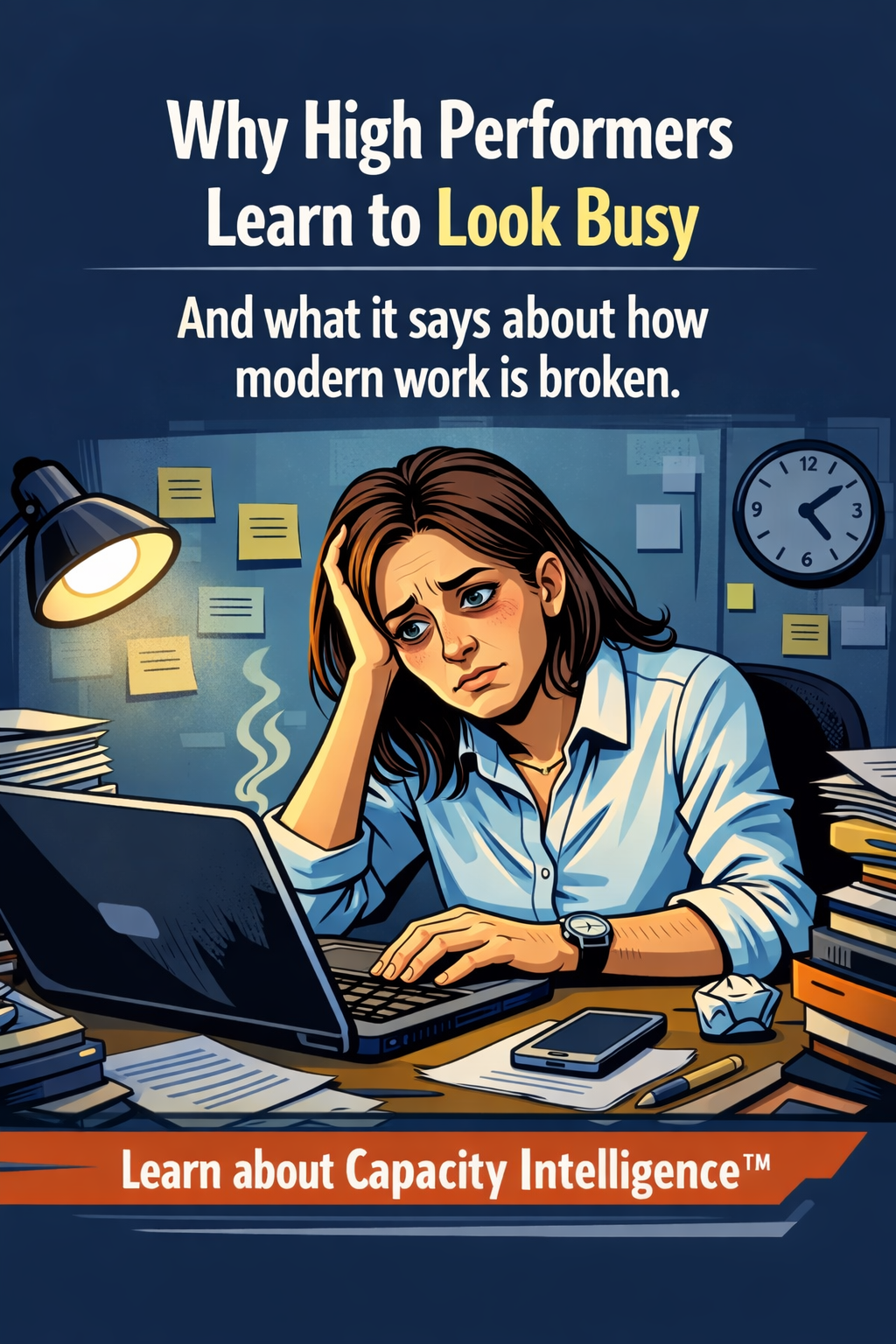
Why Your Best Employees Are Learning to Look Busy
And What That Reveals About Organizational Capacity Blindness
It's 2:47 PM and I just read something that made me put down my coffee mid-sip.
A burned-out employee discovered their survival strategy: never look too efficient. By deliberately appearing overwhelmed in meetings, managers stopped piling on extra work. Deadlines still got met. Quality stayed high. But for the first time in years, the workload became... survivable.
The post went viral. Not because it was scandalous. Because it named what 77% of the global workforce already knows: most people are disengaged, and for good reason.
This isn't a story about lazy workers gaming the system. This is a story about what happens when organizations can't see the difference between speed and spare capacity.
And honestly? I've been that employee. 🟡Yellow Zone for months, pretending everything was fine because the alternative was admitting I was drowning in a system that couldn't recognize drowning.
The Efficiency Tax Nobody Talks About
Companies claim they want high performers. In practice, they often punish them.
Finish early, and your efficiency gets misread as excess bandwidth. Not skill. Not mastery. Just unused space to be filled. Meanwhile, colleagues who appear visibly strained get perceived as "fully loaded" and left alone.
Over time, fast workers learn a brutal lesson: transparency backfires.
So they adapt. They slow their signals, not their output. They protect their capacity by managing appearances because the system can't handle honest conversations about limits.
From the outside, it looks like office politics. From the inside? It's self-preservation.
The Real Problem: Capacity Blindness
The popular takeaway from stories like this is usually tactical: "Here's how to stop your boss from giving you more work."
That misses the deeper issue.
Managers aren't malicious. They're operating without a usable model of human capacity. Most workload decisions get made using task lists, deadlines, headcount, and historical performance. What's missing is any real understanding of current cognitive, emotional, and recovery load.
Without that, speed becomes the only visible signal. And speed gets misread as availability.
The Numbers Tell the Story
44% of professionals report daily workplace stress - a record high. That's nearly half the workforce operating in 🟡Yellow or Red Zone on any given day. But there's no language for it. No shared framework. Just vibes and burnout.
When capacity isn't named or measured, employees are forced to signal limits indirectly. Looking busy becomes the only language the system understands.
What's Actually Going On: The Green Zone Trap
This is where Capacity Intelligence™ enters the conversation - and where most organizations are completely blind.
Here's the pattern:
A capable employee performs well. More responsibility gets added. Recovery shrinks. Stress quietly accumulates. The employee either burns out - or learns to hide.
From the outside, it looks like resilience. Inside? Depletion.
This is how organizations drift from sustainable performance into chronic burnout without ever making a single "bad" decision. They're just stacking work on top of invisible limits.
Low engagement costs the global economy $8.8 trillion annually - roughly 9% of global GDP. That's not a morale problem. That's the cost of asking 🟡Yellow Zone people to deliver 🟢Green Zone work without ever teaching anyone to recognize the difference.
The Zones Framework™
The Zones Framework™ gives this a name:
🟢 Green Zone
Focus, creativity, empathy possible. Tools work here. This is where productivity systems and communication skills actually function as designed.
🟡 Yellow Zone
High effort, diminishing returns. Where most people actually live. Stress management becomes critical here.
🔴 Red Zone
Survival mode. Just trying not to make mistakes. Emotional regulation feels impossible.
⚫ Can't-Even
System offline. "What's for lunch" feels like calculus. Rest and recovery are the only path forward.
Every piece of productivity advice, every performance system, every "best practice" assumes 🟢Green Zone. But most of us live in 🟡Yellow. And when you hand 🟡Yellow Zone tools to 🟡Yellow Zone people, they don't have the cognitive resources to implement them.
So what do they do instead? They perform wellness. They perform productivity. They perform being okay.
Looking busy is just another performance.
Why This Keeps Happening
The employee in that viral post justified their strategy by pointing to layoffs, instability, and a harsh job market. That context matters.
When jobs feel fragile, people stop taking risks with honesty. They stop volunteering capacity. They stop signaling health. They play defense.
Not because they don't care - but because the system hasn't proven it can respond safely.
The Trust Deficit
If appearing overwhelmed is safer than being transparent, the organization has already lost trust. And 77% of workers experiencing burnout at their current job suggests this isn't isolated. It's systemic.
What This Means For You
If you're the high performer learning to look busy: this isn't your character flaw. It's a rational response to a system without capacity language.
Capacity Intelligence™ gives you a different option. Instead of performing busyness, you learn to:
- Recognize your actual resources in real-time (not where you "should" be)
- Match tools and commitments to your current state
- Measure whether it worked (the feedback loop everyone skips)
That's operationalized self-awareness- not just watching yourself struggle, but doing something strategic about it.
The ROI of Capacity
Every $1 invested in mental health intervention returns $4 in productivity, according to WHO. But what you really get back is access to skills you already have. The communication skills. The focus. The creativity. Stress just blocks access. Capacity Intelligence™ removes the block.
The Uncomfortable Conclusion
When employees must perform busyness to survive, the problem isn't individual behavior. It's organizational design.
The solution isn't better boundary scripts or productivity hacks. It's learning to assign work based on capacity, not just competence.
Until then, high performers will keep pretending to struggle—because it's the only way to stay well in a system that doesn't know how to protect them.
A Note on Writing This
I wish I had a neat bow to tie this up with, but I'm currently at 🟡Yellow 6 and my brain's suggesting that "just end it" is a valid editorial strategy. Which... honestly tracks. That's a capacity signal. Time for a 2-minute reset before I write something I'll regret.
That's the whole point, actually. Capacity Intelligence™ isn't about being perfect. It's about recognizing "I'm fading" as useful data rather than personal failure.
If you're the one performing busyness right now—you're not lazy. You're rational. And there might be a better way.
Start Building Your Capacity Intelligence™
Stop performing wellness. Start actually having it.
- 30-Minute Crisis Reset - Free, unlimited, works at 3 AM
- Learn The Zones Framework™ - The foundation for Capacity Intelligence™
- Full Subscription - All 10 Life Skills Pillars + AI coaching
Written in 🟡Yellow Zone. Published anyway. Because that's the whole point.