
A Little Bit On
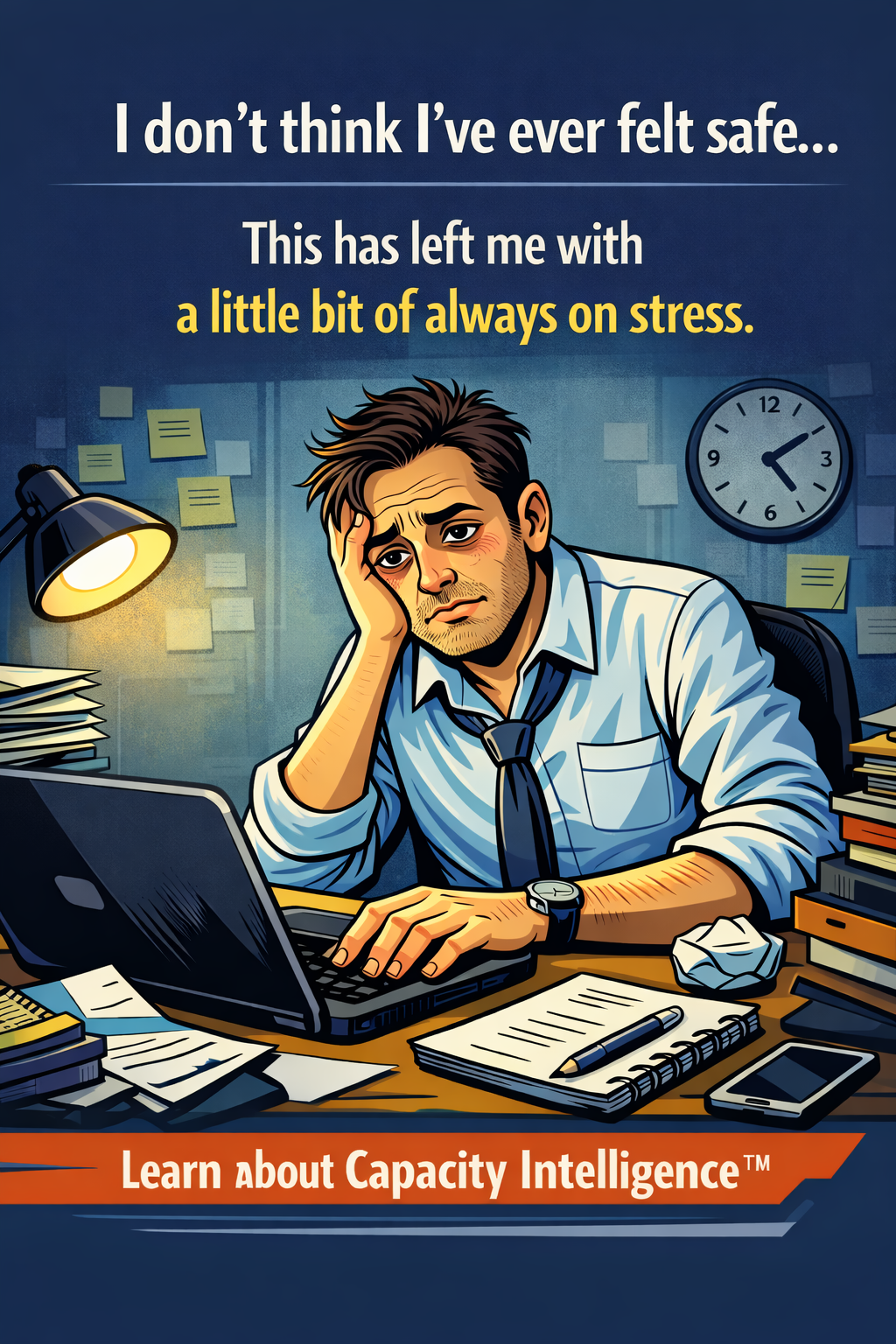
I'm 70 years old and about a year ago I realized I don't think I've ever felt safe. Not once. Not really. I'm still not sure what to do with that.
I've built a few companies. Raised kids. Worked with clients like the MTA and Rutgers. None of that matters here except to say: I wasn't sitting around. I was functional. More than functional. I thought the way I operated was just how you get things done.
I called it drive. Vigilance. Being responsible. I thought everyone was scanning like I was, always preparing for the next thing. Turns out there's a name for it. Researchers call it being "a little bit on."
It's a state where your nervous system never fully stands down. You're not in crisis. You're not panicking. You're just never off.
I've had insomnia most of my adult life. Decades. I built a whole CBT-I program, My Sleep Plan, trying to fix it - for myself, and then for others. It failed. For me and for them. I couldn't figure out why the standard approaches didn't work.
Now I think I get it. Sleep requires your body to believe it's safe enough to go completely offline. Mine never believed that. Still doesn't, most nights.
The Science Behind the State
I read a paper in Neuron recently - Lisa Feldman Barrett, Karen Quigley, others at UCSF and Northeastern. They're describing how stress actually works. Not the pop-science version. The machinery.
Your brain is constantly predicting threats. Not reacting - predicting. It looks at the world, decides what's coming, and mobilizes resources in advance. Fight or flight before there's anything to fight or flee from. This is supposed to be temporary. Handle the threat, stand down, recover. But what happens when you never learned what "safe" feels like? When you spent decades in environments that required constant adaptation? Your brain never gets the all-clear. So the system stays on.
Not full panic. Just ready. Always ready.
The Biological Cost
The research says cells in this state burn energy 60% faster. They age faster. They die younger. Your body keeps postponing maintenance because it thinks survival is still on the line. Meanwhile you're sitting in a meeting or driving your kids to soccer or lying awake at 2 AM and your system is burning through resources like there's a tiger in the room.
I spent 50 years thinking I was just wired this way. High-strung. Driven. A little anxious maybe but functional, always functional.
Building the Framework I Needed
In the last 12 months, I started developing something I call The Zones Framework™. Four states: 🟢Green, 🟡Yellow, 🔴Red, ⚫Can't-Even🪫. I built it to help overwhelmed professionals recognize where they actually are, not where they think they should be. I'd watched traditional wellness advice fail people over and over. It asks you to spend resources you've already burned through. Meditate for 30 minutes. Overhaul your sleep hygiene. Journal every morning. Great advice if you have the capacity. Useless if you don't.
What I didn't realize: I was describing my own operating system. I'd spent most of my life toggling between 🟡Yellow and 🔴Red thinking that was 🟢Green. I didn't know what 🟢Green felt like. How do you miss something you've never had?
It wasn't until I found Feldman Barrett's work that the pieces clicked. She's now part of the research foundation for what I'm building. I'd gotten to the same place from the inside out. Decades of coping strategies in corporate America with ADHD and dyslexia, learning to read my own capacity, noticing when I was slipping. I mapped the territory before I understood the biology.
What Happens When You Finally See It
Here's what happens when you finally see it. First, grief. For the years. For the sleep. For the health costs you're only now adding up. For the moments you were there but not there - present in body, somewhere else in your nervous system. Your kids remember a version of you that was always a little distracted, a little tense, and you didn't even know it.
Then something like relief. Not because anything's fixed. Just because it makes sense now. You weren't bad at relaxing. You weren't weak. Your body was doing what it thought it had to do.
The researchers say you need to find your off switch. Something that sends a signal to your body - not your mind, your body - that the threat is over. For some people it's breathwork. Six breaths a minute, long exhales. For some it's being with someone who makes you feel safe. Humans regulate each other's nervous systems. We're built that way.
For some it's something else. There's no universal prescription. And honestly I'm still figuring out what works for me.
I can't think my way there. I've tried. Fifty years of trying to think my way through things. You can't productivity-hack your way to feeling safe. You have to actually feel it. And if you've never felt it, you have to learn what it even is.
I'm 70. I'm just starting. I don't know how this ends.
Understanding Your Own Capacity
If any of this resonates - that constant readiness, the sleep that never comes, the gap between how functional you appear and how depleted you feel - you're not alone. And there's a framework for working with it, not against it.
- Capacity Intelligence™ - Learn to recognize where you actually are, not where you think you should be
- Rest & Recovery Mastery - Tools that work when your body doesn't believe it's safe to sleep
- Motivation & Emotional Resilience - Rebuilding when you've been running on empty
- Why "I'm Fine" Is Killing Your Productivity - Understanding the real cost of chronic activation
Start Where You Actually Are
The Zones Framework™ wasn't built in a lab. It came from decades of learning to work with a nervous system that never got the all-clear. If you're ready to stop fighting your capacity and start working with it, we can help.
Jim Wilde is the founder of the Emergent Skills platform. He writes from wherever his capacity actually is that day - which is the whole point.