
Why "Resilience" Is the Wrong Word for What You Actually Need in 2026
44% of professionals report daily workplace stress - a record high. The advice to "just be more resilient" assumes you have something to bounce back with. Here's what actually works when you're already depleted.
Just read a Fast Company article telling me "resilience" is the most important career skill for 2026. The one skill that will get me hired, promoted, and make me indispensable.
And honestly? I'm sitting here at 🟡Yellow Zone brain fog, on my third coffee, trying to remember why I opened this browser tab, thinking: cool, cool, another thing I'm supposed to just... have.
Here's what the article said: Be resilient with people. Be resilient with situations. Be resilient for the future. Flex! Adapt! Stay calm! Learn continuously! Be optimistic!
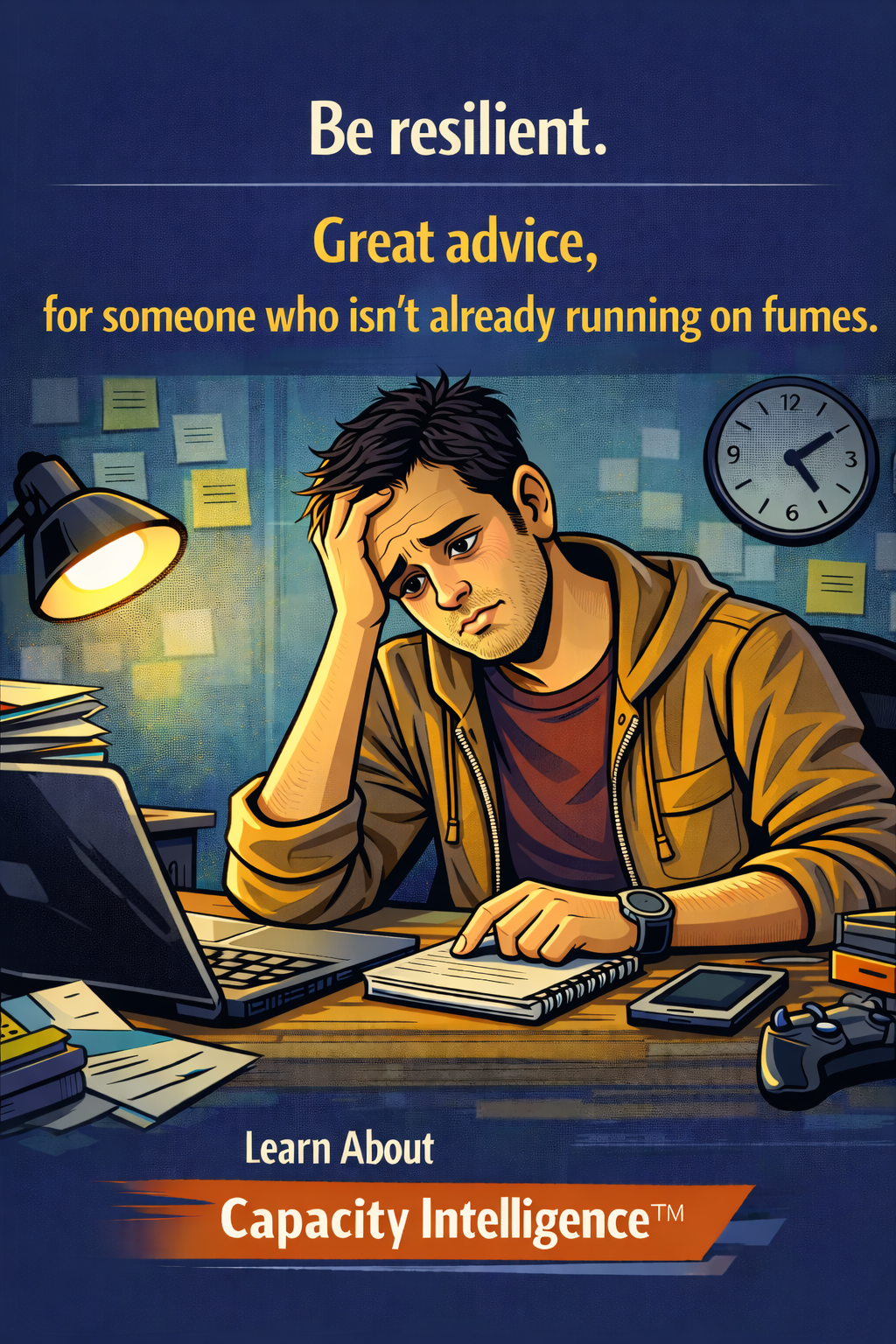
All great advice. For someone who isn't already running on fumes.
That's the problem. "Resilience" assumes you have something to bounce back with. It assumes resources. Reserves. Capacity. And if you're reading this at 3 PM on a Tuesday after your fourth Zoom call, staring at an inbox that breeds emails while you sleep - you know that's exactly what's missing.
So let me offer a different framing. Not "resilience." Something that actually works when you're depleted.
The Problem with "Just Be More Resilient"
The Fast Company piece - which is genuinely well-meaning, I want to be clear - describes resilience as "adaptability, flexibility, and responsiveness to multiple situations." It talks about flexing your style, staying calm when angry, constantly adjusting to other people's moods.
And sure. That sounds great. On paper. At 9 AM. After a full night's sleep. With no pending deadlines. When your nervous system isn't stuck in low-grade panic mode from eighteen months of continuous uncertainty.
But 77% of workers have experienced burnout at their current job according to Deloitte. Seventy-seven percent. Which means the vast majority of the people being told to "be more resilient" are being asked to bounce back from a position of already being flat on the ground.
It's like telling someone with a broken leg to just walk it off. Not because walking is bad advice in general - it's excellent advice for functioning legs - but because it requires the very thing that's been compromised.
This Is What I Call The Green Zone Trap
Most workplace advice is designed for people operating at peak capacity - what I call 🟢Green Zone. Full cognitive function. Strategic thinking works. You can hold a complex conversation, manage your emotions, adapt to unexpected situations. Great. Wonderful. The advice all works beautifully there.
But here's what nobody tells you: Most of us don't live in Green Zone anymore. We live in 🟡Yellow Zone - functional but stretched, high effort producing diminishing returns. Or we're regularly crashing into 🔴Red Zone - survival mode, body-first, executive function offline. Some days we hit ⚫Can't-Even Zone and deciding what to eat for lunch feels like advanced calculus.
And "just be more resilient" doesn't help any of those states. It actually makes them worse, because now you're depleted AND beating yourself up for not being resilient enough.
Learn more about The Green Zone Trap and why traditional productivity advice fails most professionals.
What You Actually Need: Capacity Intelligence™
Here's the thing Fast Company almost got to but didn't quite name: What matters isn't having resilience. It's knowing what you can actually do with what you actually have right now.
The Meta-Skill That Makes Every Other Skill Accessible
Capacity Intelligence™ is the ability to recognize your actual resources in real-time, then match your tools and strategies to that state - not to where you think you should be.
Because here's what nobody tells you about all those soft skills the article mentions - communication, adaptability, problem-solving, emotional regulation: You already have them. Stress just blocks access.
It's not that you can't communicate clearly under pressure. It's that 🔴Red Zone brain doesn't have the working memory to hold a complex thought while also managing your anxiety while also reading the room while also formulating a response. The skill isn't missing. It's just offline.
Capacity Intelligence™ doesn't ask you to develop more resilience. It teaches you to recognize when your executive function has gone offline and use different tools that actually work in that state.
That's a fundamentally different approach. And it actually works at 3 PM on Tuesday.
Explore Your Capacity Intelligence™ ROI to understand the real-world benefits.
The Zones Framework™: Language for Your Actual State
The first step in Capacity Intelligence™ is having language for where you actually are. Not "I'm fine, just tired" - which is what we all say and which tells us nothing - but a specific, actionable assessment.
Learn more about Why "I'm Fine" Is Killing Your Productivity.
🟢 Green Zone (7-9 on the scale)
Full capacity. Strategic thinking works. Complex tools, hard conversations, learning new systems - all accessible. This is where traditional "resilience training" lives. It's real. It's just not where most of us spend our time anymore.
🟡 Yellow Zone (4-6)
Functional but stretched. You can still think, but it takes effort. High effort, diminishing returns. This is the "I reread that email four times and still don't know what it says" zone. Simpler interventions work here. Complex ones don't.
🔴 Red Zone (1-3)
Survival mode. Executive function offline. Body-first tools only. No thinking required. This is where cognitive advice fails entirely because your prefrontal cortex isn't taking calls.
⚫ Can't-Even Zone (0)
System shutdown. The only intervention is rest. That's it. Permission to stop. Work will be there tomorrow. So will you if you recover.
Knowing you're in 🔴Red Zone doesn't fix 🔴Red Zone. But having tools that work in 🔴Red Zone? That fixes 🔴Red Zone.
Dive deeper into The Zones Framework™ to master this foundational concept.
The Fast Company Advice, Capacity-Matched
Let me take the article's main points and show you what they look like through a capacity lens. Because the advice isn't wrong - it's just 🟢Green Zone advice being offered to 🟡Yellow Zone/🔴Red Zone people.
"Be Resilient with People"
What they said: Listen with empathy, communicate effectively with diverse groups, flex your style, stay calm when angry.
🟢 Green Zone version: All of that. It works beautifully. Have the nuanced conversation. Read the room. Adapt in real-time. You've got the bandwidth.
🟡 Yellow Zone version: Pick ONE thing to focus on per interaction. "In this meeting, I'm just going to listen." Forget adapting to everyone - that's too many cognitive balls to juggle. Have one mode. Execute it.
🔴 Red Zone version: Body-first. Before the interaction: 30 seconds of slow breathing. Drop your shoulders. Unclench your jaw. That's it. You're not going to be a communication wizard right now. You're just trying not to snap at someone.
⚫ Can't-Even version: "I need to reschedule this." Full stop. The conversation can happen when you have capacity for it.
If interpersonal stress is your primary challenge, explore Connection & Communication Skills.
"Be Resilient with Situations"
What they said: Stay contextually aware, manage time effectively, take initiative when you see barriers.
🟢 Green Zone version: Absolutely. Strategic planning, proactive problem-solving, anticipating needs. Go for it.
🟡 Yellow Zone version: Triage. Three priorities max. Write them down because working memory is compromised. "What MUST happen today?" Everything else gets moved.
🔴 Red Zone version: ONE thing. The single most important task. If you can't identify it, the task is: identify the one thing. That's the whole job right now.
⚫ Can't-Even version: The situation will still be there after you rest. Trying to problem-solve in system shutdown makes everything worse.
For help with prioritization and execution under pressure, see Productivity & Achievement Skills.
"Be Resilient for the Future"
What they said: Learn continuously, stay optimistic, anticipate trends, develop new skills.
🟢 Green Zone version: Yes. Deep learning, strategic skill development, complex planning. The brain has capacity for all of it.
🟡 Yellow Zone version: Micro-learning. 5-minute chunks. One small thing per day. Don't try to master AI in a weekend when you can barely remember your own password.
🔴 Red Zone version: The future can wait. Literally. Your only job right now is restoring baseline function so you CAN think about the future later.
⚫ Can't-Even version: The most resilient thing you can do for your future is rest right now. That IS the skill development.
Struggling with burnout? Motivation & Emotional Resilience offers capacity-matched recovery strategies.
From Awareness to Action: Operationalized Self-Awareness™
Here's where I probably should have started, but I'm writing this at 🟡Yellow Zone 5 and my structure is getting a little loose. Which is... kind of the point? Stay with me.
Self-awareness by itself is useless. "I notice I'm stressed" doesn't fix anything. It's just watching yourself struggle with increasingly sophisticated vocabulary.
Learn more about When Self-Awareness Makes Everything Worse.
The Five-Step Loop That Actually Produces Change
Operationalized Self-Awareness™ is different. It's observation + strategic action + validation:
RECOGNIZE
Identify your actual resources right now. "I'm at Yellow 5" is actionable. "I'm stressed" isn't.
MATCH
Select tools appropriate to your current state, not where you think you should be. 🟡Yellow Zone brain gets 🟡Yellow Zone tools.
ACT
Use the capacity-matched intervention. Actually do the thing.
REFLECT
Did it work? Rate the effectiveness. "Helpfulness: 6/10" tells you something.
ADJUST
Create learning for next time. "Next time I hit Yellow 5, I'll switch to bullet points earlier."
That's the difference between a thermometer and a thermostat. Self-awareness tells you the temperature. Operationalized Self-Awareness™ tells you the temperature AND adjusts accordingly.
What's Actually In It For You
I could throw more statistics at you. Low engagement costs the global economy $8.8 trillion annually - about 9% of GDP. Every dollar invested in mental health intervention returns four dollars in productivity. Teams in the top quartile of engagement show 23% higher profitability.
But honestly? You probably stopped processing numbers two paragraphs ago because that's what 🟡Yellow Zone does to working memory.
So here's the translation for your Tuesday brain:
Immediate Benefit
Stop wasting energy on tools that can't work at your current capacity level. That meeting prep system that requires 45 minutes of focused planning? Skip it when you're at Yellow 6. Use the 5-minute version instead.
Tactical Benefit
Know which version of yourself shows up when, and have tools that work for each version. Tuesday-afternoon-brain gets different strategies than Saturday-morning-brain.
Strategic Benefit
Access your existing skills under stress instead of watching them short-circuit. You already know how to communicate, manage time, set boundaries. Capacity Intelligence™ removes the block.
That's not resilience. That's something better. It's working with what you actually have instead of what you wish you had.
Explore The Hidden Economics of Workplace Capacity for the business case.
The Optimism Bias Problem
Here's the cognitive bias that keeps "resilience advice" circulating even though it doesn't work for most people: Optimism Bias.
We consistently believe things will be better in the future than evidence suggests. "Next week will be calmer." "Once this project is done, I'll have bandwidth." "I just need to get through this quarter."
So we read advice designed for 🟢Green Zone and think: "That'll work when things settle down."
But things don't settle down. 44% daily stress is a record high. We're not going back to some imagined baseline where everyone operates at full capacity. This is the new normal.
Which means we need tools designed for the actual conditions we face, not the conditions we keep hoping will arrive next quarter.
If you're navigating a particularly difficult period, Resilience Through Life Transitions provides stability frameworks that work at any capacity level.
Real-Time Demonstration
I started writing this at 🟡Yellow Zone 6. Clear-ish thinking, some structure, reasonable coherence.
Now I'm at 🟡Yellow Zone 4, maybe low 4. I can tell because I just wrote "coherence" and had to check if that was the word I meant. Also I abandoned a paragraph structure about three sections ago and I'm not entirely sure where I was going with the cognitive bias thing.
Old me would push through. "Just finish the article." That's the advice, right? Be resilient.
Capacity Intelligence™ me recognizes: Yellow 4 is not "push through" territory. It's "30-second reset, then evaluate" territory.
[Thirty seconds. Cold water on wrists. Three slow breaths.]
Okay. 🟡Yellow Zone 5 now. Not great, but enough to wrap this up. That's Operationalized Self-Awareness™ in action. Recognize → Match → Act → Reflect → Adjust.
I didn't need to be more resilient. I needed to recognize my state and use a tool that works at that state. The distinction matters.
The Actually Useful Takeaway
The Fast Company article isn't wrong about resilience being valuable. It is. When you have it.
But resilience without Capacity Intelligence™ is like a life jacket that only works when you're not drowning. Impressive technology, useless when you actually need it.
Capacity Intelligence™ is the meta-skill that makes resilience - and every other skill - accessible. It's not about bouncing back. It's about knowing what you can do with what you actually have, right now, in this moment, even when that's not very much.
And honestly? That's the more useful skill for 2026.
I was going to end with something more polished, but I just got a Slack notification and completely lost my train of thought. So.
Good enough. Progress not perfection. Whatever the saying is.
Start Here
Capacity Intelligence™ works at any zone level. Begin with what matches your current state.
Free, unlimited, works at 3 AM
The foundation for Capacity Intelligence™
Or just type "reset" when you need it.
Continue Your Journey
Explore more resources designed for real-world capacity conditions:
Why Integrated Skills Training Works Better
Discover why capacity-matched approaches outperform single-method solutions.
Neurodivergent-First Design
How building for depleted states creates tools that work for everyone.
How Emergent Skills Works
10 Life Skills Pillars designed for professionals under pressure.