
Let Me Circle Back" Is Your Brain Doing Triage | Capacity Intelligence

Overwhelmed - Capacity Depleted

Capacity Intelligence • Workplace Performance

"Let Me Circle Back on That"

The Phrase That's Actually Your Prefrontal Cortex Doing Triage

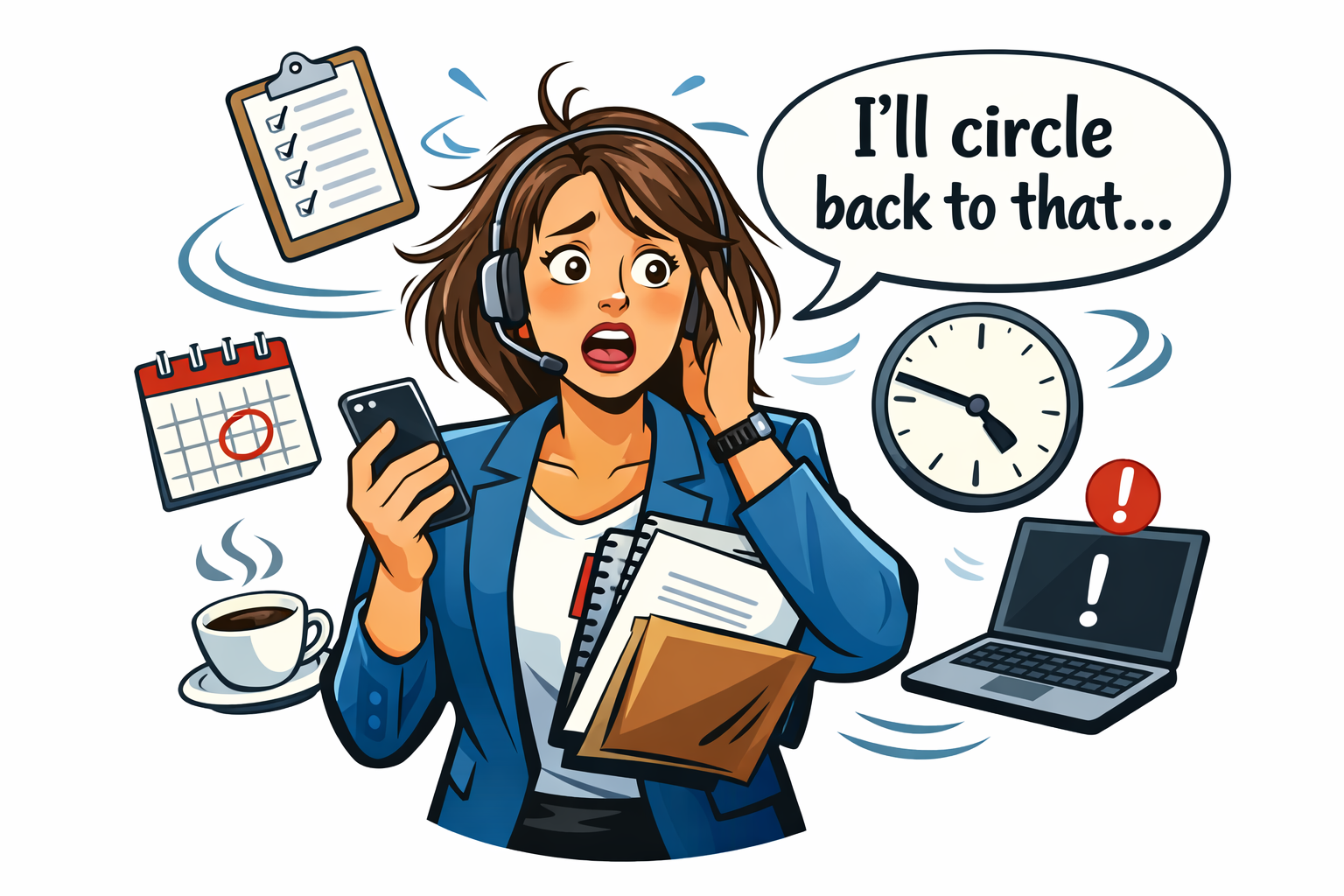
It's 2:47 PM and someone just asked me to weigh in on a project timeline that requires remembering three other conversations, cross-referencing a spreadsheet I haven't touched in two weeks, and forming an opinion that'll probably get screenshot-quoted in Slack.

"Let me circle back on that."

I said it without thinking. Then immediately wondered if I was being evasive, lazy, or—worst of all—that person who never commits.

Here's what nobody told me: 44% of professionals report daily workplace stress, according to Gallup. The other 56% are lying, in management, or have achieved a level of emotional detachment I can only aspire to.

But here's the thing about "circle back." It's not about scheduling. It's about bandwidth. Your brain did a quick resource calculation and realized: not enough capacity. So it punted. That's not a character flaw. That's your prefrontal cortex doing triage.

The Hidden Capacity Crisis

I used to think "circle back" was corporate cowardice. The verbal equivalent of putting something in a drawer and hoping it disappears.

Sometimes it is.

But most of the time it's a capacity signal. Your brain running a background process: "I could answer this, but I'd have to pull from resources I'm currently using to remember my own name and maintain basic human expression."

That's capacity depletion. And 77% of workers have experienced burnout at their current job. Which means most of us are circling back on everything—because we're always running at the edge.

This may not be you. But it's certainly someone you know.

What Your Brain Is Actually Doing

The prefrontal cortex handles working memory, decision-making, and the complex juggling act of "thinking about thinking." When someone asks a question requiring synthesis—pulling together information, weighing options, predicting outcomes—it has to allocate resources.

Those resources are finite. Our attentional processing has limited capacity. We can only process so much at once.

"Circle back" is your brain saying: "I've done the math. Answering this now would require reallocating resources from keeping-you-functional to producing-a-coherent-response, and the margin is too thin."

That's not weakness. That's the beginning of Capacity Intelligence—recognizing what you actually have before committing to work.

The Green Zone Trap

Here's what nobody tells you: every productivity system is designed for Green Zone—that state where cognitive resources are available, executive function is online, life feels manageable.

But 77% of workers worldwide are disengaged. Only 33% rate their life as "thriving."

Most of us live in Yellow Zone. High effort, diminishing returns. Functional but stretched. We regularly hit Red Zone—survival mode. Sometimes we crash into Can't-Even, when "what's for lunch" feels like calculus.

The Core Problem

The workplace performance industry assumes consistent capacity. Result? Tools fail exactly when you need them: depleted capacity → can't use coping strategies → more stress → less capacity.

This is why meditation apps have 95% abandonment rates. They're Green Zone solutions for Yellow/Red Zone problems.

If you're constantly feeling like traditional productivity approaches don't work for you, it's not a personal failing—it's a design flaw in the system itself.

What To Actually Say

The same "I can't answer this now" looks different at each capacity level:

🟢 Green Zone

"Let me pull together the relevant information and get back to you by Thursday."

You have resources to plan and commit.

🟡 Yellow Zone

"I need to circle back—can we put 15 minutes on the calendar tomorrow?"

Simpler. Externalized structure.

🔴 Red Zone

"I need to come back to this. Can you send me a reminder?"

Offloads cognitive labor entirely.

⚫ Can't-Even

"Not right now." (Three words. Maybe just "later.")

The goal is survival, not eloquence.

The Bias That Keeps You Circling

I always think I'll have more capacity tomorrow. "Monday me will definitely have bandwidth." "After this deadline, things will calm down."

That's optimism bias—believing the future will be better despite evidence. It won't. Monday has Monday's problems. "When things calm down" is fiction.

The Antidote

Realistic capacity planning: if you're circling back on everything, you're overcommitted. If tomorrow never has more capacity than today, adjust today.

When you're running on empty, building motivation and emotional resilience requires capacity-matched strategies—not just more willpower.

Circle Back to This

I could wrap this up neatly, but I just got a Slack notification mid-sentence and lost where I was going.

Which is kind of the point.

Capacity Intelligence in Action

Capacity Intelligence isn't about being perfect. It's recognizing "I just got derailed" as a Yellow Zone signal, using a 30-second reset, and getting back on track.

Most people beat themselves up for losing focus. That takes you from Yellow to Red. Capacity Intelligence says: "Okay, that's a 5. Quick body check, then back to the paragraph."

(Just did that. Cold water on wrists. Three breaths. Back to Yellow 4.)

That's operationalized self-awareness. Not watching yourself struggle—doing something about it.

Next time you say "let me circle back," try gratitude instead of guilt. Your prefrontal cortex just saved you from committing to something your actual capacity couldn't deliver.

That's not avoidance. That's intelligence.


Ready to Build Your Capacity Intelligence?

Learn to recognize your zones, match tools to your actual capacity, and stop blaming yourself for systems designed for a version of you that doesn't exist.
Start Free 30-Minute Reset

Start Free 30-Minute Reset 

Life Skills - Emotional Intelligence - Soft Skills

The Emergent Skills Program (Yeah, There's Actually a Method to This)

Look, I get it. Another program. Another system. But here's the thing — these 10 pillars? They're literally everything that's been kicking my ass for years, organized into something that actually makes sense. Especially when you're stuck in 🟡 Yellow Zone at 2 PM wondering why basic tasks feel like calculus.

Here's what nobody tells you: tools require resources you don't always have. That's not a character flaw. That's capacity depletion. And it's why we built everything around Capacity Intelligence™ — the ability to recognize what you actually have to work with and match tools accordingly.

Thirty minutes to stop the spiral. Thirty days to start the fix. Stick around longer if you want to actually master it. Works even when you're 🔴 Red Zone. Maybe especially then.

So I discovered something at 3 AM last Tuesday. Every single panic spiral, every frozen presentation moment, every "why can't I just DO THE THING" — it all fits into one of these 10 categories. And apparently LinkedIn says these are the exact skills that get people promoted? Wild.

The kicker: We use AI coaches exclusively. No awkward video calls with Brad the life coach at 7 AM. Just you, your brain, and an AI that remembers your specific flavor of panic. Plus it scales to whatever Zone you're in — full version when you're 🟢 Green, tiny version when you're Red and just trying not to cry in the bathroom.

That's Capacity Intelligence™ in action: recognizing your actual resources in real-time and using capacity-matched tools instead of forcing Green Zone solutions on a Red Zone brain.

OK So Here's What Nobody Tells You

Every single one of these skills? Connected. Fix your sleep, suddenly you can focus. Manage stress, confidence goes up. It's like your brain has been playing life on hard mode and someone finally showed you the settings menu.

The real secret? All these skills are about moving up through the Zones. Spending more time in 🟢 Green, less time in 🔴 Red, knowing what to do when you're stuck in 🟡 Yellow.

That's Capacity Intelligence™: operationalized self-awareness. Not just watching yourself struggle — doing something about it.

The Zones Framework™ — Your Capacity Intelligence™ Operating Manual

Here's what most productivity advice gets wrong: it assumes you're always at peak capacity. Morning routines, meditation apps, time management systems — all designed for Green Zone brains with cognitive resources to spare.

But 44% of professionals report daily stress at work. That means nearly half the workforce is regularly operating in Yellow or Red Zone. Tools designed for Green Zone fail exactly when you need them.

  • 🟢 Green Zone (7-9): Capacity mode — focus, empathy, creativity all online. Full tools work here.
  • 🟡 Yellow Zone (4-6): Strain mode — high effort, diminishing returns. Need simpler, right-sized tools.
  • 🔴 Red Zone (1-3): Survival mode — executive function offline, body-first tools only.
  • Can't-Even Zone (0🪫): Shutdown — system offline. Rest is the only intervention.

Every tool in Emergent Skills scales to your Zone. Because "just do better" doesn't work when your nervous system's in survival mode. That's not motivation failure — that's asking Yellow/Red Zone people to use Green Zone solutions. Capacity Intelligence™ breaks the cycle.

What Is Capacity Intelligence™?

It's the meta-skill that makes every other skill accessible. The ability to:

  1. Recognize your actual resources in real-time (Zone awareness)
  2. Match tools to your current state, not where you "should" be
  3. Measure if it worked (the feedback loop everyone skips)

This isn't self-awareness. It's operationalized self-awareness — observation + strategic action + validation. Not a thermometer (tells you the temperature). A thermostat (tells you the temperature AND does something about it).

The Emotional Intelligence Part

  • Finally understanding WTF you're feeling. Red? Yellow? Green? Changes everything. That's Zone awareness.
  • Not letting emotions hijack your whole day. Recognizing Red Zone spirals before they eat your afternoon.
  • Reading rooms without being creepy. Sensing other people's Zones equals social intelligence.
  • Navigating office politics like an adult. Requires Yellow/Green minimum.

The Career ROI Part

  • Showing up consistently. Bare minimum, still counts. Yellow Zone reliability beats Red Zone heroics.
  • Speaking without your voice shaking. Yellow/Green vocal control equals executive presence.
  • Being the calm one when shit hits fan. Staying Green while everyone else goes Red. That's Capacity Intelligence™.
  • Actually collaborating, not just cc'ing.

The Science-y Part

  • Your patterns aren't your personality. They're just Red Zone survival habits that stuck.
  • Interrupting spirals before they start. Catching Yellow before it crashes into Red. Operationalized self-awareness.
  • Techniques based on actual research. Polyvagal theory equals Zones Framework™ in fancy language.
  • Building new neural pathways. Teaching your nervous system Green exists.

McKinsey says improving workplace health could unlock $3.7–11.7 trillion in global value. For you? More energy, better focus, being the one who gets tapped for opportunities while everyone else is burning out.

You're in Green/Yellow while the competition's stuck in Red. That's not talent. That's Capacity Intelligence™.

The AI coach doesn't judge when you practice the same anxiety technique 47 times at 3 AM. No awkward "how does that make you feel" conversations. Just you, figuring out how to stop self-sabotaging, one 30-minute session at a time.

And it scales to your Zone. Full coaching in Green, bite-sized basics in Yellow, survival mode scripts in Red. Because you can't "think positive" your way out of a nervous system state, but you can give it capacity-matched tools.

Pick Your Biggest Problem & Start Fixing It

Thirty minutes to stop the spiral. Thirty days to start the fix. Stick around longer to master it. 
(Works in any Zone. Especially the bad ones.)

Learn the Zones Framework™ →  |  Explore Capacity Intelligence™ →  |  See the Research →

Start Free 30-Minute Reset