Why Human Performance Breaks Under Stress
Distributed Brain Networks & Human Capacity
Why modern neuroscience treats the mind as a dynamic system - not a machine
Much of modern work assumes a simple premise: that people can reliably access their skills, judgment, and self-control whenever they are needed.
This assumption holds reasonably well under stable, low-stress conditions. It breaks down under load.
Over the past two decades, neuroscience has been converging on an explanation for why.
From brain "parts" to brain systems
For much of the 20th century, the dominant model of the brain was modular: reason in one region, emotion in another, motivation somewhere else.
This framing was useful early on. It made the brain easier to study, teach, and diagram.
But it increasingly failed to explain real human behavior - especially under stress, fatigue, time pressure, or uncertainty.
Today, many neuroscientists view the brain not as a collection of independent modules, but as a complex system of interacting networks whose functions emerge from coordination rather than control.
Luiz Pessoa and the emergent brain
Luiz Pessoa, Professor of Psychology and Director of the Maryland Neuroimaging Center, has been a central voice in this shift.
 Pessoa argues that:
- Cognitive, emotional, and motivational processes are deeply intertwined
- Brain regions participate in multiple functions, depending on context
- Behavior arises from distributed neuronal ensembles, not isolated centers
In other words, there is no single "thinking brain" or "emotional brain" taking turns in charge.
What we experience as thinking, deciding, or reacting is the product of temporary coalitions of neural activity that form, dissolve, and re-form based on task demands, physiological state, stress and arousal, prior experience, and environmental context.
The murmuration metaphor (used carefully)
To explain this, Pessoa uses an analogy from nature: a murmuration of starlings.
A murmuration has no central leader, no master plan, no fixed structure. Yet coherent movement emerges from local interactions between birds.
Pessoa is explicit: this is a metaphor, not a claim that brains and birds are the same.
Its purpose is to illustrate a key principle of complex systems: Coordinated behavior can emerge without centralized control.
Applied to neuroscience, this means:
- The brain does not "hand off" control cleanly from emotion to reason
- Functional organization shifts continuously
- Stability is temporary, not guaranteed
What this changes about how we understand performance
If brain function is emergent and network-based, several common assumptions quietly fall apart:
Access is not constant
Having a skill does not mean it is always available. This is where The Zones Framework™ becomes essential - it gives you language for your current access level, not just your theoretical capabilities.
Behavior is state-dependent
The same person can show excellent judgment in one context and impaired judgment in another - without any change in intelligence or character. Understanding Capacity Intelligence™ helps you recognize when your system has shifted states.
Variability is normal under load
Stress, fatigue, and pressure reorganize neural coordination. They do not merely "add difficulty." If you're navigating chronic stress, Stress Mastery & Work-Life Balance offers capacity-matched tools that work even when you're already depleted.
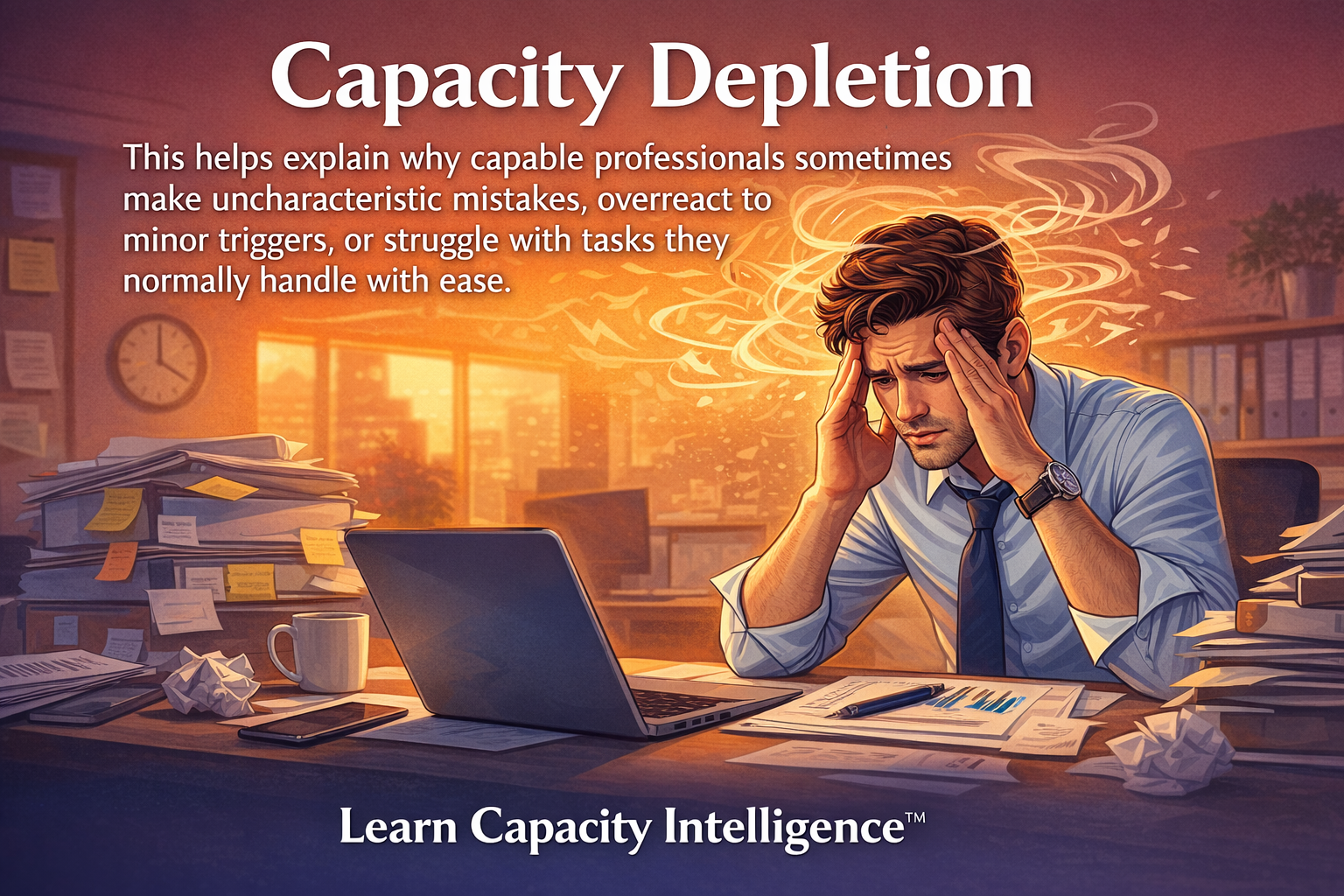
This helps explain why capable professionals sometimes make uncharacteristic mistakes, overreact to minor triggers, or struggle with tasks they normally handle with ease. Recognize any of these...? How about these...?
Not because something is "wrong," but because the system has reconfigured.
What this does not mean
It's important to be precise about what this research doesn't claim.
It does not say:
- traits are meaningless
- skills don't matter
- accountability disappears
- performance can't be measured
Trait models, skill frameworks, and performance evaluations still describe what people are capable of under supportive conditions. Emergent network models explain why access to that capability fluctuates - especially under sustained load.
These perspectives are complementary, not mutually exclusive.
Why this matters for capacity-based models
When work environments increase cognitive load, context switching, emotional regulation demands, and time pressure, the likelihood of network strain rises.
From a systems perspective, this leads to:
- narrower thinking
- reduced flexibility
- increased reliance on habitual or defensive responses
This is precisely why the Green Zone Trap is so common - most productivity advice assumes you're operating at full capacity when you're actually managing significant load.
Understanding this shift allows us to:
- distinguish skill loss from access loss
- intervene earlier
- design tools that match the system's current capacity
This is the scientific backdrop for state-aware approaches to performance and decision-making. When cognitive demands exceed available bandwidth, Focus & Self-Management skills become essential - not as aspirational goals, but as practical interventions matched to your actual state.
How this informs the Emergent Skills approach
Emergent Skills does not attempt to model the brain in full neuroscientific detail.
Instead, it uses practical abstractions - such as zones and capacity levels - to reflect recurring patterns described by network-based neuroscience.
From this perspective:
- Zones are not personality types
- They are functional system states
- They describe how much coordination and bandwidth is available right now
The goal is not perfect control, but better alignment between current capacity, chosen tools, and expectations placed on the system.
This is Operationalized Self-Awareness™ in action - awareness that leads directly to capacity-matched intervention rather than just more information about what you "should" be doing.
Why this research belongs here
This page exists for readers who want to understand why Emergent Skills treats capacity as variable rather than assumed.
You do not need to accept or study emergent brain theory to use capacity-matched tools effectively.
But for those who need a scientific grounding before trusting a system - this is one of the foundations.
For more research backing the Emergent Skills approach, visit The Research page.
Primary reference
Pessoa, L. How the Human Brain Is Like a Murmuration of Starlings. Aeon.
Ready to work with your brain's actual capacity?
The Zones Framework™ gives you practical language for your current state - and capacity-matched tools that actually work when you need them.