
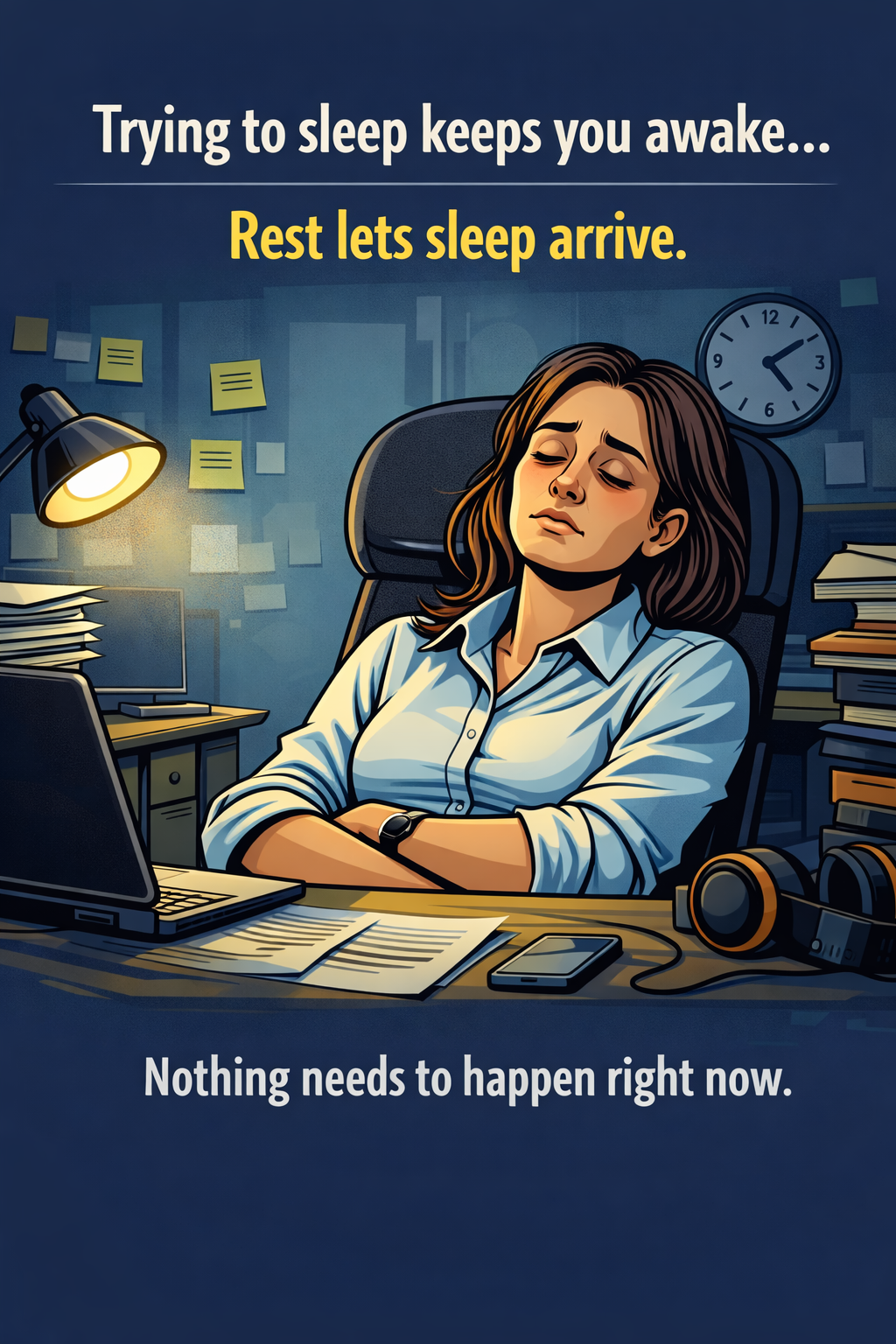
Why Trying to Sleep Is the Fastest Way to Stay Awake
And why letting go helps sleep arrive on its own
🟡 Writing this at Yellow 6. Paragraphs might get shorter toward the end.
3:47 AM and Your Brain Won't Shut Up
It's late. You've been lying there for forty-seven minutes according to the clock you promised yourself you wouldn't look at.
Gallup says 44% of workers report daily workplace stress - a record high. The other 56% are probably asleep right now. Which makes it worse.
You've tried everything. Deep breathing. The meditation app. The melatonin gummies. Now you're trying harder, because trying harder is what works for everything else.
Except it doesn't work for sleep.
Here's what nobody tells you: The harder you try to sleep, the more awake you become. This isn't failure. It's a predictable response from a nervous system doing exactly what it was designed to do.
You're not broken. You're experiencing capacity depletion - and every sleep tip you've tried was designed for someone with cognitive resources to spare. Someone in Green Zone.
At 3:47 AM, you're not in Green Zone. You're barely Yellow. Maybe Red.
The Sleep Paradox
Sleep isn't something the brain does. It's something that happens when the brain stops doing.
The moment you try to make sleep happen - monitoring your body, tracking time, evaluating whether a technique is "working" - you activate the same systems used for effort and vigilance.
Those systems are incompatible with sleep.
Trying to sleep sends a message: Stay alert. Something important is happening. The brain listens.
Even calming techniques backfire when they become tasks:
Am I breathing deeply enough? Why isn't my body relaxing yet? This should be working by now.
At that point, the nervous system isn't calming - it's checking. Checking is vigilance. Vigilance is the opposite of sleep.
The Green Zone Trap
Here's the thing nobody tells you: Every sleep solution is designed for Green Zone.
- Wind-down routines requiring sustained attention
- Meditation apps needing twenty minutes of focus
- "Just relax" advice assuming relaxation is a command your nervous system obeys
But you're already in Yellow or Red Zone by the time you're struggling to sleep.
77% of workers have experienced burnout at their current job. We're giving them sleep advice designed for people who are... already well-rested?
The Depletion Spiral
The sleep industry assumes consistent capacity. Result? Tools fail exactly when you need them:
Depleted capacity → can't use sleep strategies → less sleep → more depletion → can't use sleep strategies...
They're Green Zone solutions for Yellow/Red Zone problems.
This is exactly why Capacity Intelligence™ matters - matching tools to your actual state, not your ideal one. Learn more about why the Green Zone Trap undermines your productivity.
What Actually Works: Letting Go
One of the most reliable observations in insomnia recovery:
Sleep often returns when you stop trying to make it return.
That doesn't mean giving up. It means removing the pressure that keeps the system alert.
Letting go looks like: allowing wakefulness without panic, releasing the need to "fix" the moment, dropping the goal of sleep entirely.
Sleep is a side effect of safety, not effort.
When someone says "just relax," the brain hears: You're doing this wrong. Try harder. That creates more tension, not less.
True settling happens when there is nothing to achieve and nothing to monitor.
Capacity-Matched Sleep Tools
Capacity Intelligence™ means matching the tool to your actual state. Here's what that looks like:
🟢 Green Zone (7-9): Full Capacity
Executive function online. Complex routines work here.
- The Full Wind-Down: 60-90 minute pre-sleep routine. Dim lights, limit screens, journaling.
- The Worry Window: 15 minutes earlier in the evening to write down all concerns. Later worries: "Not now, wait for worry window."
Warning: If these feel like more work, that's a capacity signal - not a character flaw.
🟡 Yellow Zone (4-6): Strain Mode
Brain's stretched. You need simpler interventions.
- Replace "sleep" with "rest": Rest has no success criteria. "I can lie here without accomplishing anything." That alone lowers arousal.
- Stop watching the clock: Cover it. Time awareness fuels urgency. Urgency fuels wakefulness.
- Allow wakefulness: The belief "being awake is dangerous" keeps the system on guard. "I can be awake and still be okay" disarms it.
🔴 Red Zone (1-3): Survival Mode
Body-first only. No thinking required.
- Cold water on wrists: 30 seconds. The shock interrupts the spiral.
- Three deep breaths: That's it. Not an exercise. Three breaths.
- Change position: Get up. Walk to the kitchen. Come back. Motion breaks the stuck pattern.
Do less, not more. The quieter the mind's agenda, the easier sleep emerges.
⚫ Can't-Even (0🪫): Permission to Stop
- Stop trying to sleep. That's the intervention. Rest is enough.
- If you can't sleep, don't. Get up, do something boring, return when drowsy.
- Tomorrow is different. One bad night isn't a pattern. The pressure of "I must sleep or tomorrow is ruined" is what keeps you awake.
The brain falls asleep when it no longer believes it needs to stay involved. Not when it's convinced. Not when it's optimized. When it's allowed.
The Quiet Reframe
Instead of asking: "How do I fall asleep faster?"
Try: "What can I stop doing that's keeping me alert?"
Often, the answer isn't another technique. It's permission.
Insomnia isn't stubbornness. It's vigilance. And vigilance doesn't dissolve through effort - it dissolves through safety.
Sleep is not something to chase
It's something that shows up once the chase ends.
If you're dealing with the kind of workplace stress that follows you to bed, it might be worth exploring stress mastery and work-life boundaries. And if you're running on fumes during the day, rebuilding your emotional resilience can help you arrive at bedtime less depleted.
The Part Where I Almost Tied This Together Neatly
I could wrap this up inspirationally, but my cat just knocked something off my desk and I completely lost where I was going.
Which is... kind of the point?
Capacity Intelligence™ isn't about being perfect. It's recognizing "I just got derailed" is a signal, using an appropriate-sized tool, and getting back on track.
Same principle applies at 3:47 AM.
Tonight, when you can't sleep: Instead of fighting it, notice it. Instead of escalating, allow. Instead of adding another technique, remove the pressure.
Sleep shows up when the chase ends.
🔴 Going to bed now. Practicing what I preach. Probably.
Start Here
Build the foundation for better sleep - and everything else.
Full subscription includes all 10 Life Skills Pillars + AI coaching