
Why "I'll Try Harder" Is a Warning Sign, Not a Resolution

i will try harder this year - willpower - capacitty

Capacity Intelligence™ | January Reset

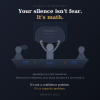
"I'll Try Harder This Year" Is Not a Resolution. It's a Warning.

Every January, millions make the same promise. More discipline. More effort. More willpower. It sounds like motivation - but it's actually a signal that you're already depleted.

Every January, millions of people make the same promise: I'll try harder this year.

More discipline. More effort. More willpower.

It sounds like motivation. It feels like commitment.

But here's what it actually is: a signal that you're already depleted - and about to make it worse.

The Misdiagnosis

When you say "I just need more discipline," you're doing something dangerous. You're misdiagnosing a capacity problem as a character flaw.

Think about what that statement assumes. It assumes you have resources in reserve that you're simply choosing not to use. It assumes the problem is laziness, weakness, or lack of commitment. It assumes that if you just wanted it more, you'd get there.

But what if none of that is true?

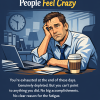
What if you're not unmotivated - you're running on empty? What if you're not lazy - you're depleted? What if the reason last year's goals fell apart wasn't insufficient effort, but insufficient capacity to sustain that effort?

This is the core insight behind Capacity Intelligence™ - learning to recognize that "I need more discipline" often means "I'm operating beyond my current capacity." It's not a character flaw. It's information.

Willpower Is Not the Problem

We've been sold a story about willpower. That it's a character trait. That some people have it and others don't. That success is simply a matter of trying harder.

The research tells a different story.

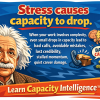
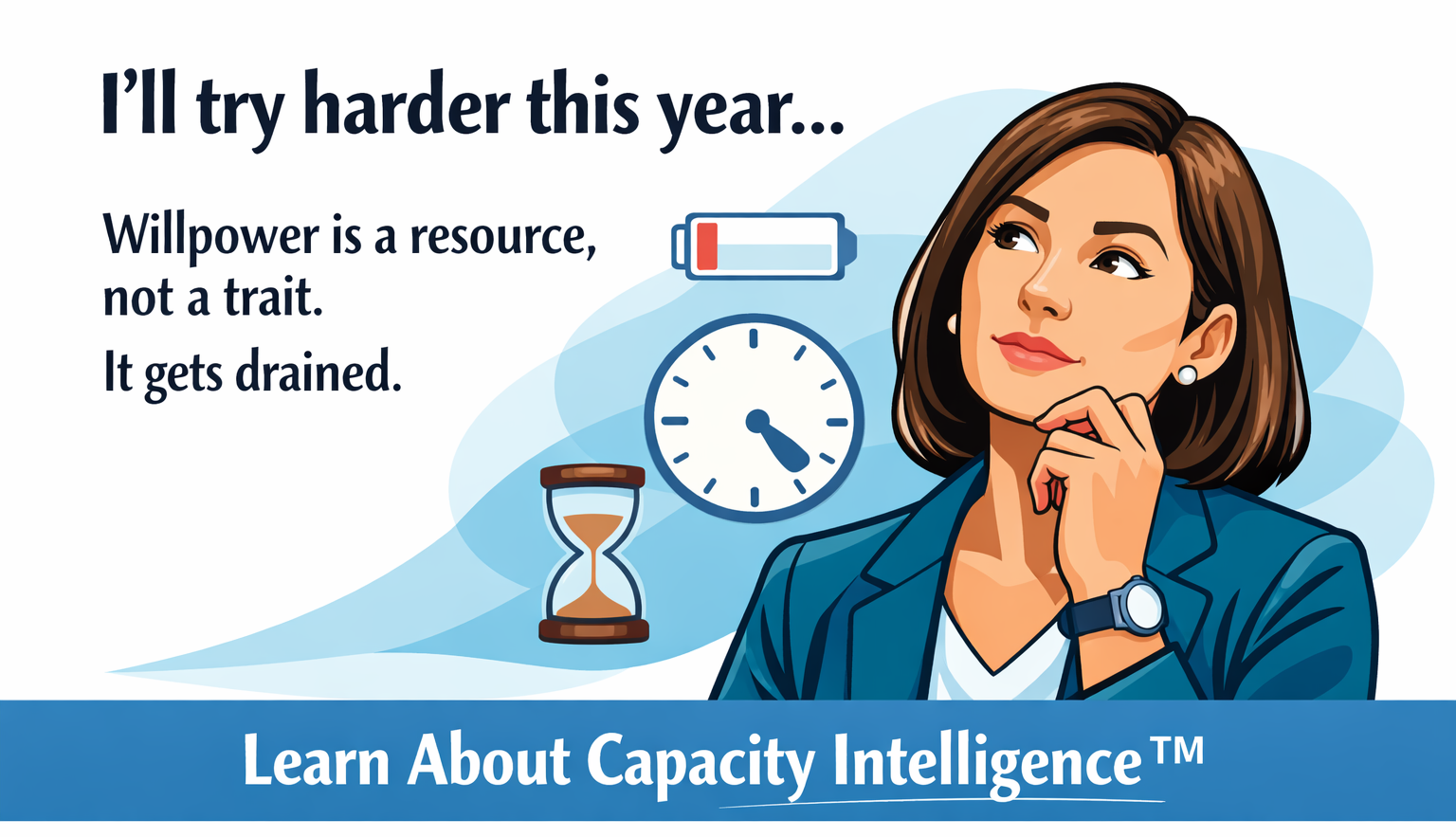
Willpower is a resource, not a trait. It fluctuates. It depletes. And when you're exhausted, stressed, overwhelmed, or burned out, you have less of it - not because you're weak, but because that's how human brains work.

So when you're already running low and you declare "I'll try harder," you're essentially saying: I'll demand more from a system that's already overtaxed.

That's not a recipe for success. That's a setup for failure - and for blaming yourself when it happens. Understanding how motivation and emotional resilience actually work changes everything about how you approach goals.

The Resolution Trap

Here's the painful irony of January.

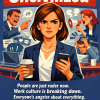
Most people making New Year's resolutions are doing so at their lowest capacity point of the year. They've just come through holiday stress, family obligations, end-of-year work pressure, disrupted sleep, and probably too much of everything - food, alcohol, spending, screen time.

They're depleted. And the cultural ritual we've created is to respond to depletion by piling on new demands.

More goals. More commitments. More things to track, measure, and inevitably fail at.

The February Pattern

By February, most resolutions are abandoned. And the person who made them? They don't think "that was bad timing" or "I was asking too much of myself." They think "I failed. Again. What's wrong with me?"

Nothing is wrong with you. The approach is wrong.

This is what we call the Green Zone Trap - designing goals and systems for your optimal self, then wondering why they fall apart when you're actually in the 🟡Yellow Zone or 🔴Red Zone.

Reading the Signal

"I'll try harder" isn't a plan. It's a signal.

It's your brain telling you that you've been pushing beyond your capacity and the only strategy you know is to push more. It's a sign that you've internalized the idea that your struggles are effort problems rather than resource problems.

When you hear yourself say it - or think it - pause.

Ask instead:

  • What's my actual capacity right now? Not my ideal capacity. Not my capacity on a good day. Right now.
  • What would it look like to work with my current capacity instead of against it?
  • What do I need to restore before I can sustainably build?

These questions won't give you a flashy resolution to post about. But they might give you something better: an honest starting point.

The Zones Framework™ gives you language for this - a way to recognize whether you're in the 🟢Green Zone (optimal capacity), 🟡Yellow Zone (depleted but functional), 🔴Red Zone (crisis mode), or the ⚫Can't-Even Zone (shutdown). Each zone requires different strategies.

Capacity Before Goals

You can't build new habits on a burned-out foundation.

Before you ask "what do I want to achieve this year?" - ask "what state am I actually in?" Before you add, consider whether you need to recover first.

The Recovery-First Approach

Sometimes the most productive thing you can do in January isn't to set ambitious goals. It's to acknowledge that you're depleted, stop demanding more from yourself, and let your capacity rebuild.

That might look like doing less for a few weeks. It might mean saying no to things. It might mean disappointing people who expect you to hit the ground running.

But it also might mean that when you do set goals, you actually have the resources to achieve them.

This is where stress mastery becomes foundational. Not stress elimination - that's unrealistic. But learning to recognize stress signals early, respond appropriately, and protect your capacity reserves.

A Different Approach

What if this year, instead of "trying harder," you tried something else?

What if you learned to read your own signals - to recognize when "I need more discipline" actually means "I'm running on empty"?

What if you designed your goals around your real capacity, not some imagined ideal version of yourself?

What if you stopped treating exhaustion as a character flaw and started treating it as information?

You don't need more willpower. You need to understand your capacity - and work with it instead of against it. That's not giving up. That's getting smart.

This is what Operationalized Self-Awareness™ looks like in practice - turning vague feelings of "something's wrong" into specific, actionable information about your current state and what it needs.

Ready to Stop "Trying Harder" and Start Working Smarter?

Learn to read your capacity signals and build goals that actually match your reality.

Try a Free Reset

See how Capacity Intelligence™ works →

"I'll try harder" is a signal. Learn to read it.
Start Free 30-Minute Reset 

Life Skills - Emotional Intelligence - Soft Skills

The Emergent Skills Program (Yeah, There's Actually a Method to This)

Look, I get it. Another program. Another system. But here's the thing — these 10 pillars? They're literally everything that's been kicking my ass for years, organized into something that actually makes sense. Especially when you're stuck in 🟡 Yellow Zone at 2 PM wondering why basic tasks feel like calculus.

Here's what nobody tells you: tools require resources you don't always have. That's not a character flaw. That's capacity depletion. And it's why we built everything around Capacity Intelligence™ — the ability to recognize what you actually have to work with and match tools accordingly.

Thirty minutes to stop the spiral. Thirty days to start the fix. Stick around longer if you want to actually master it. Works even when you're 🔴 Red Zone. Maybe especially then.

So I discovered something at 3 AM last Tuesday. Every single panic spiral, every frozen presentation moment, every "why can't I just DO THE THING" — it all fits into one of these 10 categories. And apparently LinkedIn says these are the exact skills that get people promoted? Wild.

The kicker: We use AI coaches exclusively. No awkward video calls with Brad the life coach at 7 AM. Just you, your brain, and an AI that remembers your specific flavor of panic. Plus it scales to whatever Zone you're in — full version when you're 🟢 Green, tiny version when you're Red and just trying not to cry in the bathroom.

That's Capacity Intelligence™ in action: recognizing your actual resources in real-time and using capacity-matched tools instead of forcing Green Zone solutions on a Red Zone brain.

OK So Here's What Nobody Tells You

Every single one of these skills? Connected. Fix your sleep, suddenly you can focus. Manage stress, confidence goes up. It's like your brain has been playing life on hard mode and someone finally showed you the settings menu.

The real secret? All these skills are about moving up through the Zones. Spending more time in 🟢 Green, less time in 🔴 Red, knowing what to do when you're stuck in 🟡 Yellow.

That's Capacity Intelligence™: operationalized self-awareness. Not just watching yourself struggle — doing something about it.

The Zones Framework™ — Your Capacity Intelligence™ Operating Manual

Here's what most productivity advice gets wrong: it assumes you're always at peak capacity. Morning routines, meditation apps, time management systems — all designed for Green Zone brains with cognitive resources to spare.

But 44% of professionals report daily stress at work. That means nearly half the workforce is regularly operating in Yellow or Red Zone. Tools designed for Green Zone fail exactly when you need them.

  • 🟢 Green Zone (7-9): Capacity mode — focus, empathy, creativity all online. Full tools work here.
  • 🟡 Yellow Zone (4-6): Strain mode — high effort, diminishing returns. Need simpler, right-sized tools.
  • 🔴 Red Zone (1-3): Survival mode — executive function offline, body-first tools only.
  • Can't-Even Zone (0🪫): Shutdown — system offline. Rest is the only intervention.

Every tool in Emergent Skills scales to your Zone. Because "just do better" doesn't work when your nervous system's in survival mode. That's not motivation failure — that's asking Yellow/Red Zone people to use Green Zone solutions. Capacity Intelligence™ breaks the cycle.

What Is Capacity Intelligence™?

It's the meta-skill that makes every other skill accessible. The ability to:

  1. Recognize your actual resources in real-time (Zone awareness)
  2. Match tools to your current state, not where you "should" be
  3. Measure if it worked (the feedback loop everyone skips)

This isn't self-awareness. It's operationalized self-awareness — observation + strategic action + validation. Not a thermometer (tells you the temperature). A thermostat (tells you the temperature AND does something about it).

The Emotional Intelligence Part

  • Finally understanding WTF you're feeling. Red? Yellow? Green? Changes everything. That's Zone awareness.
  • Not letting emotions hijack your whole day. Recognizing Red Zone spirals before they eat your afternoon.
  • Reading rooms without being creepy. Sensing other people's Zones equals social intelligence.
  • Navigating office politics like an adult. Requires Yellow/Green minimum.

The Career ROI Part

  • Showing up consistently. Bare minimum, still counts. Yellow Zone reliability beats Red Zone heroics.
  • Speaking without your voice shaking. Yellow/Green vocal control equals executive presence.
  • Being the calm one when shit hits fan. Staying Green while everyone else goes Red. That's Capacity Intelligence™.
  • Actually collaborating, not just cc'ing.

The Science-y Part

  • Your patterns aren't your personality. They're just Red Zone survival habits that stuck.
  • Interrupting spirals before they start. Catching Yellow before it crashes into Red. Operationalized self-awareness.
  • Techniques based on actual research. Polyvagal theory equals Zones Framework™ in fancy language.
  • Building new neural pathways. Teaching your nervous system Green exists.

McKinsey says improving workplace health could unlock $3.7–11.7 trillion in global value. For you? More energy, better focus, being the one who gets tapped for opportunities while everyone else is burning out.

You're in Green/Yellow while the competition's stuck in Red. That's not talent. That's Capacity Intelligence™.

The AI coach doesn't judge when you practice the same anxiety technique 47 times at 3 AM. No awkward "how does that make you feel" conversations. Just you, figuring out how to stop self-sabotaging, one 30-minute session at a time.

And it scales to your Zone. Full coaching in Green, bite-sized basics in Yellow, survival mode scripts in Red. Because you can't "think positive" your way out of a nervous system state, but you can give it capacity-matched tools.

Pick Your Biggest Problem & Start Fixing It

Thirty minutes to stop the spiral. Thirty days to start the fix. Stick around longer to master it. 
(Works in any Zone. Especially the bad ones.)

Learn the Zones Framework™ →  |  Explore Capacity Intelligence™ →  |  See the Research →

Start Free 30-Minute Reset