
"Let Me Circle Back on That"
The Phrase That's Actually Your Prefrontal Cortex Doing Triage
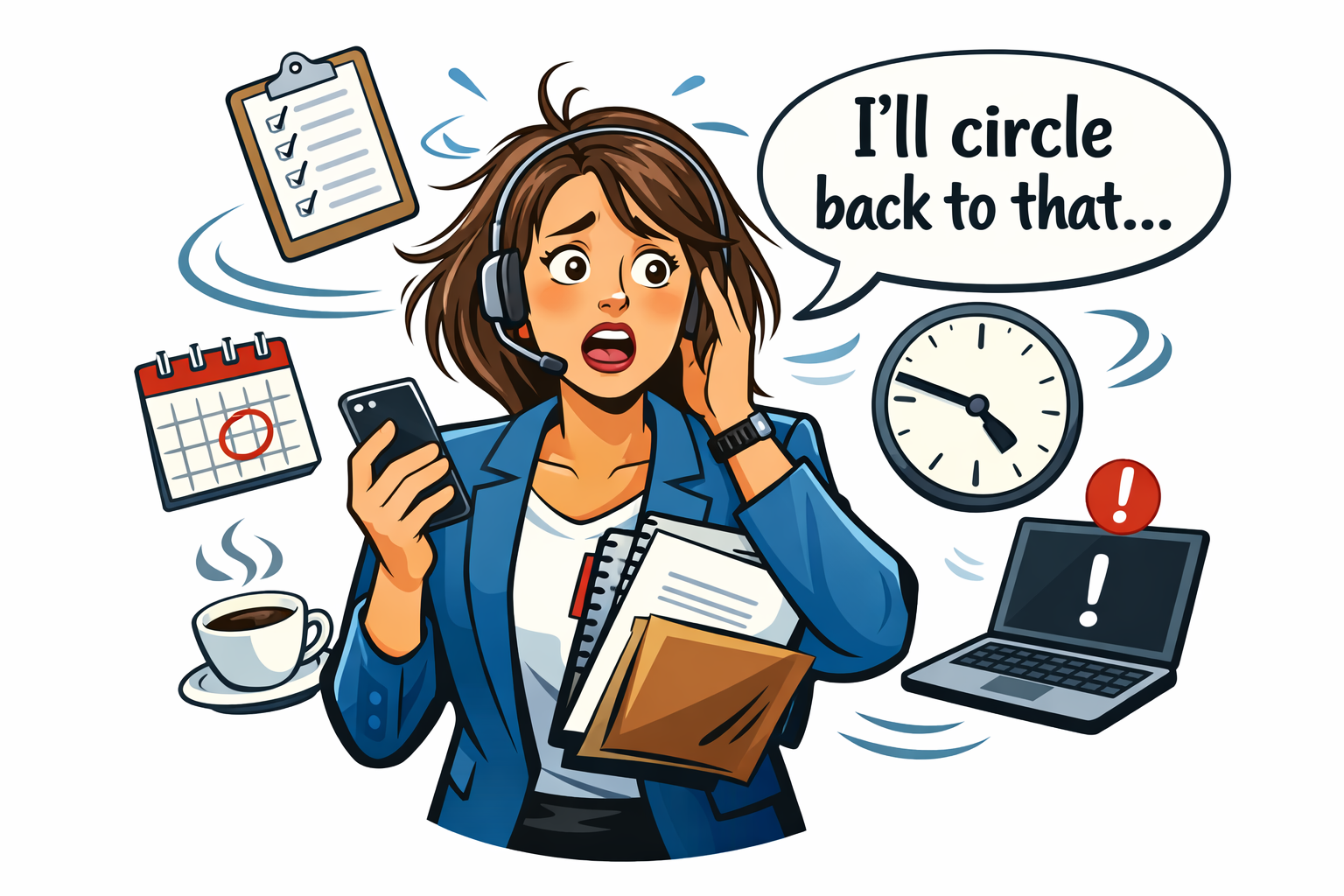
It's 2:47 PM and someone just asked me to weigh in on a project timeline that requires remembering three other conversations, cross-referencing a spreadsheet I haven't touched in two weeks, and forming an opinion that'll probably get screenshot-quoted in Slack.
"Let me circle back on that."
I said it without thinking. Then immediately wondered if I was being evasive, lazy, or—worst of all—that person who never commits.
Here's what nobody told me: 44% of professionals report daily workplace stress, according to Gallup. The other 56% are lying, in management, or have achieved a level of emotional detachment I can only aspire to.
But here's the thing about "circle back." It's not about scheduling. It's about bandwidth. Your brain did a quick resource calculation and realized: not enough capacity. So it punted. That's not a character flaw. That's your prefrontal cortex doing triage.
The Hidden Capacity Crisis
I used to think "circle back" was corporate cowardice. The verbal equivalent of putting something in a drawer and hoping it disappears.
Sometimes it is.
But most of the time it's a capacity signal. Your brain running a background process: "I could answer this, but I'd have to pull from resources I'm currently using to remember my own name and maintain basic human expression."
That's capacity depletion. And 77% of workers have experienced burnout at their current job. Which means most of us are circling back on everything—because we're always running at the edge.
This may not be you. But it's certainly someone you know.
What Your Brain Is Actually Doing
The prefrontal cortex handles working memory, decision-making, and the complex juggling act of "thinking about thinking." When someone asks a question requiring synthesis—pulling together information, weighing options, predicting outcomes—it has to allocate resources.
Those resources are finite. Our attentional processing has limited capacity. We can only process so much at once.
"Circle back" is your brain saying: "I've done the math. Answering this now would require reallocating resources from keeping-you-functional to producing-a-coherent-response, and the margin is too thin."
That's not weakness. That's the beginning of Capacity Intelligence—recognizing what you actually have before committing to work.
The Green Zone Trap
Here's what nobody tells you: every productivity system is designed for Green Zone—that state where cognitive resources are available, executive function is online, life feels manageable.
But 77% of workers worldwide are disengaged. Only 33% rate their life as "thriving."
Most of us live in Yellow Zone. High effort, diminishing returns. Functional but stretched. We regularly hit Red Zone—survival mode. Sometimes we crash into Can't-Even, when "what's for lunch" feels like calculus.
The Core Problem
The workplace performance industry assumes consistent capacity. Result? Tools fail exactly when you need them: depleted capacity → can't use coping strategies → more stress → less capacity.
This is why meditation apps have 95% abandonment rates. They're Green Zone solutions for Yellow/Red Zone problems.
If you're constantly feeling like traditional productivity approaches don't work for you, it's not a personal failing—it's a design flaw in the system itself.
What To Actually Say
The same "I can't answer this now" looks different at each capacity level:
🟢 Green Zone
"Let me pull together the relevant information and get back to you by Thursday."
You have resources to plan and commit.
🟡 Yellow Zone
"I need to circle back—can we put 15 minutes on the calendar tomorrow?"
Simpler. Externalized structure.
🔴 Red Zone
"I need to come back to this. Can you send me a reminder?"
Offloads cognitive labor entirely.
⚫ Can't-Even
"Not right now." (Three words. Maybe just "later.")
The goal is survival, not eloquence.
The Bias That Keeps You Circling
I always think I'll have more capacity tomorrow. "Monday me will definitely have bandwidth." "After this deadline, things will calm down."
That's optimism bias—believing the future will be better despite evidence. It won't. Monday has Monday's problems. "When things calm down" is fiction.
The Antidote
Realistic capacity planning: if you're circling back on everything, you're overcommitted. If tomorrow never has more capacity than today, adjust today.
When you're running on empty, building motivation and emotional resilience requires capacity-matched strategies—not just more willpower.
Circle Back to This
I could wrap this up neatly, but I just got a Slack notification mid-sentence and lost where I was going.
Which is kind of the point.
Capacity Intelligence in Action
Capacity Intelligence isn't about being perfect. It's recognizing "I just got derailed" as a Yellow Zone signal, using a 30-second reset, and getting back on track.
Most people beat themselves up for losing focus. That takes you from Yellow to Red. Capacity Intelligence says: "Okay, that's a 5. Quick body check, then back to the paragraph."
(Just did that. Cold water on wrists. Three breaths. Back to Yellow 4.)
That's operationalized self-awareness. Not watching yourself struggle—doing something about it.
Next time you say "let me circle back," try gratitude instead of guilt. Your prefrontal cortex just saved you from committing to something your actual capacity couldn't deliver.
That's not avoidance. That's intelligence.
Ready to Build Your Capacity Intelligence?
Learn to recognize your zones, match tools to your actual capacity, and stop blaming yourself for systems designed for a version of you that doesn't exist.