
Why Your Brain "Logs Out" After 5 Tasks (And Your Coworker Crushes 15)
It's not discipline. It's not caffeine. It's not childhood trauma. It's capacity intelligence™ - and nobody's teaching it.
There's a Reddit thread in r/productivity that's been living in my head rent-free.
The poster runs a small agency with a friend. Every morning they send each other task lists for accountability. His friend's list looks like a college syllabus—sprawling, ambitious, slightly terrifying. His own list? Normal human length.
And every few hours, he watches his friend update: cut. cut. cut. cut. Deleting tasks like he's speedrunning life.
Meanwhile, the poster says: "if my list looked like his I'd immediately get distracted, overwhelmed, maybe cry a little idk."
His question to the internet: "is this focus? discipline? caffeine? childhood trauma???"
Nearly 100 people commented. Breaking down task size. Discussing ADHD. Mentioning Adderall. Talking systems and hacks.
Nobody gave the actual answer.
Because nobody's talking about capacity.
What's Actually Happening Here
That business partner isn't superhuman. He's not more disciplined or caffeinated or trauma-optimized into productivity.
He's unconsciously matching task complexity to his capacity state.
When he's at full capacity—🟢 Green Zone—he tackles complex work. When capacity drops to 🟡 Yellow Zone, he switches to smaller, clearer tasks. When he hits 🔴 Red Zone, he probably does admin stuff that doesn't require thinking. He probably doesn't even know he's doing this. It's intuitive.
Most people don't have that intuition. So they try to force complex work when capacity is depleted, fail, and wonder what's wrong with them.
Nothing's wrong with you. Your strategy was mismatched.
Here's the part where I mention that 44% of professionals report daily workplace stress—a record high according to Gallup. That's 44% of the workforce operating in Yellow or Red Zone most of the time, trying to do Green Zone work.
That math doesn't work.
The Comments That Almost Got It
One person in that thread wrote:
That's capacity management. Adjusting task size to match current state.
Another said:
That's building structure for variable capacity. When executive function is unreliable, you create systems that work when capacity drops. If this resonates, our focus and self-management tools were designed for exactly this pattern.
And this one:
They're describing their capacity threshold. The exact point where functional becomes overwhelmed.
Everyone in that thread is talking about capacity without having language for it.
Which is honestly kind of maddening? Because this affects literally everyone and we just... don't have words for it.
The Green Zone Trap
Here's the thing nobody tells you:
Every productivity system is designed for Green Zone.
Morning routines that take 90 minutes of focus. Time blocking that requires executive function to implement. Meditation apps that need sustained attention you don't have. The Eisenhower Matrix that assumes you can think strategically when you're drowning.
All of which require full capacity to implement.
But most of us live in Yellow Zone. High effort, diminishing returns. Functional but stretched. And we regularly hit Red Zone—survival mode, just trying not to make mistakes.
76% of workers report experiencing burnout according to Deloitte and Gallup research. That's not occasional stress. That's regular trips to Red Zone and Can't-Even territory. When you're in that space, rebuilding motivation and emotional resilience becomes the actual work.
So what happens? The meditation app that helps on Tuesday fails catastrophically on Thursday. Not because you're doing it wrong. Because your capacity changed and the intervention didn't.
That's the Green Zone Trap
Tools designed for optimal conditions, applied during suboptimal states.
What Nobody's Teaching
Your capacity isn't consistent.
9 AM: Full capacity. Clear thinking. Complex work possible.
2 PM after three meetings: Depleted. Simple tasks feel impossible.
That's not inconsistency. That's capacity fluctuation. It's normal. It's biological. And you need different strategies for different states.
🟢 Green Zone (Low stress)
Full capacity. Strategic thinking online. Complex work possible. This is when you can do 15 tasks—if they're appropriately sized.
🟡 Yellow Zone (Moderate stress)
Functional but depleted. Everything takes more effort. One unexpected Slack message away from overwhelm. You need structure, smaller tasks, shorter sessions.
🔴 Red Zone (High stress)
Survival mode. System flooded. Making mistakes or frozen. Thinking tools don't work here. Body-first interventions only.
⚫ Can't-Even (🪫Battery dead)
Capacity collapse. Even simple tasks feel impossible. This isn't failure—it's depletion. The intervention is rest.
Once you know your zone, you know what's possible. Not what you "should" be able to do. What you can actually do with the capacity you have right now.
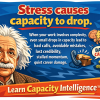
That's Capacity Intelligence™. Recognition → adjustment → continued function instead of crash.
Why The ADHD Folks Almost Had It
Multiple comments in that thread mentioned ADHD and variable capacity.
They understand capacity fluctuation because they live it.
Neurotypical brains have more stable baselines. Neurodivergent brains—ADHD, autism, high sensitivity—have baseline variability. Capacity swings based on environment, stimulation, emotional state, executive function.
Here's what's interesting: Under high stress, neurotypical brains start operating like ADHD brains. Executive function goes offline. Working memory drops. Emotional regulation fails.
So the capacity management strategies ND people develop? They work for everyone in high-stress states. That's 77% of the global workforce who's disengaged according to Gallup's State of the Global Workplace—people whose brains are regularly operating in depleted states without tools designed for depletion.
Low engagement costs the global economy $8.8 trillion each year. That's the cost of asking Yellow Zone people to do Green Zone work without ever teaching them the difference.
The Uncomfortable Truth
Some people have higher baseline capacity than you.
Genetics, environment, neurology, support systems, privilege—all affect your starting point.
That's not fair. It's also not changeable.
What IS changeable: learning to work with your actual capacity instead of fighting it.
The person who does 7 quality tasks at Yellow Zone capacity will outperform the person forcing 15 tasks at Red Zone capacity. Sustainable performance beats heroic burnout.
Back To That Reddit Thread
488 people upvoted a question about why their brain "logs out."
Nearly 100 people commented with partial answers, intuitive strategies, personal experiences.
Not one person said: "Oh, that's capacity fluctuation. Here's the systematic framework for managing it."
Because that framework doesn't exist in mainstream productivity culture.
That poster asked: "How do people do 15 tasks without exploding?"
Wrong question.
The right question: "What can I actually do with the capacity I have right now?"
Your coworker crushing 15 tasks isn't superhuman. He's matching task complexity to capacity. Breaking big work into smaller pieces when depleted. Tackling complex work when capacity is full.
You can learn this. Not through discipline or caffeine or trauma. Through recognition.
What's my capacity right now? What's actually possible in this state? What strategy matches this zone?
Your brain isn't broken. Your strategy is mismatched. Once you understand that, everything changes.
Writing this at Yellow 5. Quality holding, effort increasing. Which is kind of the point.
Start Here
Learn to work with your actual capacity instead of fighting it.
- Discover your Zone → The foundation for Capacity Intelligence™
- 30-Minute Crisis Reset → Free, unlimited, works at 3 AM
- Full subscription → All 10 Life Skills Pillars + AI coaching
The capacity you have right now is the capacity you have. The only question is whether you'll work with it or against it.