
The Real Reason Your "Soft Skills" Aren't Working
You've taken the workshops. Done the training. Built the skills. So why do they disappear exactly when you need them most?
The answer isn't more training. It's understanding what's actually happening to your capacity.
There's a Forbes article making the rounds - one of those organizational psychology pieces - claiming that soft skills aren't really skills at all. They're personality traits. Stable patterns you either have or don't.
Resilience. Empathy. Communication. According to this thinking, companies are wasting money trying to train these things because you can't teach someone to be empathetic any more than you can teach them to be tall.
And honestly? He's not wrong.
But he's missing something. Something that explains why your naturally empathetic coworker snapped at you in the Slack thread last week. Why your usually-eloquent boss sent that word salad email. Why you can handle difficult conversations beautifully on some days and completely fall apart on others.
The trait doesn't disappear. The capacity to access it does.
The Missing Variable Nobody Measures
Here's what the research hasn't caught up with yet: 77% of workers worldwide are disengaged, according to Gallup. 44% report daily workplace stress. And we're still pretending that the solution is better soft skills training.
But think about the last time you sat through one of those workshops. Communication skills. Emotional intelligence. Conflict resolution. You probably left with good intentions. Some frameworks. Maybe a workbook you never opened.
Then you went back to your desk. 47 unread emails. A meeting invite for something that should have been an email. That deadline you're behind on because you spent all morning in meetings about being behind on deadlines.
And within 20 minutes, you were right back to your old patterns.
This Isn't a Failure of Willpower
It's not a character flaw. It's not that you don't have the traits.
It's that you don't have the capacity to access them.
That's the thing about capacity depletion - it doesn't just make you tired. It takes your existing abilities offline. Your communication skills, your emotional regulation, your creative problem-solving... they're all still there. They're just temporarily unavailable. Like trying to run software on a laptop that's at 3% battery.
The software isn't broken. The battery is dead.
This is where Capacity Intelligence™ comes in - not as another skill to add to your overloaded toolkit, but as the meta-awareness that helps you understand why your existing skills go offline and how to bring them back.
The Green Zone Trap (Why Every Training Fails)
Here's what nobody tells you: every soft skills training is designed for 🟢Green Zone.
🟢Green Zone equals full capacity. Strategic thinking works. Complex tools work. You can learn new things and actually implement them.
But most of us don't live in Green Zone. We live in 🟡Yellow Zone. Functional but stretched. High effort, diminishing returns. The part where you can still technically do your job but everything costs three times more cognitive energy than it should.
And we regularly hit 🔴Red Zone. Survival mode. Body-first only. When "what's for lunch" feels like a calculus problem.
Sometimes we crash into ⚫Can't-Even Zone. When the only intervention that works is permission to stop.
The Fundamental Design Flaw
The workplace performance industry assumes consistent capacity.
Result? Tools fail exactly when you need them. The empathy training doesn't help when your nervous system is in threat response. The communication framework doesn't work when your working memory is offline. The conflict resolution technique doesn't function when you're running on caffeine and spite.
That's not a trait problem. That's a capacity problem. And you can't trait your way out of a capacity problem.
This is what we call the Green Zone Trap - the assumption that everyone operates at peak capacity, when the reality is that most professionals spend their days in depleted states where traditional tools simply don't work.
The Hierarchy Nobody Talks About
Think of it this way:
Your personality traits determine what you're capable of at your best.
Your skills represent what you've learned to do with those traits.
Your capacity - your current state of mental, emotional, and physical resources - determines what's actually available to you right now.
You can have world-class traits and hard-won skills, but if your capacity is depleted, you're operating with a fraction of your actual capability.
It's like having a sports car with an empty tank. The engineering is all there. You're just not going anywhere.
This is why the same person can handle a difficult conversation brilliantly on Tuesday and blow up over something minor on Thursday. It's not inconsistency of character. It's fluctuation of capacity.
The research backs this up. McKinsey Health Institute found that better workforce health - actual capacity, not just skills - could add up to $11.7 trillion in global economic value. That's not a wellness stat. That's a performance stat.
Because you can't perform what you can't access.
Understanding this hierarchy is what The Zones Framework™ is built around - giving you language and tools for working with your capacity as it actually is, not as it should ideally be.
What This Actually Means For You
Before you sign up for another workshop. Before you add another professional development goal to your list. Before you accept the premise that you need to fundamentally change who you are...
Ask yourself this:
Am I trying to build something new, or am I too exhausted to use what I've already got?
If it's the latter - and honestly, for most people I talk to, it's the latter - no amount of skill-building will help. You need capacity first.
This is what Capacity Intelligence™ actually is. Not another skill to add to the pile. The meta-skill that makes every other skill accessible:
- Knowing where your capacity actually stands in real-time
- Matching your tools to your actual state, not where you "should" be
- Understanding that when your communication skills go offline, the answer isn't more communication training - it's capacity restoration
The good news is that capacity can be restored. Not through more effort. Through recognition. Seeing where you actually are. Understanding why your usual abilities aren't available. Taking the small steps that bring them back online.
If you're dealing with burnout or chronic depletion, the path forward isn't pushing harder - it's learning to work with your capacity, not against it.
The Point Is This
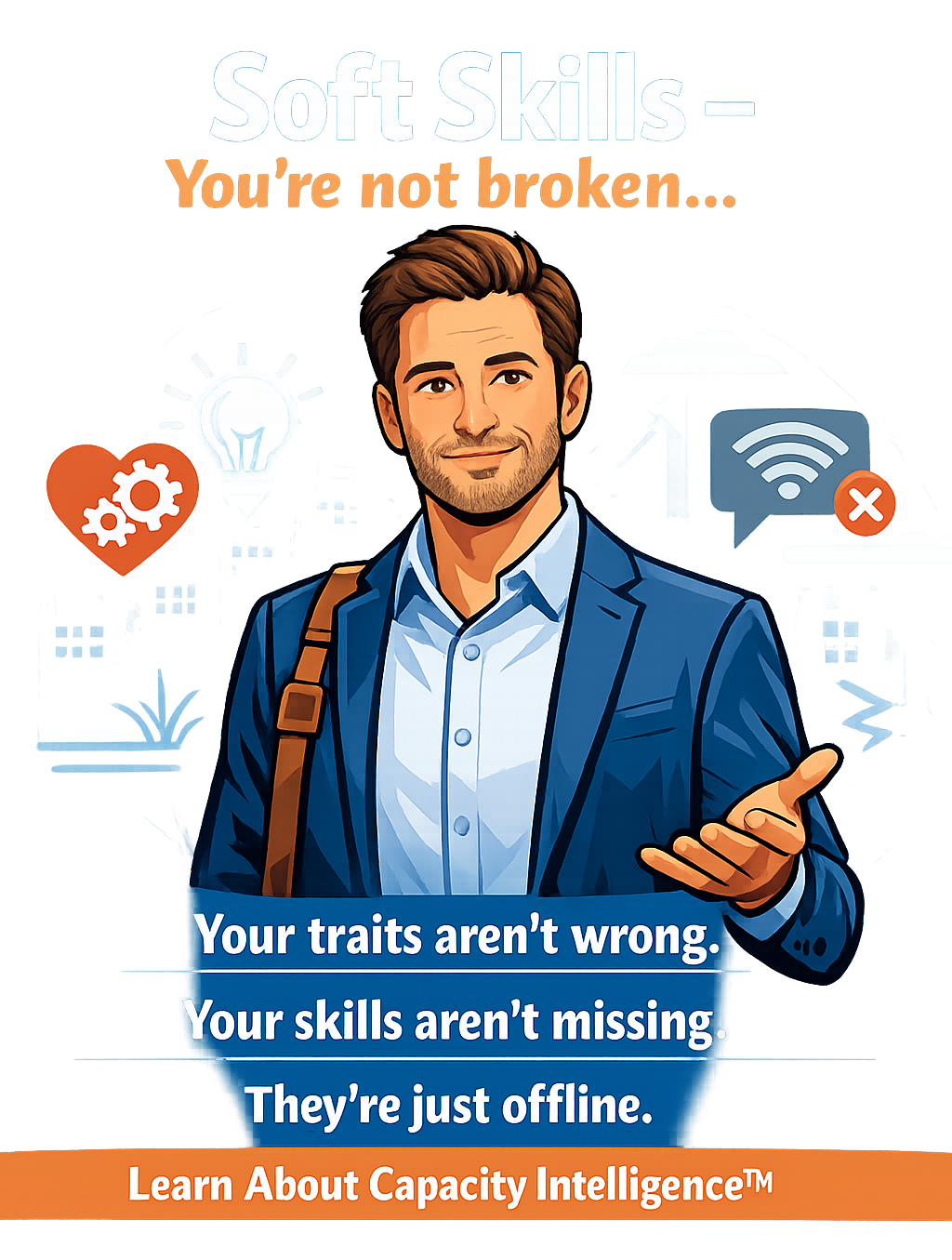
You're not broken. Your traits aren't wrong. Your skills aren't missing.
They're just offline.
And the answer isn't adding more software to a dead battery.
It's learning to manage the battery.
That's what Operationalized Self-Awareness™ provides - not just knowing you're depleted, but having clear, actionable steps that match your current zone. Because awareness without action just makes you feel worse about feeling bad.
Ready to Work With Your Capacity Instead of Against It?
Start with understanding where you actually are - then get tools that work for that state.
This post lives in Reset - the stage where you just need to stop the free-fall.