Curriculum + Deploy Capacity = Performance Infrastructure
Train the skills.
Reset access. Deploy Green capacity.
Ten professional skills. Five Green paths. Built for the floor, scaled to the ceiling.
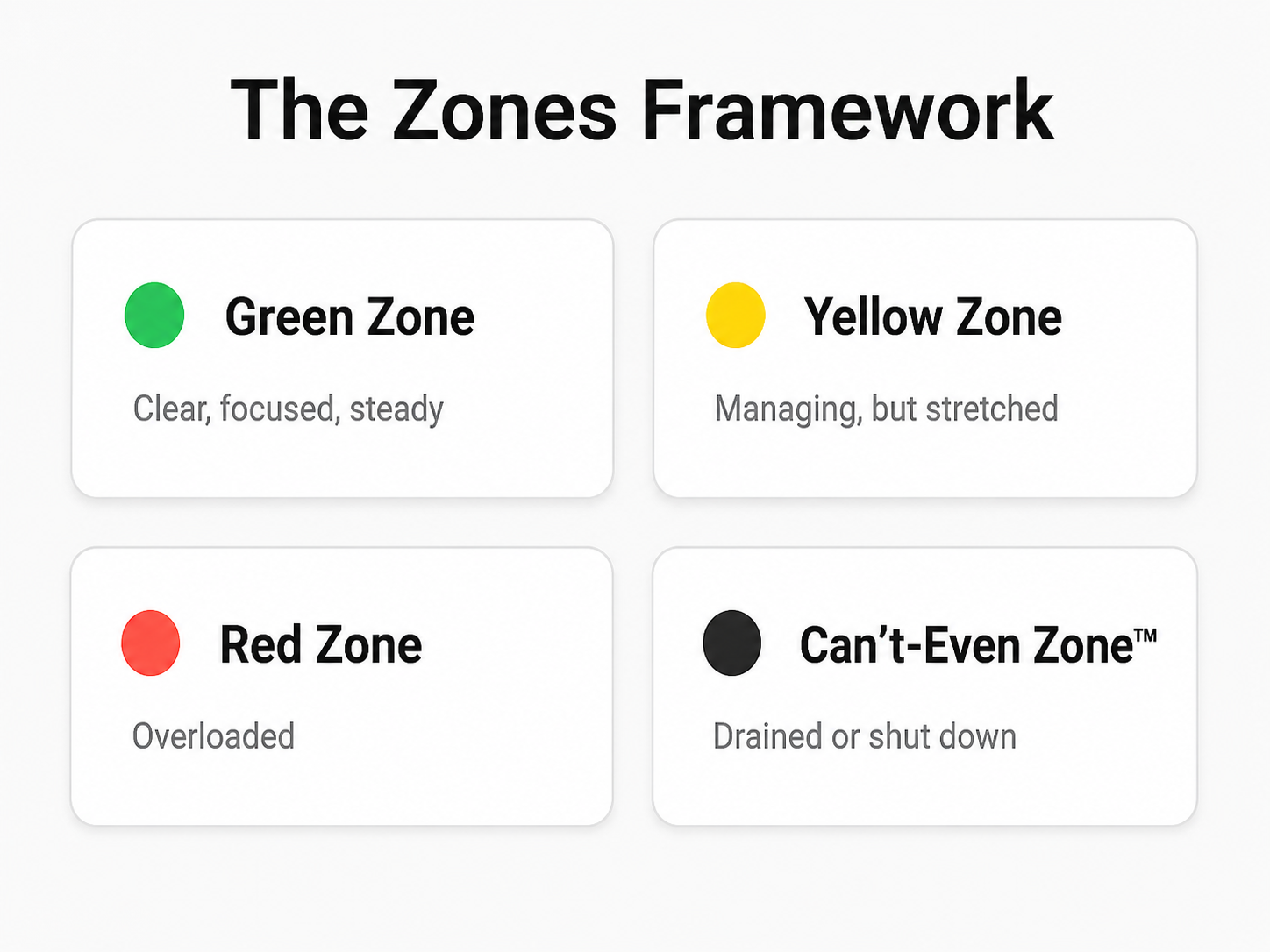
Most workplace training is built for a person who isn't in the meeting. The failure mode has a name: the Green Zone Trap. Conventional training is built for 🟢Green Zone capacity and delivered to a workforce that lives in 🟡Yellow Zone and hits 🔴Red Zone exactly when the program needs to work.
It assumes a participant who is rested, alert, and able to absorb new content. That person exists. They are not the person you are trying to reach. The person you are trying to reach is in their fourth hour of context-switching, two emails behind, and one bad decision away from a Yellow afternoon. That person cannot run a six-step framework. They can press their feet into the floor.
This curriculum is built for that person first, then scaled up. The design principle is "build for the floor, scale to the ceiling." The most depleted user gets the most attention. Everyone else benefits from that decision.
The Curb-Cut Principle
Curb cuts were designed for wheelchair users. The people who use them most are parents with strollers, delivery workers with carts, and travelers with luggage. Build for the constrained case and the design works better for everyone. Build for the unconstrained case and most of your users are excluded most of the time.
Conventional training builds for the unconstrained case. The work that brought the participant to the program is never happening in Green. This is what Neurodivergent-First Design means in practice: engineering for the constrained case so the design holds when capacity drops.
The Shape
Ten pillars, twelve weeks each, roughly ten minutes a day. Delivered as PDFs you can print, mark up, and read when your screen is the last thing you want to look at. A participant works through one pillar at a time, in three phases.
Weeks 1-4
Reset - Body-first
Twelve tools across grounding, breath, movement, and anchoring. The first month has one job. Prove that the participant's nervous system responds to deliberate input. Without that proof, nothing after Week 4 lands. The Week 4 check is the proof gate. It answers a single question: can the participant shift their own state? Everything that follows depends on the answer being yes.
Weeks 5-8
Build - Cognitive
Cognitive tools layered on top of the body-first base. Reframes, evidence collection, pattern interrupts, daily rituals. By Week 8 the participant recognizes their own zone without thinking about it. That is what we are training. Not awareness in the abstract. Recognition that runs at the speed of a conversation, before the bad decision is made.
Weeks 9-12
Thrive - Strategic
The participant uses Green capacity deliberately instead of letting it leak. They plan around their real capacity instead of their idealized capacity. By Week 12 the zone distribution has measurably shifted from where it was on Day 1. The participant can name what changed in their work.
Four Versions of Every Tool
This is the part most training gets wrong.
A tool that works at 🟢Green Zone does not work at 🔴Red Zone. Asking a Red participant to do a six-step grounding sequence is asking them to use the exact cognitive resources they just lost. They will not complete it. They will conclude the program does not work.
Every tool in the curriculum exists in four versions, sized to where the participant actually is, not where the training assumes they should be.
| Zone | Version | Duration | What the participant does |
|---|---|---|---|
| 🟢 Green | Full | 3-5 min | Six-step grounding sequence with breath, pressure, and awareness |
| 🟡 Yellow | Smaller | 1-2 min | Three steps: press, squeeze, breathe |
| 🔴 Red | Tiny | 30 sec | Press feet. Feel floor. One breath. |
| ⚫ Can't-Even | Crisis | 5 sec | Press heels. Feel ground. |
Same tool. Four entry points. The Tiny and Crisis versions are not simplified versions of the Full tool. They are engineered separately for the cognitive constraints of those states. A participant in Red who attempts the Full version will not complete it. That is not a participant failure. It is a design failure of conventional training.
This single decision is what makes the curriculum work for the population it was built for.
Ten professional skills. Ten pillars.
Each pillar follows the same three-phase, four-tier architecture. Different content, same shape.
- Composure & Performance Under Pressure
- Stress Load & Sustained Output
- Execution & Delivery
- Focus & Attention Control
- Communication & Connection
- Emotional Regulation & Recovery
- Resilience & Change
- Confidence & Standing
- Motivation & Drive
- Rest & Recovery
Where a participant starts depends on what is costing them most. A new employee facing high-stakes meetings starts with Composure & Performance Under Pressure. A team running on fumes starts with Stress Load & Sustained Output. An R&D group losing attention to context-switching starts with Focus & Attention Control. After 90 days, the participant moves to a second pillar or repeats the first with deeper practice.
The live operating layer
The curriculum builds the skill. The App is for the moment.
The App has two jobs: reset access when capacity is low, and deploy access when capacity is high. It does not route a participant into a zone. It helps them identify the state they are already in, routes them to the right intervention, and helps route the next work to what that state can support.
🟡 Yellow · 🔴 Red · ⚫ Can't-Even
Reset access, or route around the state.
A zone-matched reset interrupts carryover from the meeting, decision, conflict, or stretch of context-switching that spent capacity. The next move may be to recover, reduce the demand, simplify the task, pair on the work, defer it, or move it.
The goal is not to force Green. When usable capacity does not return, consequential work waits or moves. Sometimes the right instruction is: do not make this decision now.
🟢 Green
Deploy access while it is available.
Green is not reset mode. It is a temporary window in which judgment, range, creativity, communication, and pattern recognition are more available. The App asks one operating question: Where should we use it?
Protect the window. Use Green on the work that needs the best thinking, not the inbox, status updates, or low-value coordination that can be done later.
Reset protects value. Deploy Green creates it. Emergent Skills does not merely reduce capacity loss. It improves the allocation of the capacity the organization already pays for.
Deploy Capacity
Five Green paths. One question: where should this capacity go?
When a participant has usable capacity, the App directs the moment toward the work that benefits most from it. Green is not the absence of a problem. It is a scarce window for higher-value judgment and execution.
Think Better
Decisions, priorities, plans, and tradeoffs. Use available range before pressure narrows what the participant can see and avoidable rework begins.
Communicate Better
Messages, feedback, and hard conversations. Use Green for clarity, nuance, and the sentence that prevents a week of cleanup.
Fix the Pattern
Meetings, handoffs, rework, and bottlenecks. Use available capacity to see the system around the problem instead of blaming the person inside it.
Create Better
Ideas, positioning, product thinking, and strategic connections. Original thinking needs range, and pressure is what narrows it first.
Prepare Better
Preparation before predictable pressure. Move the decision, message, or plan upstream instead of leaving it for the worst-capacity moment.
Deployment
Printable PDFs are the format because PDFs work when the participant cannot look at another screen. They work offline. They do not require an LMS. They remain readable when executive function is offline, which is the moment when most training fails by design. Includes workbook and compass for navigating.
The App runs alongside the curriculum as the live operating layer. The lessons build capability over time. The App helps the participant use it in the moment: reset access when capacity is low, route around the state when it does not return, and deploy Green capacity toward higher-value work when it is available.
A license includes the full curriculum, App access for all participants, senior consultant onboarding for the pilot cohort, and reporting at Weeks 4, 8, and 12. Reporting combines operating outcomes with delayed, privacy-protected cohort trends. No manager sees individual usage, live zone status, or drill-down data. Managers route from declared capacity, observable workload, and task consequence, never from private App data. The engagement runs Audit, Pilot, License.
This is what career progress looks like...
Start where progress becomes visible. The four-week Reset Phase of Composure & Performance Under Pressure gives you twelve practical tools built for real workdays, a Week 4 proof gate that shows whether you can shift your state when pressure rises, and workbook pages that turn the change into evidence you can see and use.
Capacity Intelligence™ · The Zones Framework™
Performance infrastructure for professionals. Not therapy. Not wellness.